Showing posts with label Catlin Marsh. Show all posts

Marsh Bird Surveys

The research staff has spent yet another Spring surveying marsh birds. Once a week for the past 6 weeks, staff arrive to work well before dawn and begin the survey approximately 30 minutes before official sunrise. The species of interest in this survey are Black Rail, Virginia Rail, King Rail, Clapper Rail, Least Bittern, Sora, and Common Moorhen. The data is ultimately used by the D.E.E.P., as we are just one place of many that perform this sort of survey. However, this data is also useful to us here at White Memorial because it tells us about the health of our wetlands. These birds are considered indicator species, ie, they indicate how much humans have disturbed that habitat. So, you can imagine our excitement when we find the birds we're looking for!


Interns Abby Wilson (Left) and Cheyenne Liberti (Right) during the
canoe portion of the survey on the Bantam River

The surveys start at first light (30 minutes before official dawn) and generally last about three to four hours. The survey consists of 16 points at which researchers drive or boat to. Once at the point, researchers play a CD provided by the D.E.E.P. The CD begins with 5 minutes of silence to allow the birds to settle after the initial disturbance of arriving on scene. Next, 7 different songs/calls are played for 30 seconds each, and separated by 30 seconds of silence. Whenever researchers hear a call or song of one of the birds of interest, we record the species heard, and at which point in the CD we heard it.


Pictured above is the CD player  a point on the survey which is accessed by truck.  

So far this season, researchers have heard Sora and Virginia Rail. As seen in a previous blog post, we were lucky enough to see a Virginia Rail calling to our canoe at the end of a recent survey. It called to us at the very last point on the survey, so once the CD was finished playing and the survey was over, we used an app to play Virginia Rail calls toward its direction. Within a few minutes we saw two, calling to us and back and forth to each other. The one pictured in the video in the previous blog post actually flew right into the gunwale of our canoe about 30 seconds after that video was taken. These birds are so mysterious. Not much is known about them, and they are presumed to be very secretive. In this encounter however, we witnessed some curious behavior by the birds.
--------------------------------------------------------------------------------------------------------------------------
Here is a link to the blog post which highlights the Virginia Rail discussed above:Virginia Rail Call

Here is a D.E.E.P. special report from 1999 when state biologists first began these surveys :
Special Report Wetland Birds
--------------------------------------------------------------------------------------------------------------------------
Sora
Photo of a Sora courtesy of Ian Davies -Macauley Library
Cornell Lab of Ornithology : SORA

Virginia Rail
Photo of a Virginia Rail courtesy of Evan Lipton - Macauley Library
Cornell Lab of Ornithology : Virginia Rail


Integrated Pest Management of Purple Loosestrife

On Tuesday, June 12th, forester Lukas Hyder, volunteer Eddie Matthews, and I went out to Catlin Marsh to find and capture the Galerucella leaf-feeding beetles. These beetles are used as a biological control agent for the invasive purple loosestrife plant (Lythrum salicaria). Between May and July the females lay up to 500 eggs on the leaves and stems of the loosestrife. When the eggs start to hatch they feed on growing shoot tips and flower buds. When there is a high abundance of larvae on a plant, it can cause the plants to defoliate. Loss of shoots and buds reduces the growth of the purple loosestrife and its ability to flower and produce a seed. Also without leaves, photosynthetic capability is reduced, which will eventually kill the plant. Using these beetles as a means of reducing purple loosestrife is preferred over using herbicides, which is expensive and can cause adverse effects to the environment.

Galerucella Leaf-feeding Beetle

In preparation for this project White Memorial has been growing several potted loosestrife plants. When we noticed the beetles starting to breed, we went out to capture them. In order to get an even ratio of male to female beetles we tried capturing beetles that were in the process of breeding. Then every ten beetles that were caught were placed into a holding jar. On our first try of Catlin Marsh we were able to capture approximately 70 beetles. We brought the beetles back to the museum, and each vessel of ten beetles were released onto a potted loosestrife plant, which was then canopied with a light fabric covering. The beetles will remain on the plant for about a month and a half or until they lay eggs and the larvae begin to emerge. Once the first new adults start to emerge it is time to take the pots to a wetland that is infested with purple loosestrife. At the wetland the fabric covering will be removed from the plant and the beetles will be released. Released adults feed on leaves for a few weeks, but disappear around mid-August to overwinter in the soil near their host plant. Galerucella leaf-feeding beetles were introduced to Connecticut in 1996; they primarily feed on purple loosestrife. If purple loosestrife is left unchecked, it can become a serious issue because the plant’s rapid growth can crowd out native species, therefore reducing biological diversity.

Purple Loosestrife (Lythrum salicaria)
The potted loosestrife covered with fabric
after the beetles were added.


Common Ravens

Common Raven photo by Ralph Kerr
from http://www.rrbo.com/ via Google Images
While marking locations for safer places for duck nest boxes (see a previous post about this) this past Monday, 1/31, Scott Dayton and I encountered very few birds and mammals in Catlin Woods and Marsh. One species that made its presence known with its distinctive raucous call was the Common Raven. We heard the first one as we re-entered the woods from the marsh. Soon we heard and then saw a second one. They flew from treetop to treetop and then around overhead. The presence of 2 together in suitable breeding habitat in late January could indicate a pair establishing a breeding territory. In the case of Catlin Woods it would probably be re-establishing a territory, as a pair of these birds were encountered here on 2 of our breeding bird census visits last year. At other times last year they were found at Cranberry and Little Ponds, and various other places in between. Common Ravens have large territories, so it is quite likely that this pair claims this entire area. Though they usually nest on ledges and cliffs, they will nest in the tops of tall White Pine and Hemlock trees when their preferred nesting microhabitat isn't available. We have found nesting evidence for this species on our miniscule ledge microhabitat at Plunge Pool and the Solnit Parcel, but I also found an active nest with young in the top of a tall White Pine tree along the Duck Pond Trail a few years ago. Since there are plenty of tall evergreen trees in Catlin Woods, this probably would make a good nesting place for them. We'll have to keep our eyes and ears open for indications of them when we are out there over the course of the next few months. They are usually early-nesters, with building activity occuring in February and March. They could even be incubating eggs by late March if the weather becomes favorable. They would then be likely to be found around the area for the rest of the year. This species has undergone a dramatic population increase and range expansion in southern New England, beginning in the early 1980's. They can now be found with regularity throughout Connecticut, with White Memorial being one of the more reliable places to find them. Besides Catlin Woods and Marsh, I also suggest our Sawmill Field, N. Shore Marsh, Pt. Folly, Little Pond, and Apple Hill as being places to look for them. Please let us know if you find them.

Fresh Bobcat Tracks!

12:05 p.m., 28.5 degrees F, wind NE 5-10 mph, cloud cover 40%, occasional flurries

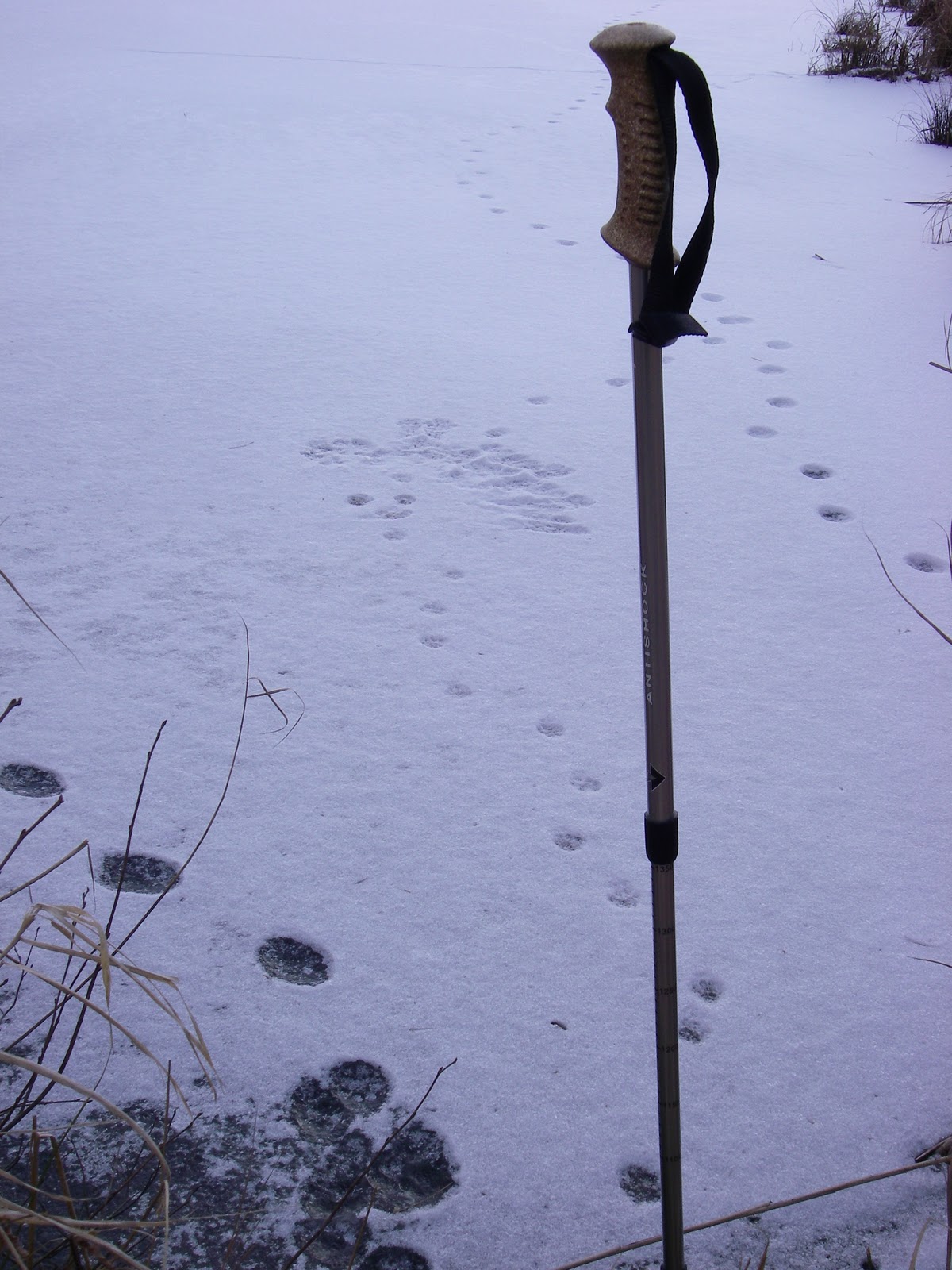
We have a new volunteer joining the Research and Conservation Program!  Her name is Helena Sasso and on her first day we did little bit of tracking after this morning's hike to Heron Ridge.  We stopped at Catlin Marsh at the junction with Webster Road.  We found more bobcat tracks from yesterday's visit and these looked really fresh!  You can see the tracks record how the animal slowly loped onto the ice then stopped and postured in one place, leaving a really unique pattern in the snow, probably to groom and then continued to walk onto a trail that was used before by a bobcat (maybe the same individual).  Pretty Cool!  I can't tell you how much I wanted to walk out onto the ice to see this in closer detail, but the ice is only about two inches thick!  Just a tad bit too thin for me, but not for a bobcat.

Snow Tracking

14:40 to 16:05 (EST) 30 degrees F., North wind ~0-5 mph, 25% cloud cover.

Nicole Morin, volunteer from Wamogo Regional High School, visited today and helped with some of the first snow tracking of the year.  We hit several locations.  The best site was Catlin Marsh junction of Webster Road!  Look for yourselves, bobcat tracks!  We also saw old coyote tracks. 


Bobcat Tracks!  Notice the walking gate (direct register) on the right trail and the running gait on the left trail.  


We saw 8 turkeys (all males) leave one of the Arethusia Farm fields and enter into the white pine stand on the north side of the road.  They were scratching the ground and probably will roost in the pines overnight.

We also saw a bald eagle soaring over Cranberr Pond.  The ice on Heron Pond was at least one inch thick, not enough to support my foot, I tried!