Showing posts with label Broad-winged Hawk. Show all posts

White Memorial Hawk Watch Sets New Records on September 16, 2013


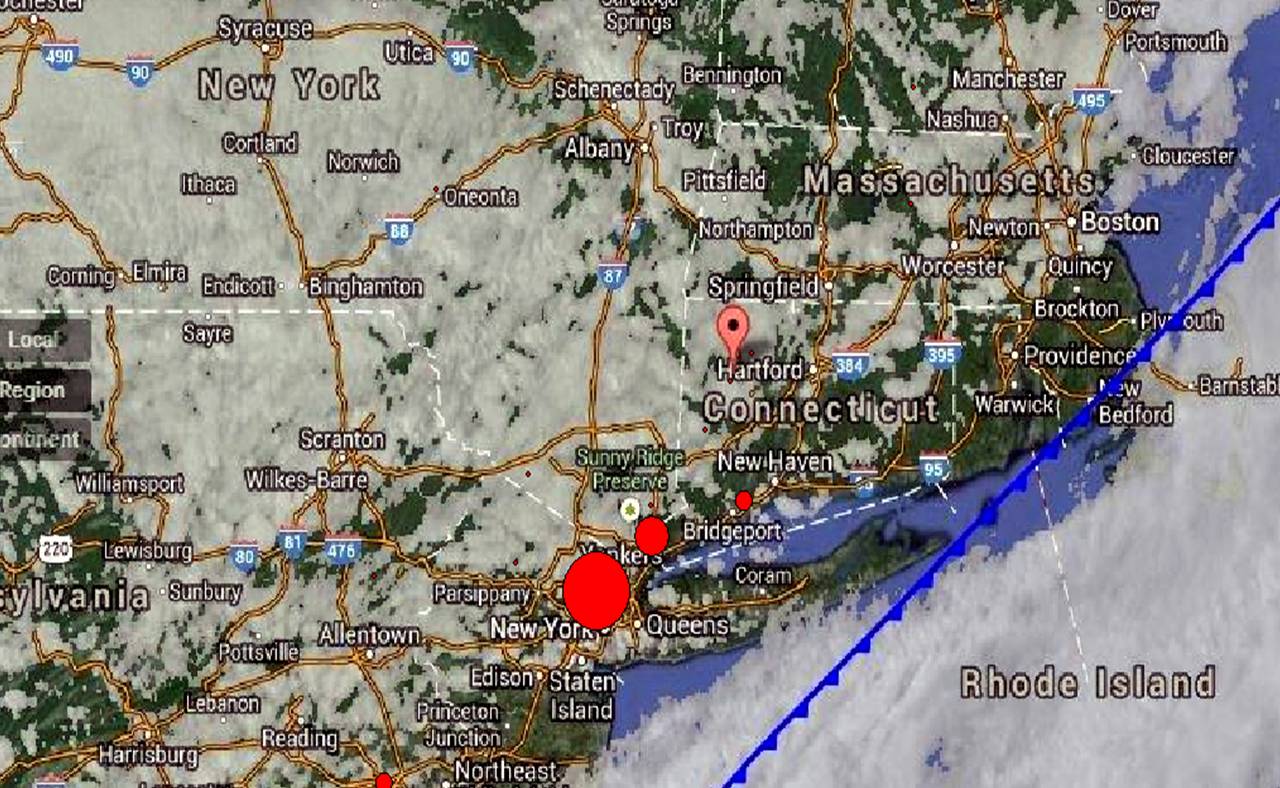
Several hawk species, mostly Broadwing Hawk (Buteo platypterus), migrated in a massive push on Monday 16 September 2013 through southern New England and the northern Mid-Atlantic states.  The conditions were just right for this event.  A cold front progressed through the area from the northwest bringing with it a steady northwest wind and a short break in the cloud cover.  The front also pushed out a blanket of clouds that were in the area in the early morning. The hawks were observed taking flight as soon as the cloud cover started to break up!  The clear sky lasted for only a few hours but it was long enough for the ground to heat up thereby creating thermals or up-welling pockets of hot air that the birds ride upward gaining altitude.  There was a steady stream of birds coalescing into kettles consisting of hundreds of birds.  New kettles were forming every 5 minutes in the sky.  Our counters for the day included James Fischer, Jared Franklin, and Kelly Lawlor.  They observed a total of 2608 birds for the day, which is a record number of birds in one day for the White Memorial Hawk Watch site.  Several other Hawk Watch sites observed similar conditions and it is presented to you below.  The following images show the hourly satellite imagery and progressing cold front.  The number of birds observed at each station is illustrated for each Hawk Watch.  You can see for yourself the massive wave of birds that moved through the area in just a few short hours!

10:00 a.m. EST  The clouds were just starting to break and birds took to the skies!

11:00 a.m. EST  The wind picked up speed due to the advancing cold front
bringing with it clear skies and lots of birds!

12:00 p.m. EST  A steady queue of birds were observed at nearly every
Hawk Watch site throughout western Connecticut and southern New York.

1:00 p.m. EST  A few birds could still be observed as clouds were moving in from the northwest.

2:00 p.m. EST  White Memorial Hawk Watch calls it a day after observing a total of 2608 birds!

3:00 p.m. EST  Many of the birds were now being observed and counted in northern New Jersey.

Number of Hawks Observed Each Hour at Selected Northeastern U.S. Stations
Hawk Watch Station9:00 AM10:00 AM11:00 AM12:00 PM1:00 PM2:00 PM3:00 PMTotal
Russell, MA115154462051101044
Torrington, CT18427985557541213904451
Litchfield, CT02401173824322002559
Bridgewater, CT02310391582565702133924
Bedford, NY051938592228247608587
Montclair, NJ0019139107693413233491
Fort Washington, PA000165810513541533

A Hawk Watch is in Effect for Litchfield County

With the shorter days and cooler temperatures arriving, the plants and animals are beginning to prepare themselves for this coming winter through building up fat stores or by migrating south. 

This migration is easily seen in our hawks, eagles, and other large birds of prey.  Throughout September and into October, we at the Conservation Center will have our eyes fixed on the sky as these birds begin to move to warmer climes.  Already we have seen some movements; from our observation post on Sawmill Hill, we have seen Turkey Vultures, Red-tailed, Red-shouldered, and Broad-winged Hawks, Kestrels, Peregrine Falcons, Bald Eagles, Northern Harriers, and all three North American Accipiter species. 

Bald Eagle juvenile
This observation of hawk migration is part of our annual Hawk Watch, done in conjunction with the Hawk Migration Association of North America.  Please join us, whether as a volunteer hawk-watcher at the Conservation Center or simply as someone who enjoys gazing at these magnificent birds in the sky.

Peregrine Falcons over WMF Hawk Watch, 9/30/11

Peregrine Falcon adult in flight

by Jim Burns from www.azgfd.gov


The weather finally improved enough on Friday, 9/30/11, to conduct a hawk watch around the Museum Area between 11:00 a.m. and 3 p.m. Since the winds were out of the southeast, south, and southwest at a sustained 20 m.p.h., conditions were not really good for hawk migration, but 30 members of this group flew over our site, anyway. I wouldn't have bothered to engage in hawk watching/counting this day if it hadn't started with a gorgeous adult Peregrine Falcon flying low over us. It went from north to south without showing any difficulty in dealing with the headwind. Soon after that the first of 8 high-flying migrant Red-tailed Hawks went over. This species doesn't usually migrate until later in October or November, but these birds had to be migrants because of their altitude and their direct flight from northeast to southwest. The rest of this day's migrant raptors consisted of 4 immature Bald Eagles, 6 Ospreys, 5 Sharp-shinned Hawks, 4 Cooper's Hawks, 1 late Broad-winged Hawk, and an immature Peregrine Falcon. We, and the hawks, quit when the sky became overcast. So far this fall's hawk watching hasn't been particularly good at White Memorial because the weather has been unfavorable, and quite often downright awful, for most of the month of September. We've only been able to put in 4 days of effort, which has yielded a grand total of 412 hawks. This breaks down to 354 Broad-winged Hawks, 14 Sharp-shinned Hawks, 9 Bald Eagles, 8 Ospreys, 8 Cooper's Hawks, 8 Red-tailed Hawks, 4 Red-shouldered Hawks, 4 Black Vultures, 2 Peregrine Falcons, and 1 N. Harrier. It is amazing that we haven't seen any American Kestrels, yet. We hope to have at least one more day of good hawk watching conditions before their migration season ends. Last year, we counted a total of 905 hawks passing over our site on 15 favorable days, so we don't expect to come anywhere close to that figure, but it would be nice to end this year with a total around 450. If the weather forecasts are correct, we might be in for more movement later this week.

Hawk Watch results from White Memorial for 9/16, 17, & 19/2011

Broad-winged Hawk photo by Ron Austing


Northern Harrier from http://www.allaboutbirds.org/


Sharp-shinned Hawk photo by Darlene Knox


Osprey photo by Bob Stanowski


Bald Eagle adult photo by Paul Fusco

from http://www.paulfuscowildlifephotography.com/


Red-shouldered Hawk adult

photo by Darlene Knox


Cooper's Hawk immature


The White Memorial hawk watch started its 2011 season on September 16th with a good showing of birds. The weather for much of the month prior to this was too lousy for hawk migration to occur. By contrast, the weather on the 16th was sunny, very cool, and with a steady 20 - 30 m.p.h. wind from the northwest. These conditions were optimal for hawk migration along the coast, as many birds were blown that far. I saw reports from Lighthouse Pt. in New Haven of 3,000 hawks and from Greenwich Audubon Center of 6,000 hawks that day. Inland sites, like White Memorial did o.k., but the results were not nearly as impressive as those from coastal sites. We counted a total of 259 hawks passing over the Museum Area between 10:15 a.m. and 5:15 p.m. The vast majority of these (255) were Broad-winged Hawks. The biggest kettle (or group) of Broad-wings consisted of 40 birds circling around overhead at one time. We also saw 1 Osprey, 2 Bald Eagles, and 1 Sharp-shinned Hawk. The next day, 9/17, was our "official" hawk watch day for the public. About 20 people attended at various times between 10:15 a.m. and 5:15 p.m. and were rewarded with a total of 107 hawks passing overhead. Of these, 93 were Broad-winged Hawks, including 50 in one kettle. We also saw 2 Black Vultures, 1 Osprey, 3 Bald Eagles, 3 Sharp-shinned Hawks, 2 Cooper's Hawks, and 3 Red-shouldered Hawks. No one manned our hawk watch site on Sunday, 9/18, but judging from observations from other places, we didn't miss much. Winds were coming from out of the south, and hawks weren't moving. The next day, 9/19, the winds shifted around to the west, and a few hawks started moving in the afternoon. Between 2 and 5:15 p.m. we counted a total of 16 hawks passing over the Museum Area. These consisted of 2 Black Vultures, 1 Northern Harrier, 5 Sharp-shinned Hawks, 2 Cooper's Hawks, 1 Red-shouldered Hawk, and 5 Broad-winged Hawks. The weather since this day has been too lousy for hawk migration to occur.

Wildlife Management and Inventorying Activities, 4/14/11

Red-tailed Hawk photo by Leo Kulinski, Jr.

from whalesandwolves.com Sharp-shinned Hawk photo by Darlene Knox Eastern Bluebird photo by Bob Stanowski
Bluebird nest box photo by Dave Rosgen

Yesterday, 4/14/11, Volunteers John Eykelhoff, Jim Kandefer, and Bob Stanowski assisted me with bluebird nest box maintenance and monitoring and a wide variety of wildlife surveying. Most of the time this type of field work is a case of multi-tasking. While working on the bluebird boxes we frequently scanned the skies for raptors, looked around the fields and edges for other birds and mammals, and listened for any birds or frogs than might be calling. Since it was a nice, sunny, warm day there was a constant concert of bird and frog sounds to enjoy. This included our first Northern Leopard Frogs of the season at the Litchfield Town Beach and in the Icehouse Marsh. Our first Common Snapping Turtles of the year also appeared today. Gerri Griswold and Lee Cook saw a huge one moving very slowly in the Bantam River and I saw a big one sticking its head out of Bantam Lake's N. Bay. Our third first-of-the-year animal found this day was a Blue-gray Gnatcatcher behind the Campground Store. Hawk migration activity was very good, with the best viewing being from the Bantam River Field. While replacing a rotted wooden bluebird box pole with a new metal one and replacing a cracked bluebird box front door we saw 3 Ospreys, a Sharp-shinned Hawk, and a Broad-winged Hawk fly over. Turkey Vultures and the resident pair of Red-tailed Hawks were also circling around overhead. These, and 3 other pairs of Red-tails seen elsewhere this day, were engaged in courtship activity. Migrant songbirds seen included Palm and Yellow-rumped Warblers. Eastern Bluebirds were seen at 4 nest box locations, and one of the boxes had a complete nest in it already. Tree Swallows were abundant everywhere. They were joined by a Barn Swallow in the Icehouse Field and N. Rough-winged Swallows at Wheeler Hill, the Bantam R. Field, and Cemetery Pond. Bantam Lake produced lots of action. This included at least 5 Ospreys fishing. Three of them were successful while we watched them, but one promptly lost its catch of a Northern Pike when an adult female Bald Eagle chased and scared it. The Pike disappeared when it hit the water, and the eagle failed to retrieve it. In addition to this eagle, an adult male (possibly her mate) was perched in a White Pine on the east shore, a 3rd-year immature female was flying around and then perched in a tree in N. Shore Marsh, and a 2nd-year immature male was perched in a White Pine at the tip of Lennox Hill Pt. He was being mobbed by American Crows for awhile. Bob was able to get really good Digiscoped photos of these eagles, so I will use them to do a future blog about the ways to determine the ages of immature and subadult Bald Eagles. While the eagles posed for photos, an immature Northern Harrier flew past us and disappeared into N. Shore Marsh, 7 Rusty and many Red-winged Blackbirds called from trees in the Marsh, 2 Green-winged Teal and 3 Wood Ducks swam along the shoreline, and 21 Double-crested Cormorants lazed on the stone blocks in N. Bay. Finally, we ended the day with 3 American Woodcock calling and displaying at dusk at Cemetery Pond. If you take a trip out to these locations, especially in the late afternoon and evening, you may very well be rewarded with these same sights and sounds of nature.