Showing posts with label CT DEEP Wildlife Division. Show all posts

Bat House Installation

~~~~~~~~~~~~~~~~~~~~~~~~~Materials~~~~~~~~~~~~~~~~~~~~~~~~~~

  • Bat House
  • Treated Wood
  • 3 wood planks (cut to fit the width of the bat house) (referred to as support brackets)
  • Screws to fasten bat house to support brackets
  • Bolt (we used 6" long, 3/8" wide) with washers, nut 
  • Lag screws to fasten beam to post
  • Lag screws to fasten support brackets to beam. 
  • Cordless drill and bits to suit your needs
  • Tape measure, pencil, level, framing square
  • Work gloves, hard-hat, other protective gear
  • BATS!

~~~~~~~~~~~~~~~~~~~Before the installation~~~~~~~~~~~~~~~~~~~~~

Decide where to put the house

South or South East facing is usually best. You want the house to get sun first thing in the morning, and remain sunned for at least 8 hours/day, but preferably 10 to 12 hours. Avoid placing it near shade casting trees. However, do not avoid trees altogether. You should think about what a bat would consider an attractive neighborhood. Proximity to trees, open water, and wetlands are important, as they provide the bats' food: Insects! 
Houses can be installed on a post, wooden beam, or on an existing structure like a house or barn. When installing on a post/beam, opt for a large capacity house to allow heat retention. Single or double chamber houses will lose their heat too early in the night. These smaller houses can be installed on the sides of houses/barns because those buildings give off some heat. 
If you live in the Northeast, paint your bat house BLACK. It is essential for absorption of heat. 


Manage the vegetation

If you had to knock down vegetation to install your bat house, you'll need to continue to manage that vegetation. Bats need room to exit the roost, so shrubs/trees growing under the house can quickly become a problem. 
We chose to place this house in an invasive Japanese knot weed stand for a couple of reasons. First, the vegetation would self regulate its height, so as not to grow above the height of the bat house and shadow it. Second, we knew the ground here would be suitable for setting a post about 4 feet deep. Once we decided on a spot, we knocked down a large area around it to allow for room to work. The wooden beam we will be hoisting into the air is 16 feet long, so we needed to keep that in mind when clearing a working area.

Prepare the Materials


If you're installing a free standing house, you'll need to attach support brackets to the main beam or post. These will be perpendicular to the post/beam, and the house will be secured to these. Be sure these are secure and level. 
We attached the brackets using pre-drilled holes, lag screws, and washers. 
Next, attach the house to the support brackets using sturdy screws. We used 6 screws, and our house came with pre-determined areas where the screws will go. If your house does not have pre-existing places for screws, attach it any way you see fit that will not poke into the chamber. You DO NOT want sharp screws point in toward where the bats will be entering. 


Pound the post or Dig the hole


This only applies to you if you're installing a free standing house. This may seem like a simple step but it can easily backfire. Having a level support beam is KEY!. Whether pounding a post into the ground or burying a beam with cement, be sure to use a level every few seconds to ensure it is not going in crooked. 


If you're using a post:
Measure the distance from the ground to the hole you'll be using to attach the beam to the post. In our case, it was about 41". Now, pre-drill a hole that distance from the bottom of the beam to accommodate the bolt during installation. 


~~~~~~~~~~~~~~~~~~~~~~~~~~~Installation!~~~~~~~~~~~~~~~~~~~~~~~

Step 1. Attach the bat house


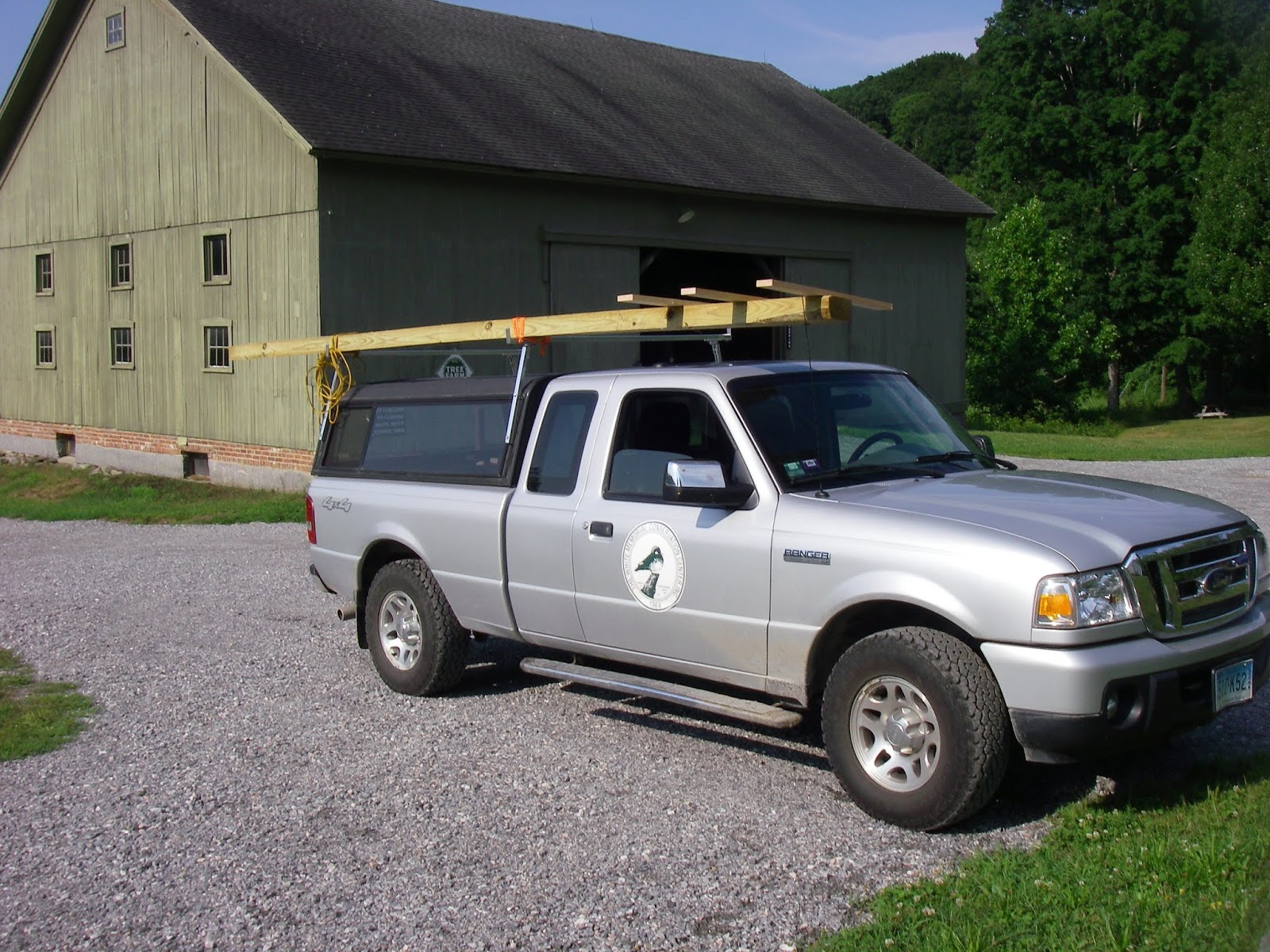
A pick-up truck served as the perfect platform to place the beam on before rotation. Saw horses could work just as well. Once the beam is in place and the bolt is secure, the bat house can be screwed into the brackets. We also used washers in this installation.


Step 2. Attach the beam to the post


To attach the wood to the post, we used a 3/8" bolt. We started out with the beam horizontal (perpendicular to the post). The bolt will act as a fulcrum from which the beam will rotate to its upright position. 


Step 3. Rotate beam to lift bat house into the air


This step can be tricky and requires at least 4 people. Because this set up is top-heavy, getting it and keeping it vertical is a challenge. Once the beam is vertical, use ratchet straps to secure it in place. DO NOT ever take all the hands off the beam until the very end. Once the ratchet straps are taught, you can ensure your set up is level. 


Now you can insert the lag screws to secure the beam to the post. We used three and placed them about equidistant apart. Make sure everything is tight and let go. 
You now have successfully installed a bat house! Congrats!


To learn more about bats, see these links from the CT Dept. of Energy and Environmental Protection: 

  • Bat Fact Sheet - This link gives an overview of bat biology, ecology, management, and other information about building a bat house
  • Bat In Connecticut -  This link tells you what you can do to help save Connecticut's bats. Note the bottom of the page has several other links to articles written about bats in Connecticut- mostly pertaining to White-Nose Syndrome. 


You can purchase a bat house, online, from  https://batmanagement.com/collections/bat-houses

Summary:

Every bat house installation project is unique.  Ultimately, the most important considerations to keep in mind is making sure the bat house is constructed properly and it is placed near good quality habitat that receives good sun exposure.  It is really important to make sure that the bat house is stable and secure when it is ultimately installed, bat don't like houses that sway in the wind or get visited by predators.    

New England Cottontail Monitoring

 Image By: John Huff Foster Daily Democrat via AP

Habitat management performed throughout the range of New England Cottontail (NEC) and assessing the conservation status of the species is being partially measured during the winter of 2016 - 2017 at White Memorial.  A total of two plots were selected on the property, which are located at Apple Hill and on North Shore Road.  The Apple Hill plot is being managed to ensure adequate habitat for NEC and other early successional habitat species.  The North Shore Rd. plot is a grassland that has been permitted to revert to early successional habitat through ecological succession. 

Transects were flagged using orange and yellow surveyor tape 
on the Apple Hill Plot on East Shore Rd., Morris, Litchfield Co., CT, USA.

This project is coordinated by the NEC Technical Committee and researchers at the U.S. Geological Survey.  The monitoring objectives are to assess occupancy rates of both cottontail species (Eastern and NEC) throughout the NEC range, observe how this occupancy status changes through time, and to determine how management activities influence the changes in the occupancy status of both species.  White Memorial's two plots were part of a total of 283 plots selected throughout CT, MA, ME, NH, NY, and RI.  Connecticut currently conserves the largest number of NEC populations in the habitats of highest priority and is surveying the bulk of the total plots (83 plots).  The plots consist of 200 meter long transects that are spaced every 30 meters, ultimately sampling piece of land approximately 2 hectares in size.  The plots were visited at least 24 hours after a fresh snowfall, when the temperature remained below 30 degrees Fahrenheit, and with very little wind or no rain.  Each plot was visited a total of 4 times within a 4 - 6 week time period.  The location of cottontail scat was georeferenced and collected for future molecular analysis to determine the species.  

Various habitat measurements were recorded throughout the plot that described the vegetation density at various heights, land management, and land cover types.  Generally, the vegetation favored by both cottontail species is very dense and can consist of several thorny plant species, which makes working in them very labor intensive and at times dangerous. 

2017 Mid-Winter Eagle Count at Bantam Lake and Vicinity

Bald Eagle at Bantam Lake with nesting material.  Photo by Leo Kulinski, Jr.

An annual count coordinated throughout North America is the Mid-Winter Eagle Count.  This count is coordinated by the US Fish and Wildlife Service, as well as various state and local agencies.  Observers conduct the count at waterbodies and watercourses while carefully scanning the shorelines for perched birds and looking skyward for gliding eagles.  This year's count was conducted on Saturday 14 January 2017.  We counted one adult bald eagle at Bantam Lake.  We also looked for birds at Pitch, Morris, and Wigwam Reservoirs but did not observe any birds.  Nearly 100 other localities are monitored annually.  This information is very useful for monitoring eagle populations and is a data source that was used when the US Fish and Wildlife Service reviewed the conservation status of Bald Eagle, which was delisted from US Endangered Species list in 2007.  Bald Eagles remained a protected species by many state endangered species lists and the federal act "The Bald and Golden Eagle Protection Act".

Bald Eagles have been steadily recolonizing the state of Connecticut as a breeding bird.  New nests are being found throughout the state almost every year.  If we are lucky, we may be able to report that they will be nesting at Bantam Lake soon.  Until then, you can see them hunting for fish on Bantam Lake and River usually each spring, late summer, and into the autumn until the ice covers the lake.  When ice coverage is nearly complete, Bald Eagles fly to nearby rivers that don't tend to freeze, especially at the foot of large dams that constantly discharge water.

Mid-winter eagle count at Bantam Lake

Adult Bald Eagle observed during the 2016 Mid-winter Eagle Count (Jan. 9, 2016)
 along Bantam River, south of Little Pond by Michael Doyle.
 (Photo by Michael Doyle)


Frank Errico scanning the Bantam Lake outlet at North Shore Rd.

Frank Errivo and Michael Doyle helped with this year's survey. The Mid-winter eagle count is conducted by he US Fish and Wildlife Agency and by state agencies to assess the status of Bald Eagle and Golden Eagle populations.  This year one mature bald eagle was observed along Bantam River, south of Little Pond by Mike Doyle.  Since we the time and our winter weather has rather mild, we also surveyed several other nearby water bodies.  There was plenty of open, ice-free water so it was worth the investment, unfortunately we didn't observe any other Eagles.  All of our data was reported to CT DEEP Wildlife Division.

Posted from the field.