Showing posts with label Little Brown Bat. Show all posts

Bat House Installation

~~~~~~~~~~~~~~~~~~~~~~~~~Materials~~~~~~~~~~~~~~~~~~~~~~~~~~

  • Bat House
  • Treated Wood
  • 3 wood planks (cut to fit the width of the bat house) (referred to as support brackets)
  • Screws to fasten bat house to support brackets
  • Bolt (we used 6" long, 3/8" wide) with washers, nut 
  • Lag screws to fasten beam to post
  • Lag screws to fasten support brackets to beam. 
  • Cordless drill and bits to suit your needs
  • Tape measure, pencil, level, framing square
  • Work gloves, hard-hat, other protective gear
  • BATS!

~~~~~~~~~~~~~~~~~~~Before the installation~~~~~~~~~~~~~~~~~~~~~

Decide where to put the house

South or South East facing is usually best. You want the house to get sun first thing in the morning, and remain sunned for at least 8 hours/day, but preferably 10 to 12 hours. Avoid placing it near shade casting trees. However, do not avoid trees altogether. You should think about what a bat would consider an attractive neighborhood. Proximity to trees, open water, and wetlands are important, as they provide the bats' food: Insects! 
Houses can be installed on a post, wooden beam, or on an existing structure like a house or barn. When installing on a post/beam, opt for a large capacity house to allow heat retention. Single or double chamber houses will lose their heat too early in the night. These smaller houses can be installed on the sides of houses/barns because those buildings give off some heat. 
If you live in the Northeast, paint your bat house BLACK. It is essential for absorption of heat. 


Manage the vegetation

If you had to knock down vegetation to install your bat house, you'll need to continue to manage that vegetation. Bats need room to exit the roost, so shrubs/trees growing under the house can quickly become a problem. 
We chose to place this house in an invasive Japanese knot weed stand for a couple of reasons. First, the vegetation would self regulate its height, so as not to grow above the height of the bat house and shadow it. Second, we knew the ground here would be suitable for setting a post about 4 feet deep. Once we decided on a spot, we knocked down a large area around it to allow for room to work. The wooden beam we will be hoisting into the air is 16 feet long, so we needed to keep that in mind when clearing a working area.

Prepare the Materials


If you're installing a free standing house, you'll need to attach support brackets to the main beam or post. These will be perpendicular to the post/beam, and the house will be secured to these. Be sure these are secure and level. 
We attached the brackets using pre-drilled holes, lag screws, and washers. 
Next, attach the house to the support brackets using sturdy screws. We used 6 screws, and our house came with pre-determined areas where the screws will go. If your house does not have pre-existing places for screws, attach it any way you see fit that will not poke into the chamber. You DO NOT want sharp screws point in toward where the bats will be entering. 


Pound the post or Dig the hole


This only applies to you if you're installing a free standing house. This may seem like a simple step but it can easily backfire. Having a level support beam is KEY!. Whether pounding a post into the ground or burying a beam with cement, be sure to use a level every few seconds to ensure it is not going in crooked. 


If you're using a post:
Measure the distance from the ground to the hole you'll be using to attach the beam to the post. In our case, it was about 41". Now, pre-drill a hole that distance from the bottom of the beam to accommodate the bolt during installation. 


~~~~~~~~~~~~~~~~~~~~~~~~~~~Installation!~~~~~~~~~~~~~~~~~~~~~~~

Step 1. Attach the bat house


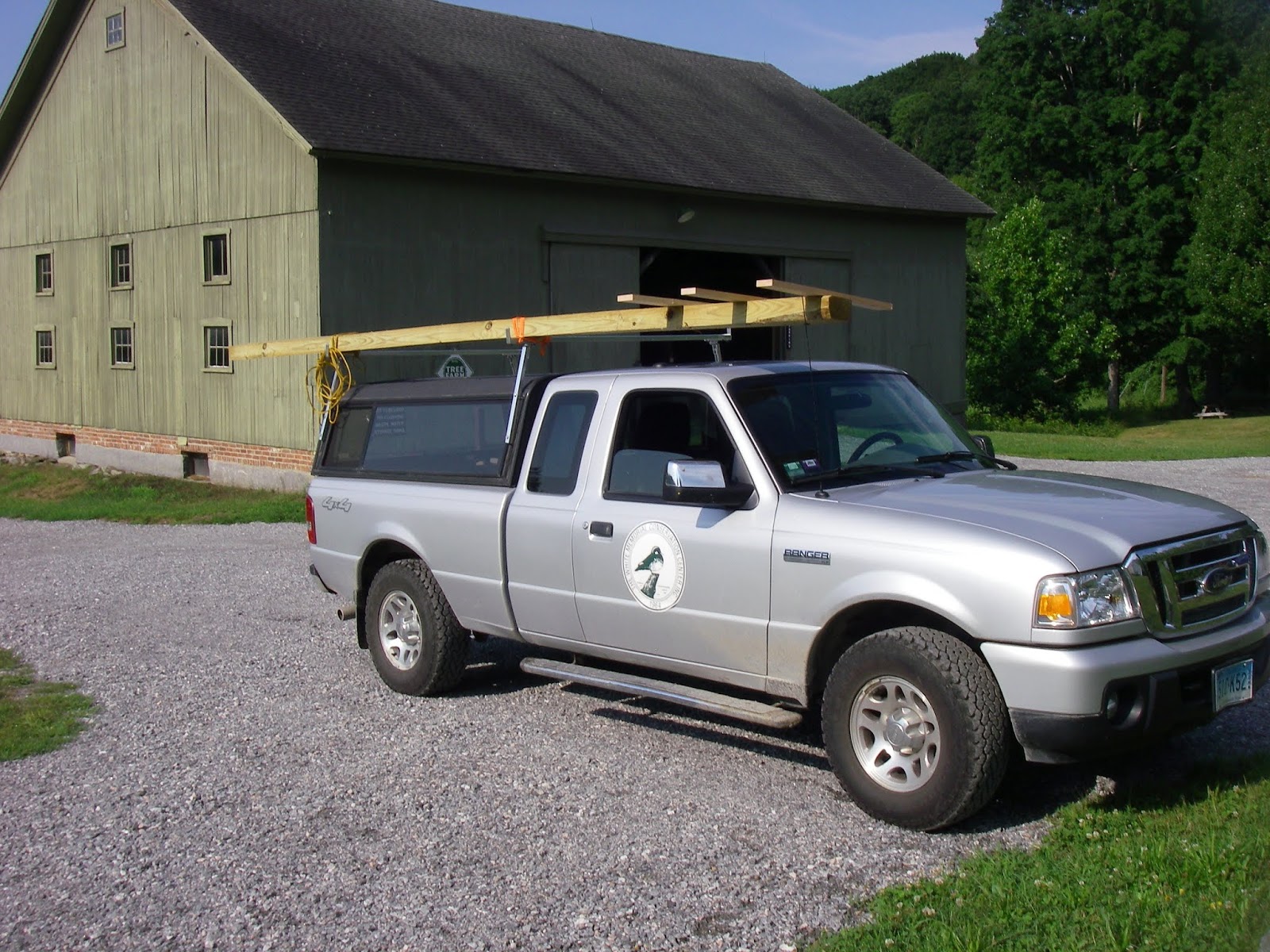
A pick-up truck served as the perfect platform to place the beam on before rotation. Saw horses could work just as well. Once the beam is in place and the bolt is secure, the bat house can be screwed into the brackets. We also used washers in this installation.


Step 2. Attach the beam to the post


To attach the wood to the post, we used a 3/8" bolt. We started out with the beam horizontal (perpendicular to the post). The bolt will act as a fulcrum from which the beam will rotate to its upright position. 


Step 3. Rotate beam to lift bat house into the air


This step can be tricky and requires at least 4 people. Because this set up is top-heavy, getting it and keeping it vertical is a challenge. Once the beam is vertical, use ratchet straps to secure it in place. DO NOT ever take all the hands off the beam until the very end. Once the ratchet straps are taught, you can ensure your set up is level. 


Now you can insert the lag screws to secure the beam to the post. We used three and placed them about equidistant apart. Make sure everything is tight and let go. 
You now have successfully installed a bat house! Congrats!


To learn more about bats, see these links from the CT Dept. of Energy and Environmental Protection: 

  • Bat Fact Sheet - This link gives an overview of bat biology, ecology, management, and other information about building a bat house
  • Bat In Connecticut -  This link tells you what you can do to help save Connecticut's bats. Note the bottom of the page has several other links to articles written about bats in Connecticut- mostly pertaining to White-Nose Syndrome. 


You can purchase a bat house, online, from  https://batmanagement.com/collections/bat-houses

Summary:

Every bat house installation project is unique.  Ultimately, the most important considerations to keep in mind is making sure the bat house is constructed properly and it is placed near good quality habitat that receives good sun exposure.  It is really important to make sure that the bat house is stable and secure when it is ultimately installed, bat don't like houses that sway in the wind or get visited by predators.    

The fight for our bats

Little Brown Bat with White-Nose Syndrome
Photo by A. Hicks (NYDEC)

White-Nose Syndrome


Bats in Connecticut have found themselves to be the focus of many conservation efforts after White-Nose Syndrome (WNS) spread through the state. WNS gets its name from the white fungus that can be seen growing on the bare skin on the face and wing membranes of affected bats. The fungus, Pseudogymnoascus destructans, infects bats during winter hibernation and causes physiological changes that irritate the bat, and may even cause it to exit the cave during the day. Being awake and active during the winter depletes the fat reserves which should have carried them through to the spring. Because bats are especially vulnerable during hibernation, this disease has a very high kill rate. Some caves in Connecticut have seen up to 95% of hibernating bats killed in one winter. It is estimated that millions of bats across North America have died from WNS since its discovery in 2007. 


Little Brown Bats hibernating in a cave in CT.
White-Nose Syndrome can clearly be seen on the left bat
Photo by P. Fusco
Bats provide an essential ecosystem service which humans value very much: insect control. With the increasing rate of insect-borne diseases affecting people around the country, the value of insectivores (insect eaters) also continues to increase. All of Connecticut's bats are insectivores. One Little-Brown Bat can eat 1,200 mosquitoes in one hour. Connecticut would sorely miss the bat if it were to stop existing in our state, and the Little Brown Bat was one of the species most affected by WNS. The first step to conserving these animals is gathering all the data we can on them. 


Big Brown Bat in flight.
Photo courtesy of Science Magazine and Micheal Durham

What are we doing about WNS?


The research staff at White Memorial have been doing their part to gather data on bats in our area. We participate in three bat-centric surveys: 1. Bat Maternity Counts, 2. Stationary Bat Detecting Microphone, and 3. Mobile Bat Detecting Microphone. 

1. Summer Bat Colony Counts
This survey consists of counting bats as they exit a known roost at dusk. We observe the a colony of Big Brown bats that resides in the storage barn during the summer. These bats exit through the East and West ends of the barn around sunset to hunt for insects. We do this survey twice a year to monitor changes in the population. Once before the pups begin to fly, and once after the pups begin to fly.
This year we counted 193 bats in the initial survey and 363 bats in the second survey.


Intern Abby Wilson sets up the stationary bat detector
over a vernal pool
2. Stationary Bat Detecting Microphone
By using a sophisticated microphone which can detect and record very high frequency noises, we can find spots on the property where bats are using echolocation to hunt for insects at night. We set up this microphone in places we predict bats to be flying; places such as vernal pools, marshes, swamps, etc., and wait a few days. Upon retrieving the device, we read the recorded files through a special software which can analyze the noises and attribute them to species of bat. Each species has a slightly different "call".  

So far over many nights and different locations, we've recorded Big Brown Little Brown, Hoary, Red, and Silver-Haired bats with this microphone.


The white tube contains a microphone (the size
of a smart phone) 
3. Mobile Bat Detecting Microphone
You can probably guess from the name that this survey is similar to the former. It also uses a microphone specially designed to register and record high frequency noise. However, this microphone is much smaller (about the size of a smartphone), and used in a slightly different way. This mobile survey is named such because we use magnets to stick this microphone to the top of the truck, and follow pre-determined transects across all 4,000 acres of the White Memorial property. This method affords us the ability to survey many different habitats in one night, and has yielded some amazing results. We've observed all the same species recorded using the stationary microphone (which took many nights), in one single survey night, which takes about two hours. What an amazing diversity of bats we have here in Connecticut!


The signature sound profile of a Big Brown Bat, Eptesicus fuscus,
labelled Epfu for the first two letters of the genus and species.


What can you do?

If you want to help the bats, see this website from the CT DEEP: Help CT's Bats 

!!P. destructans spores can last a long time on clothe surfaces, so it is imperative that people exploring caves be mindful to wash all clothes, shoes, and gear before entering a new cave. !!

Surveying White Memorial's Bat Population


 This summer, White Memorial adds its efforts to an ongoing survey of Connecticut's bat species. Begun in 2010 by the Department of Energy and Environmental Protection, the survey uses sound recordings to monitor bat activity. Starting a half-hour after sunset and continuing until late at night, White Memorial's research technicians drive a 24-mile route through the woods roads of the property, using a truck-mounted microphone to record high-pitched sounds. The microphone is sensitive to sounds well above the range of human hearing, and records the calls of bats as they seek out insects for food, along with any high-pitched background noise from nearby telephone wires, insects, and radio transmissions. We'll pass these recordings on to the DEEP, where computer analysis will distinguish the bat calls from surrounding noise and identify the bats by species based on their unique sound patterns. We'll likely find evidence of big brown bats (Eptesicus fuscus), little brown bats (Myotis lucifugus), and northern long-eared bats (Myotis septentrionalis), all known to inhabit White Memorial's property.


     Relying on acoustic recordings of bats allows us to form a much more detailed picture of bat populations, distributions, and activity than do older methods such as counting bats caught in mist nets. Furthermore, as white nose syndrome continues to decimate bat populations in the eastern United States, bat monitoring has become increasingly important. The white nose fungus (Pseudogymnoascus destructans) has been present in Connecticut since the winter of 2007-2008, when it was found among hibernating bats in northern Litchfield county. Bats affected by the fungus exhaust their fat reserves and die during their winter hibernation. Monitoring efforts at White Memorial and in towns around Connecticut will help measure surviving bat populations, determine which species are affected and not affected, and provide long-term data against which management efforts can be judged.

Big Brown Bat censusing

Big Brown Bats roosting


photo from http://www.bu.edu/


Big Brown Bat in flight


White Memorial's Green Barn, which is located in the Main Area right behind the Museum, has hosted a Big Brown Bat colony for as long as anyone can remember. Since 1999, we have conducted sporadic censuses of this colony, usually as they exit in the evening to feed. This work has become increasingly important in the past few years with White Nose Syndrome decimating bat populations. Little Brown Bats are now greatly diminshed in numbers around this area because of this disease, but Big Brown Bats are still holding on in good numbers. They may not be affected by this disease quite as badly as other bats, or it is just a matter of time before it hits them hard, too. This year they had problems dealing with prolonged cold, wet weather in June. We found a total of 22 dead pups on the floor of the barn during this time period. Our censusing has also been adversely impacted by persistant lousy weather this year. Bats are not inclined to fly in the rain, so we don't try to census them under those conditions. With many other tasks to perform, it has been hard to find time on nice evenings to count the bats. On one such evening in early July I counted 193 bats exiting the barn. I didn't have another opportunity until Saturday, 8/6, when the bat census was supposed to be a major component of our "Serenade for the Bats" program for the public. However, heavy rain descended upon us about 5 minutes into the count after 70 bats had emerged. Not only did bats cease to come out, but the bats that had just come out went right back in. We quit counting them at that point. The rain didn't quit until the next day. I was a lot luckier the following Saturday, 8/13. The weather was mostly clear and warm with a light breeze. I parked myself on the northwest side of the barn where I could see the primary exit point under the peak of the roof on the west side and the secondary exit out through the front doors on the north side. I started watching for bats at 7:35 p.m., but didn't see the first one emerge until 7:47. The peak action occurred between 7:55 and 8:05. The last bat exited the building at 8:17. I went into the barn at 8:25 to see if any bats were still there, and didn't see any. The total that night was 164 bats, with all but 13 exiting from the west side. Almost all of them flew toward the Lake Trail and Ongley Field. The weather this past Saturday evening, 8/20, was also perfect for the bats and for us to count them. This time it was part of our "Things That Go Bump In The Night" program for the public. Twenty people participated in this walk which wound up at the Green Barn at 7:40 p.m. We postioned ourselves to see the west and north sides easily, and were rewarded with a total count of 149 bats between 7:45 and 8:20 p.m. Just like last week, the peak activity occurred around 8 p.m. When we went into the barn at 8:25 to check for remaining bats we didn't see any. All but 9 of the bats had exited from the west side of the building. We can't account for the decrease in bats with any certainty. We could have missed seeing bats exit the east or south sides of the building, or they may have been roosting in a different building, or they may have left the area, or they may have been eaten by an owl or other predator, or they may have died from some other cause. We did look for dead bodies in the barn and didn't see any. It is interesting to note that I saw a Great Horned Owl perched on the barn's roof right over the exit hole on Tuesday, 8/9, and we heard a Barred Owl hooting from the Interpretive Trail on Thursday, 8/11. We'll see what the rest of the summer brings for bat numbers as we continue to try to count them on a weekly basis. The more people helping to count, the better, so come on out.