
 Yellow-billed Cuckoo photo by Ronnie Maum
from http://www.fws.gov/
 Pectoral Sandpiper photo by Paul Lewis
 American Redstart from http://www.tringa.org/
 American Pipit from http://www.tringa.org/
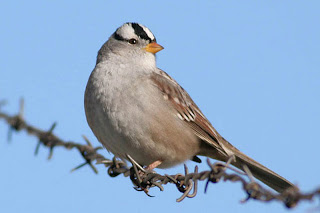 White-crowned Sparrow photo by
 Pectoral Sandpiper photo by Paul Lewis
 American Redstart from http://www.tringa.org/
 American Pipit from http://www.tringa.org/
 White-crowned Sparrow photo by
Keith Carolson from http://www.idahofishandgame.gov/
 Lincoln's Sparrow photo by Linda Williams
 Savannah Sparrow photo by Paul Fusco
 Lincoln's Sparrow photo by Linda Williams
 Savannah Sparrow photo by Paul Fusco
The cold, wet weather that has been a nuisance to us for much of this month has also played a role in the fall bird migration. It stalled on rainy days and moved along at a brisk pace on pleasant days and nights. Winds out of the south also hindered migration activity on some days. For birders, this often meant a bounty of birds on the few nice days this month. One period of time that was especially good was from the 7th through the 11th. Many birds were seen then, including our first American Pipits of the year, which were seen and heard flying over the Museum Area. The Litchfield Hills Audubon Society team conducting the Big Sit bird survey on the Sutton's Bridge portion of the Little Pond boardwalk on the 9th got our first Yellow-billed Cuckoo and Pine Siskin of the year. They also got other rarities like Pectoral Sandpiper, Sora, and Lincoln's Sparrow; and they had some unusually late migrants like Solitary Sandpiper and American Redstart. Before dawn they heard Great Horned, Barred, Eastern Screech, and Northern Saw-whet Owls calling. In all, this survey produced a very respectable 78 species. The day before the Big Sit I led a walk for mostly beginning and novice birders to Pine Island and the Old Sewer Beds portion of the Little Pond Trail. Highlights on this walk were 4 Red-breasted Nuthatches, a Blue-headed Vireo, and several Golden-crowned Kinglets at Pine Island, and 3 White-crowned Sparrows, a Field Sparrow, and a Lincoln's Sparrow at the Old Sewer Beds. We also saw Lincoln's Sparrows in Ongley and Activity Fields this past week. That's pretty good for a species that is usually rare and hard to find! Ongley Field has also produced a Savannah Sparrow and lots of White-throated and Chipping Sparrows over the past 10 days. Yellow-rumped and Palm Warblers have been prevalent around the Museum Area, and Dark-eyed Juncos have been increasing slowly, but steadily in number since Friday, 10/7. Nice weather today, tonight, and tomorrow should bring even more migrants to, and through, northwest Connecticut.


