Showing posts with label Solitary Sandpiper. Show all posts

Results from the BIG SIT and other fall migration monitoring

Yellow-billed Cuckoo photo by Ronnie Maum


from http://www.fws.gov/


Pectoral Sandpiper photo by Paul Lewis


American Redstart from http://www.tringa.org/


American Pipit from http://www.tringa.org/
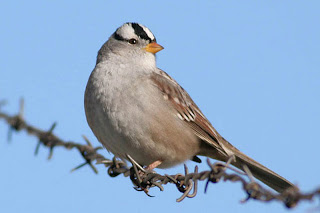


White-crowned Sparrow photo by


Keith Carolson from http://www.idahofishandgame.gov/


Lincoln's Sparrow photo by Linda Williams


Savannah Sparrow photo by Paul Fusco


The cold, wet weather that has been a nuisance to us for much of this month has also played a role in the fall bird migration. It stalled on rainy days and moved along at a brisk pace on pleasant days and nights. Winds out of the south also hindered migration activity on some days. For birders, this often meant a bounty of birds on the few nice days this month. One period of time that was especially good was from the 7th through the 11th. Many birds were seen then, including our first American Pipits of the year, which were seen and heard flying over the Museum Area. The Litchfield Hills Audubon Society team conducting the Big Sit bird survey on the Sutton's Bridge portion of the Little Pond boardwalk on the 9th got our first Yellow-billed Cuckoo and Pine Siskin of the year. They also got other rarities like Pectoral Sandpiper, Sora, and Lincoln's Sparrow; and they had some unusually late migrants like Solitary Sandpiper and American Redstart. Before dawn they heard Great Horned, Barred, Eastern Screech, and Northern Saw-whet Owls calling. In all, this survey produced a very respectable 78 species. The day before the Big Sit I led a walk for mostly beginning and novice birders to Pine Island and the Old Sewer Beds portion of the Little Pond Trail. Highlights on this walk were 4 Red-breasted Nuthatches, a Blue-headed Vireo, and several Golden-crowned Kinglets at Pine Island, and 3 White-crowned Sparrows, a Field Sparrow, and a Lincoln's Sparrow at the Old Sewer Beds. We also saw Lincoln's Sparrows in Ongley and Activity Fields this past week. That's pretty good for a species that is usually rare and hard to find! Ongley Field has also produced a Savannah Sparrow and lots of White-throated and Chipping Sparrows over the past 10 days. Yellow-rumped and Palm Warblers have been prevalent around the Museum Area, and Dark-eyed Juncos have been increasing slowly, but steadily in number since Friday, 10/7. Nice weather today, tonight, and tomorrow should bring even more migrants to, and through, northwest Connecticut.

Little Pond Does It Again!

Glossy Ibis photo by Dave DeReamus

from www.pabirds.org

Pectoral Sandpiper photo by Paul Lewis


From http://www.carolinabirdclub.org/


Short-billed Dowitcher from http://www.nrdc.org/


Pied-billed Grebe photo by Bob Stanowski


Little Pond has produced again! As usual, it is notable birds. August is one of the best months to look for this group of animals at this place. On Thursday morning, 8/4/11, Mike Doyle spotted a Glossy Ibis at the south end of the Pond, near Sutton's Bridge. This may only be the 4th record for this coastal species on WMF property. It is a bird that is prone to wandering after the breeding season, and August is when most of this wandering to inland locales occurs. I went out to Little Pond to look for this bird about 4 hours after Mike reported it. Unfortunately, I couldn't find it; and I presume that it had already moved on. However, in my search of the west side of the Pond for it, I turned up a Pied-billed Grebe with a flightless young one following it. We had seen this species sporadically here since April, and had heard it calling a few times in early May, but had given up hope of any breeding activity here this year. They did successfully nest here in 2002 and at Cemetery Pond in 2007. It is a species that is prone to nest late in the season, after water levels recede from spring flooding, so we shouldn't have given up hope for them as soon as we did. This young bird proves that. Virginia Rails will also nest late in the season, especially if they fail in their first attempts. On our visit on the evening of 8/8/11 we encountered a total of 10 of these birds along the north side of the pond. One was an adult, 2 were well-grown juveniles, and the others were all uttering fledgling food calls. One of the juveniles even hopped up on the Boardwalk, affording us excellent views of it. A major reason why Jim Kandefer, Marie Kennedy, and I went out there that day was to look for the Short-billed Dowitcher, Pectoral Sandpiper, and Semipalmated Plover that Fran Zygmont saw out there on the mud and sand bar Sunday morning, 8/7/11. Unfortunately, water levels had risen about 6" due to heavy rains, so much of the mud was under water, and none of these sought-after shorebirds were present. We did see 4 Killdeer on the remaining portion of the sandbar and 2 flyover Solitary Sandpipers. We also saw 14 Marsh Wrens along the north side of the Boardwalk; many of which were fledglings. That evening's adventure produced a total of 31 species of birds. I tallied a total of 49 species of birds the previous Friday, 8/5/11, after we installed the Purple Martin nest box near Sutton's Bridge. Most of the birds that day were the usual, common residents, plus 3 Green Herons, an adult and fledgling Virginia Rail, 2 singing Alder Flycatchers, 3 Bank Swallows, and 8 migrant Bobolinks. No matter when you go to Little Pond in August, it will yield plenty of birds.

Two More Visits to Little Pond

Green Heron photo from

www.barhorst.org

Great Egret photo from


Pied-billed Grebe photo by Bob Stanowski


Immature male Red-winged Blackbird

photo by Bob Stanowski

Juvenile Cedar Waxwing

photo by Bob Stanowski

What a difference a week makes! Actually, my visit to Little Pond on the evening of Thursday, 7/28, was only 5 days after our field trip out there on the evening of the 23rd. In that short time span the water levels in the pond and adjacent marsh have dropped a few inches, the Deer Fly population has decreased to a tolerable amount, and the mosquito population has decreased to a million or so. Much of the bird life is the same, with Red-winged Blackbirds, Swamp Sparrows, Cedar Waxwings, and American Goldfinches remaining abundant, but a few more species have arrived on the scene or become more numerous. My main reason for going out to this pond was to look for the Great Egrets that John Marshall and Jeff Greenwood had reported earlier in the day. They were the first ones seen this year on White Memorial property. They also become my first ones for this year when I spotted them right where John and Jeff said they saw them. Whether these birds are early fall southbound migrants from the small nesting population on Lake Champlain or post-breeding wanderers from some Atlantic coastal location we have no way of knowing. They (assuming they were the same ones) were seen again on Friday and Saturday. I couldn't find them on my next visit on Sunday afternoon, 7/31. On my visit on 7/28 I found an early fall migrant Pied-billed Grebe, 2 Green Herons, and a Solitary Sandpiper, none which were found on the 7/23 visit. My visit on the hot afternoon of Sunday, 7/31, turned up a newly-fledged Red-tailed Hawk, but nothing else that we hadn't had on the previous visits. Actually, each of these subsequent visits produced fewer species than the 7/23 visit, which yielded 51 species. On 7/28 I had 43 species and on 7/31 I had 32 species. This is mostly due to my covering much less ground than we did on the 23rd. On that day we went all the way around the entire boardwalk and trail, while my other 2 visits only took me along the north side of the boardwalk. On all 3 days we went in from the S. Lake St. entrance. It is also obvious from the number and variety of birds found that evening is a far better time to go out than afternoon. We've always known that, but these observations reinforce that belief.

RED-NECKED PHALAROPES at Bantam Lake

Red-necked Phalarope photo from www.fssbirding.org.uk

After a nearly a week of absolutely awful weather a major improvement occurred for a short while yesterday, 5/20. The day began mostly sunny and stayed nice until late afternoon, when thunderstorms rolled in. Migrant birds, which had been stalled since last Sunday by the combination of rain, drizzle, fog, and northeasterly winds staged a significant movement during the brief interlude of nice weather. I'll try to do a blog post next week about the other birds that poured through northwest Connecticut this day, but this posting is about the absolute best bird that we found. That is the Red-necked Phalarope. It is such a rare bird in Connecticut that I've only seen the species once before in my 42 years of birding. Amazingly, the first one was only a few miles away from White Memorial and only 3 days off from this sighting. That bird was at a pond at Anderson's Farm on Anderson Rd. in Morris on 5/23/2000. The weather pattern was very similar to that which occurred this week. I think that the shifting winds from northeast to southeast, coupled with rapidly deteriorating weather conditions over the Atlantic Ocean, drove (or blew) these birds inland. Three additional Red-necked Phalaropes were reported yesterday from Mansfield Hollow Reservoir in Windham. Our sighting consisted of 4 birds that I spotted from the tip of Pt. Folly as they flew up the length of Bantam Lake. Having only binoculars since I had left my spotting scope home under the assumption that this day's weather was also going to turn out to be awful, I initially had a hard time deciding what these birds were. They were too small to be terns or gulls, but too large to be swallows. Besides, they flew erratically like shorebirds often do. With a Spotted and a Solitary Sandpiper right in front of me for comparison I decided that these had to be shorebirds. Fortunately, they kept flying toward me. I yelled for Jim Kandefer, who was birding the Point with me, but had followed a wave of warblers up into the woods. He came down to the tip of the Point just as I got a good enough side view of these birds to decide that they were phalaropes. Even though Red and Wilson's Phalaropes are less likely to show up in southern New England in the spring than Red-necked, they still can't be ruled out. Since I had already gotten John Marshall heading up to Pt. Folly with my earlier report of a Bonaparte's Gull and 13 Blackpoll Warblers, I got him to speed our way even faster with my next call to him reporting phalaropes. Fortunately for us, he had his really nice Swarovski spotting scope with him. He arrived a few minutes later as the birds settled onto the water about 400' out from us. I put the scope on them, and we got excellent views which left no doubt that they were Red-necked. We also double checked oursleves with our field guides. One bird was an adult male in full breeding plumage. The other 3 appeared to be in various stages of molt from basic to alternate plumage, so we couldn't be sure if they were males or females. Oddly, it is the female phalaropes that are more colorful than the males. It is also the males that incubate the eggs and tend the young on their Arctic nesting grounds. As we watched these birds they flitted back and forth, flew around, spun around in circles on the water as this group of birds characteristically does when they are feeding, and sat and preened. After 20 minutes of enjoying the antics of these very rare birds a thunderstorm rolled in and chased us back to our vehicles. We then set-about the task of trying to notify as many birders as possible to the presence of these birds, both via the ctbirds listserve on the Internet and phone calls. To our knowledge only one other birder braved the thunderstorms to come out and see them this evening. All attempts by birders to find them today came up empty. They had probably continued their journey to the Arctic as soon as the storms passed by last night. It should also be noted that the only other sighting of this species on White Memorial property was on August 22, 1997. Jeff Feldmann found and photographed that bird while kayaking on Little Pond. Stormy weather preceded that sighting, too. The photograph still hangs on a wall in the Museum's upstairs bathroom. More than ever it is an incentive for me to spend less time in there and more time in the field looking for birds.

Solitary Sandpipers aren't always solitary

Spotted Sandpiper from http://www.discoverlife.org

Solitary Sandpiper from http://www.utahbirds.org/


Many of my previous posts have discussed the various groups of birds migrating back to and through White Memorial this spring. That includes shorebirds, which I've touched upon a couple of times. Now that we've passed the halfway point in May the shorebird migration will pick up, both in terms of diversity of species and the numbers of individuals moving through. Even though most people associate shorebirds with coastal, saltwater locations, there are inland places such as Bantam Lake and Little Pond in Litchfield, Great Pond in Simsbury, and Nod Brook in Avon which also appeal to shorebirds. If these birds become tired and/or hungry when they are passing over a lake or pond with a muddy shoreline, they are likely to drop in. They seem to be just as capable of finding and eating freshwater invertebrate animals as they would ones from saltwater environments. In fact, many shorebirds breed along bodies of freshwater in Canada. One of them, the Solitary Sandpiper, is pretty much exclusive to freshwater. It is one of the most likely species to be seen at inland water bodies in New England as it passes through northbound in April and May and southbound from late July through late September. Its name is somewhat of a misnomer, at least during migration time. While they aren't sociable, it is still possible to find quite a few of them in an area like Little Pond which offers them ideal feeding conditions when the water is low enough. We are currently experiencing these ideal conditions as floodwaters from the past month recede and expose mud inhabited by a host of invertebrate critters. That's why we encountered 14 Solitary Sandpipers, each, on 5/7 and 5/9 at Little Pond. E-bird flagged these as unusually high numbers, which I had to explain for them to accept. These birds weren't all concentrated on the mud bar at the Bantam River's inlet to Little Pond, as most shorebirds like Greater and Lesser Yellowlegs are. Instead, they were spread out rather evenly from this point down around to the River's outlet and then down the length of the River to a point below Sutton's Bridge on the Boardwalk. That's a distance of 1/4 mile. Each bird had its own foraging space. When one bird encroached into another bird's space, objections were voiced, and sometimes a chase ensued. Obviously, they would be solitary if they had a choice. By contrast, the Greater and Lesser Yellowlegs and Least Sandpipers all foraged together in relative peace at the mud bar, inlet, and outlet. Also found in this area was a Spotted Sandpiper. They prefer to remain somewhat solitary, too. Unlike these other shorebirds, though, this species will remain here to nest. Each summer we can usually find one pair at Little Pond, one or two pairs along the Bantam River as it heads down to Bantam Lake, and 2 pairs in the North Shore Marsh along Bantam Lake's North Bay. They nest on the ground among grasses and sedges, and forage for food along the muddy, sandy, and rocky shorelines. The Old Camp Townsend beach is an especially good place to see them from now through late September.