Showing posts with label Red-bellied Woodpecker. Show all posts

July 2017

Images recorded at White Memorial Conservation Center Bird Blind, unless stated otherwise on the White Memorial Foundation Property.  Time stamped is Eastern Standard Time, daylight savings time is not used.

Mammals

Bobcat at Plunge Pool
Eastern Chipmunk at Plunge Pool
 Southern Flying Squirrel at Plunge Pool
Southern Flying Squirrel at Plunge Pool
Eastern Gray Squirrel at Plunge Pool
White-tailed Deer Fawn at Ice House Marsh
Eastern Chipmunk at Cathedral 
Black Bear at Cranberry Pond
Bobcat at Cranberry Pond
Cottontail Rabbit at Ice House Marsh
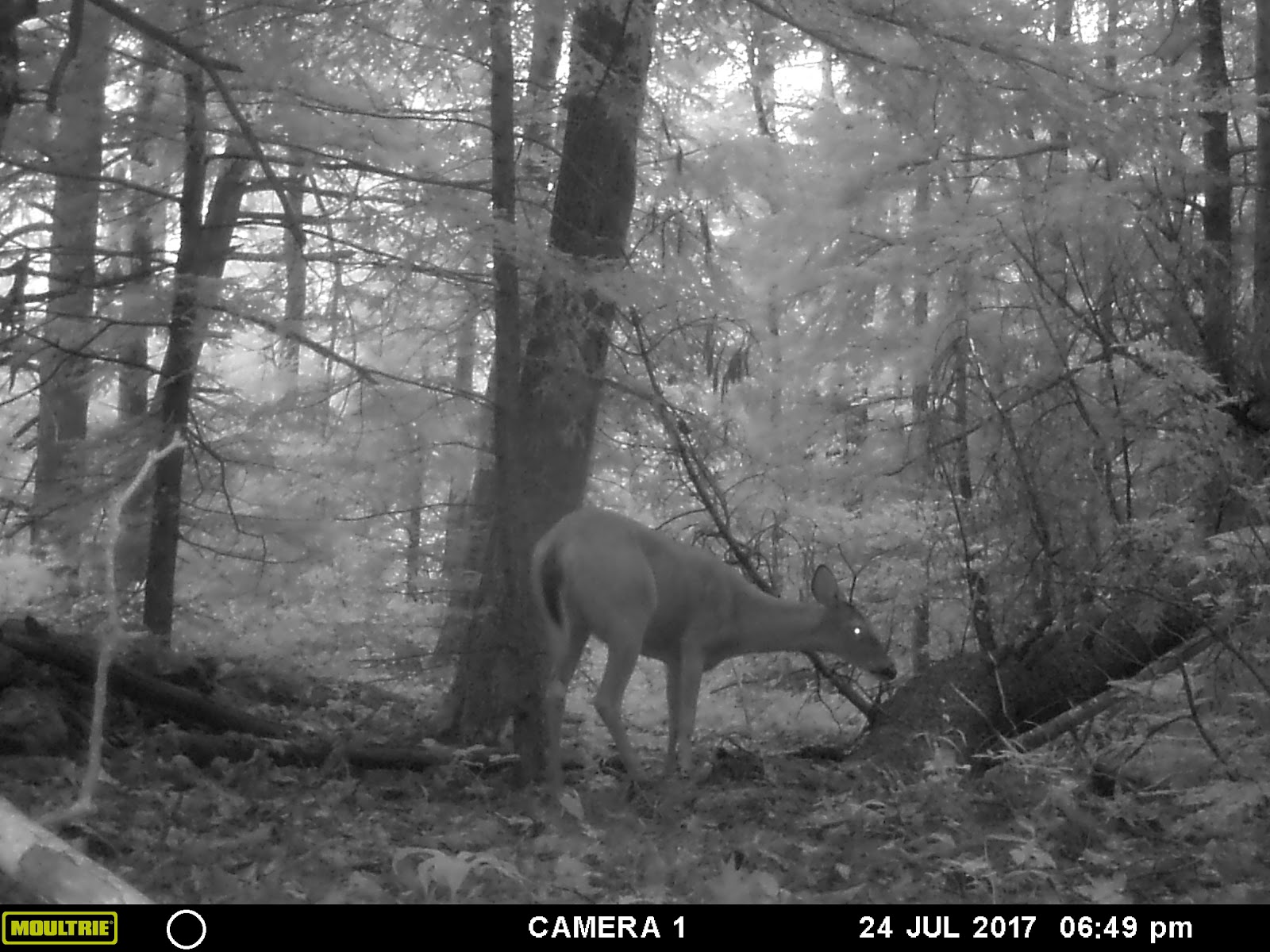
White-Tailed Deer at Old Camp Townshend
White-tailed Deer at Cranberry Pond
White-Tailed Deer at Ice House Marsh
White-tailed Deer at Old Camp Townshend
White-Tailed Deer at Cathedral
White-tailed Deer Buck at Ice House Marsh
Eastern Gray-Squirrel at Cranberry Pond
Raccoon at Ice House Marsh

Birds
Red-bellied Woodpecker at Cranberry Pond
Gray Catbird at Ice House Marsh
Juvenile American Robin at Duck Pond
Common Grackle at Old Camp Townshend 
Gray Catbird at Duck Pond
Flycatcher species at Ice House Marsh
Blue Jay at Cranberry Pond-West
Veery at Ice House Marsh


Summary of Results of the 2011 Warren Breeding Bird Survey Route

American Bittern photo by Sallie Gentry
from www.fws.gov
Black-throated Green Warbler photo by
Jacob Spendelow from www.tringa.org
Veery photo by Darlene Knox
Pileated Woodpecker photo by Leo Kulinski
Gray Catbird photo by Leo Kulinski from
www.whalesandwolves.com
Downy Woodpecker photo from
Cedar Waxwing photo by Bob Stanowski
The U.S. Geological Survey's Breeding Bird Survey of the Warren-to-Northfield route was conducted by Dave Rosgen on Sunday, June 19, 2011. This is an annual event that is always undertaken in June or early July on a day with sunny skies and little or no wind. White Memorial has assisted with this survey and the one that runs from Woodbury to Goshen every year since 1965. I've been doing it since 1998. So, why did I wait until December 8th to post the results on this blog? Simple. Even though I sent the field data sheets to the U.S.G.S. in late September, I haven't had time until now to tally-up all the numbers for our analysis purposes. Nicole Morin was an invaluable assistant with this effort. The photos above illustrate some of the species that highlighted this year's survey. Tops among them was our first-ever American Bittern at Hart Pond Wildlife Management Area in Cornwall. Otherwise, this year's survey produced an average total of 75 species and an above-average total of 2,081 individual birds. More species were found in higher numbers this year than in lower numbers. Since this standardized survey involves spending only 3 minutes at each of 50 stops, it is actually very hard to compare the numbers of birds found from one year to the next due to the variables of weather and other things that affect the detectablity of birds. However, it is interesting to note that almost all of the birds found in higher-than-average or lower-than-average numbers on this survey were also found in similar situations on the Litchfield Hills Summer Bird Count and on White Memorial's Breeding Bird Censuses. Species which were found to be much more numerous this year than last year included Red-bellied, Downy, and Pileated Woodpeckers, Eastern Phoebe, Veery, Wood Thrush, Gray Catbird, Cedar Waxwing, Yellow, Black-throated Green, and Black & White Warblers, Ovenbird, Red-winged Blackbird, and American Goldfinch. Less numerous species included Eastern Kingbird, Red-eyed Vireo, American Crow, Barn Swallow, Black-capped Chickadee, Tufted Titmouse, and Common Yellowthroat. The top 5 most abundant species this year were Veery, Gray Catbird, Cedar Waxwing, Red-eyed Vireo, and American Goldfinch.

Baby Birds Are Hatching Out All Over!

Red-bellied Woodpecker

by Patty Levin from http://www.birds.cornell.edu/


Downy Woodpecker from


Common Grackle by John Borom

from http://www.weeksbay.org/


Baltimore Oriole by Jeff Lewis from


American Crow by Darlene Knox


Despite the absolutely awful weather that has plagued us for the past few days it seems as if baby birds are hatching out all over White Memorial. Some of those birds that hatched in the past 2 or 3 weeks are already fledging. The photos above depict just a few of the many birds that we saw yesterday and Sunday. Pt. Folly was especially productive. Amazingly, 2 of the Baltimore Oriole nests with young were only 25' apart. They were near campsite 3 for anyone interested in seeing them. Also around that site and the observation platform were 4 Common Grackle nests. Two of them had young fledging out when a pair of Cooper's Hawks came winging in. Each hawk grabbed a young grackle before flying off with many angry adult grackles and other birds in hot pursuit. I wish we could have gotten photos of all that action! Grackles around the Museum Area and N. Shore Marsh also have a ton of babies. While not nearly as abundant as some other bird species, Red-bellied and Downy Woodpeckers seem to be having a very good year for producing young. I found active Red-bellied Woodpecker nests around the Museum, behind Ongley Pond, and along N. Shore Rd., and Downy Woodpecker nests along the Lake, Windmill Hill, Butternut Brook, and Cranberry Pond Trails and at the Bantam Lake Outlet. American Crows have been nesting around here since March, and now fledglings are everywhere. I found 3 Fish Crows with their American cousins at Wheeler Hill yesterday. Other less common species that we found feeding fledglings included Blue-winged Warblers at Icehouse Field, Eastern Towhees at Wheeler Hill, Wood Thrushes along the Lake and Butternut Brook Trails, Black-and-White Warblers along N. Shore Rd., and Barred Owls at Wheeler Hill and Pine Island. My next few blog postings will probably cover more breeding bird activity, including results from the Litchfield Hills Summer Bird Count, as this is the season for them. Despite the hoards of mosquitoes this would be an ideal time of year for you to go out and look for those birds while they are busy attending their young.

Results from Saturday's Bird Walk along N. Shore Rd.

Drake Northern Pintail from werc.usgs.gov
Continuing the theme of my recent blog postings about waterfowl surveying at Bantam Lake, this one gives the highlights of our public field trip along N. Shore Rd. this past Saturday, 3/12. The focus was on waterfowl at Bantam Lake and along the Bantam River from the Outlet downstream to the Oxbows. Fortunately for us, N. Shore Rd. affords ample views of these places. Otherwise, we would have had great difficulty accessing Pt. Folly and the Litchfield Town Beach due to serious flooding of those spots. On a positive note, this flooding brought many of the ducks and geese up close to the road as they foraged in the flooded bottomland. Whenever woodlands and shrublands become flooded, waterfowl are quick to exploit the new-found feeding opportunities. Our group of 30 people, including 15 Boy Scouts, were treated to excellent views of a Cackling Goose, 350 Canada Geese, 10 Northern Pintails, 2 Green-winged Teal, 27 American Black Ducks, 70 Mallards, a hybrid American Black Duck x Mallard, 45 Ring-necked Ducks, 2 Buffleheads, 4 Common Goldeneye, 40 Common Mergansers, and 5 Hooded Mergansers. Though 8 Wood Ducks were present, only 6 members of our group got to see them because these birds hid so well among the shrubs. Waterfowl weren't the only birds spotted on this trip. Everyone got to see a Yellow-bellied Sapsucker as it foraged among the trees by the Butternut Brook bridge, a male Eastern Bluebird as it sang from the tops of the trees at the Bantam R. Oxbows, a Red-bellied Woodpecker at Gail Scoville's feeders, and numerous Black-capped Chickadees, Tufted Titmice, White-breasted Nuthatches, and other common birds. In all, we saw 38 species of birds in 2.5 hours along 1.25 miles of road. We also saw a Muskrat, 2 Red Squirrels, and lots of Gray Squirrels. That's pretty good!