Showing posts with label porcupine. Show all posts

Confirming the presence and local distribution of porcupine (Erithizon dorsatum) on the White Memorial Foundation property, Litchfield and Morris, Litchfield County, USA. -- Update I

Peculiar gnawing patterns observed on a salt-treated pine stake,
could be evidence of porcupine but we'll see!
photo by James Fischer

Setting the Scene:  Remote-Triggered Infrared Game Camera image of a salt-treated pine stake
 to serve as an attractant for animals that crave salt during the summer months,
 including porcupine, white-tailed deer, and squirrel species.
photo by James Fischer

A porcupine was observed near Teal Pond July 18, 2011 (Wildlife Monitor blog post).  This observation corresponds with other porcupine evidence observed earlier this year, which is our first observation of this species for the White Memorial Foundation property (Wildlife Monitor blog post).  We have been placing salt-treated pine stakes throughout the vicinity of these observations since late-March.  Marcus Johansson and Amanda Downey helped replace the stakes on July 28 & 29 with fresh stakes, which has occurred approximately monthly.  This insures that the amount of salt on the stakes is fairly consistent from month to month, since the salt can be leached out by precipitation and several different species that are also attracted to salt during the summer.  We observed some peculiar chewing on several of these stakes over the past several months (Wildlife Monitor blog post).  Notably, we observed this same peculiar gnawing pattern on the stake that was closest to the locale of the direct observation of the porcupine (see image).  This same stake has already been chewed on within the past week since it was replaced with a fresh salt-treated stake!  Therefore, we have selected this stake as a site for the use of a remote-triggered infrared game camera (see image).  We'll post any images that are recorded by this game camera, so check back often!

Click on the labels below to review all of our Wildlife Monitor published posts associated with this project. (i.e. porcupine, Five Ponds, etc.)

Porcupine Sighted Near Teal Pond


Kyle Courtney is on our maintenance crew and he observed a porcupine while he was bicycling on the trails around Teal Pond!  Kyle observed the porcupine on June 18, 2011 at approximately 4:15 p.m.  This is the first direct observation of a live porcupine recorded on the property!  This past winter we observed several signs near Teal Pond that indicated a porcupine lived on the property during the winter months.  Connecticut's porcupine population resides in the northwest and northeastern corners.  The White Memorial Foundation property is located on the edge of Connecticut's porcupine geographic range.  We have an ongoing experiment that has placed salt treated wooden stakes at regular intervals throughout the Five Pond region to observe porcupine chew marks on the sticks.  Porcupines have a strong salt drive from April to August and we wanted to use this behavior in our favor so initialized this project to indicate where the porcupine resided on the property this summer.  To date, the salt treated wooden stakes have not yielded clear evidence of a porcupine residing on the property this summer.  Therefore, Kyle's observation is an important one.

When we heard this news, we had to run to see if we could find the animal for ourselves.  Olivia Riccio, Becca Solnit, and I performed several straight line transects through the region looking up into every tree for our porcupine.  Although the weather was quite warm and humid, Becca and Olivia showed some true grit.  After two hours of tromping over logs, rocks, and through swamps, we didn't find our animal.  But we have not given up, yet!

Porcupine Update

Salted Stakes Removed in June

This past winter, we found evidence of a porcupine for the first time on the White Memorial property. In an effort to determine whether this porcupine is still on the premises, Jamie has been conducting an experiment for the past two months. Jamie's experiment relies on the porcupines' high affinity for salt, especially during the summer months. With this in mind, Jamie has placed 16 wooden stakes in a grid around the area where the evidence of the porcupine was found this winter. The stakes have been soaked in a salt-water solution with approximately the same salinity as the ocean in hopes that if Mr. or Mrs. Porcupine is still on the property, he or she, will gnaw on these salty stakes.

On Friday June 17 and Tuesday June 21, Jamie and I went around replacing the salty stakes for the second time since he began this experiment. Using a hand-held GPS and a carefully marked trail map, we trekked through the woods in the five ponds area, checking for possible porcupine chewing as we went. (This may sound easier than it actually was because since the stakes were placed by GPS coordinates, they weren't exactly in the most convenient locations.)


Chewing on Stake 179

As of this point, if the porcupine is still around the property, it has chosen not to chew on our carefully positioned, salty stakes. Most stakes had no evidence of anyone chewing on them. Some, such as stake 179 which is situated off the south-east corner of Beaver pond, showed some evidence of gnawing, but Jamie doesn't believe the marks were left by a porcupine (see above photo). Stake 180 also had some interesting marks on it, though once again, not from our prickly friend. We found two small holes at one corner of this stake (see photo below). Jamie believes that these holes could have been made by a bear's canine tooth, as a bear will sometimes mark his or her territory by biting and wounding trees in addition to other scent-related methods.


Holes on Stake 180
As they say, "third time's a charm," and maybe the porcupine will decide to chew on the third round of salt-soaked wooden stakes we have just finished positioning!

Confirming the presence and local distribution of porcupine (Erithizon dorsatum) on the White Memorial Foundation property, Litchfield and Morris, Litchfield County, USA.

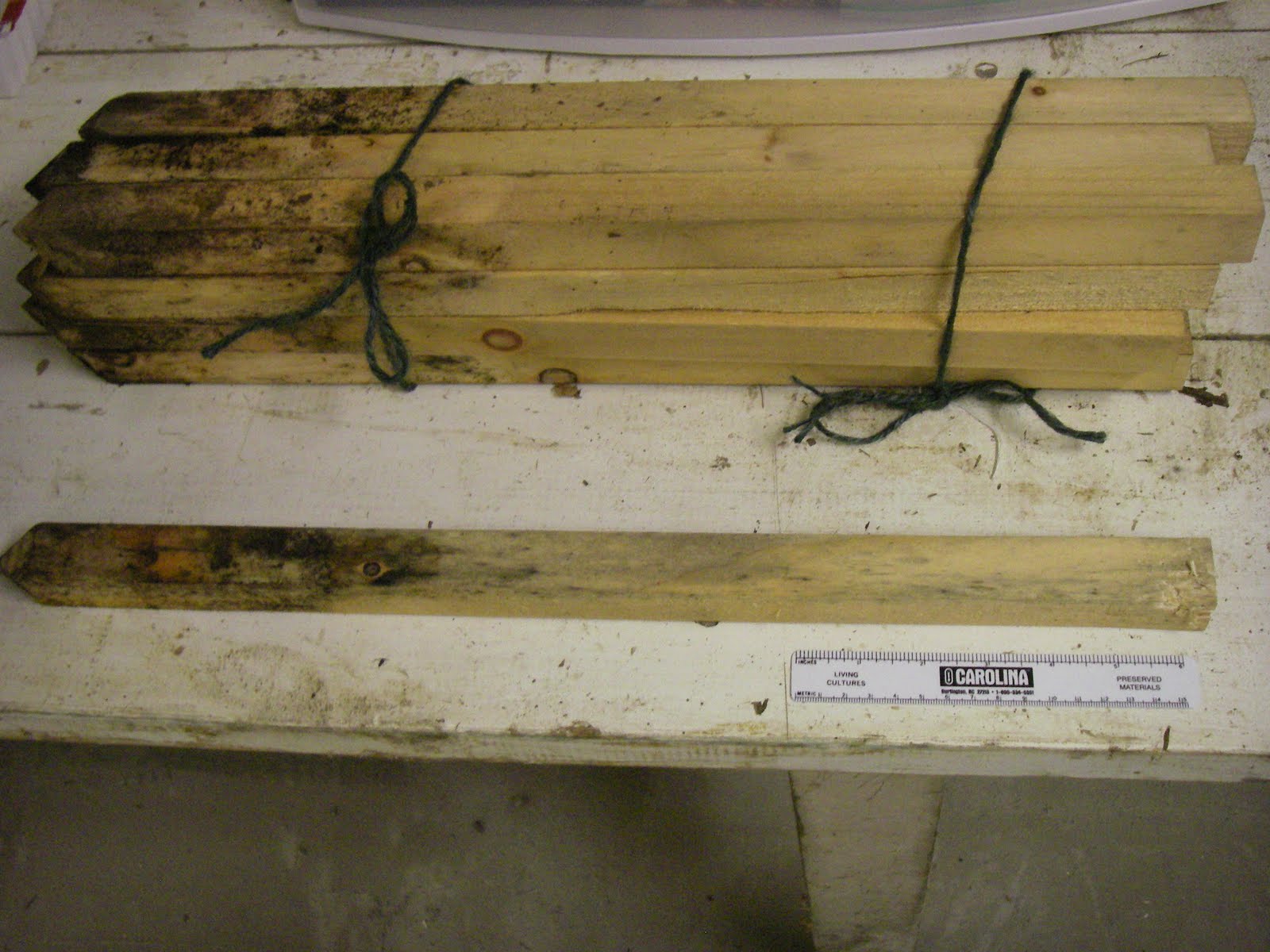
This project is examining if a porcupine that was observed in the Five Pond vicinity this winter still resides in this area.  Porcupines have a limited distribution in Connecticut, inhabiting the Northwest and Northeast corners of the state.  Porcupines have been observed in Litchfield, as well as other towns in close proximity.  So far we have not observed a porcupine residing on the White Memorial Property until this past winter.  Porcupines have a strong salt drive in the spring and early summer months, therefore we want to use this behavior to aid in detecting this species during the summer.  We want to learn where/if this animal is living on the property and what habitat it is using.  We soaked pine 1 inch x 1 inch x 18 inch stakes in a salt water solution equivalent to sea water for 4 days then let them dry.  We placed these stakes in a grid around the winter homerange at 0.25 mile intervals.  I visited the stations today and replaced each with new salt-water soaked stakes.  I observed some chewing on the stakes, but it appears to have been by our squirrel species primarily.  We'll keep checking and replacing the stakes for a couple more months.

Check back here to stay up to date with this project!

Confirming the presence and local distribution of porcupine (Erithizon dorsatum) on the White Memorial Foundation property, Litchfield and Morris, Litchfield County, USA.

We observed our first definitive evidence of porcupines on the property on March 15, 2011.  Lukas Hyder, WMF Asst. Property Superintendant, observed 4 to 5 sugar maple (Acer saccharum) trees that were recently de-barked by chewing animal while performing the forest inventory.  The de-barked regions of the tree boles were approximately 10 to 15 feet above the forest floor; each tree was approximately 6 to 10 inches dbh (Figure 1).  
Figure 1:  Sugar maple tree debarked by porcupine.
Photo By: James Fischer
Trails in snow, claw marks on tree boles, gnawing tooth marks, and nipped twigs of yellow birch (Betula alleghaniensis) (Figure 2) and red maple (Acer rubrum) (Figure 3)  were observed in this vicinity. 

Figure 2:  Yellow birch nipped twigs by porcupine.
Photo By:  James Fischer
Figure 3: Red maple nipped twigs by porcupine.
Photo By James Fischer

To date, all of this evidence was observed in the ravine and valley that extends SSW of Plunge Pool across the Beaver Pond trail and ends at the Teal Pond-south woods road.  We have not yet observed the animal, only the evidence of its activities.

Since this is our first observation of this species on the property, we need to establish if this animal is a resident or using it as a corridor.  Summer home ranges expand greatly from winter home ranges (Roze, 2009).  However, attempting to capture, mark, or track this lone animal will be costly and time consuming.  We would like to attempt a novel approach to detecting the presence and potential local distribution of this animal on the property.  Porcupines have a seasonal salt drive from April to August, which peaks in May (Roze, 2009).  We propose to utilize this behavior to our advantage by placing “salt licks” in the local vicinity of where we made our initial observations.  We are going to distribute salt soaked stakes (1"x1"x20" white pine) throughout the 5 Ponds region and to observe the presence/amount of chewed wood at each station.  If the animal remains on the property then the wood should be chewed by the porcupine.  We'll be replacing the stakes every month to assure that the stations display a relatively constant amount of salt because the rain will leach the salt from the stakes over time.

We are going to need a lot of help with this project, so if you are interested in volunteering to help us.  Please contact James Fischer.


Roze, U. 2009.  The North American Porcupine.  2 ed. Cornell University Press, Ithaca, NY.  pp. 282