Showing posts with label grey squirrel. Show all posts

June 2017

Images recorded at White Memorial Conservation Center Bird Blind, unless stated otherwise on the White Memorial Foundation Property.  Time stamped is Eastern Standard Time, daylight savings time is not used.

Mammals

Black Bear

Two Black Bears
Black Bear scratching back
Chipmunk at Ripley Swamp
White-tailed Deer adult doe at No Man's Land Swamp
White-tailed Deer adult buck with antlers at Solnet Parcel
White-tailed Deer Looking into the camera at Little Pond
White-tailed Deer adult buck with small antlers at Little Pond
White-tailed Deer adult doe and fawn at Bissell Road
White-tailed Deer adult doe and fawn eating tree that camera is on at Bissell Road
Fox species
Eastern Coyote at Solnit Parcel
Virginia Opossum
Raccoon
Raccoon at Bissell Road
Eastern Grey Squirrel at Riley Swamp

Birds

Blue Jay at Ripley Swamp
Blue Jay at Solnet Parcel
Male Northern Cardinal
Female Northern Cardinal and Blue Jay
Mourning Dove
Mourning Dove at Little Pond 
Veery at Ripley Swamp
Wood Thrush at Ripley Swamp


Squirrels Communicating Over the Bridge

Northern Spicebush (Lindera benzoin) branch serving as a bridge for
Eastern Gray Squirrel (Sciurus carolinensis) to cross over a
small spring seep in a Connecticut woodland.
Photo by James Fischer
Jared Franklin and I were surveying the Apple Hill vicinity.  We came upon an interesting observation of Eastern Gray Squirrel that I would like to share with you.  All of us at times observe squirrels navigating through the tree canopies over our heads.  You can observe this behavior in many of our woodlands at White Memorial.  I often see squirrels using the trees canopies a bridges over the wood roads, especially when I am leading a large group of people on walks or when I am walking with a dog.  It appears to me that the squirrels are using the intermingled branches of several individual trees as another thoroughfare through the woods.  What a great way to avoid potential threats while still making their way through the forest.  These canopy through-ways bypass threats from both the ground and to a certain extent the air because there are so many branches that could shield a squirrel from the approach of a aerial predator.  This connectivity has always intrigued me because I wonder if these thoroughfares could be limited to the use of only certain individual squirrels.  Or could there be potential tolls for the use of these thoroughfares?  Similar to the way people pay a fee to use the state government turnpike or through-way road systems.

The evidence that I have had trouble collecting were ways that squirrels could communicate that these bypasses were frequently used by squirrels.  Jared and I observed a sturdy Northern Spicebush branch leaning over a small wet area.  The wet area was sparsely vegetated, which left little cover for a squirrel to use for protection.  What drew our attention to how important this branch was to the local squirrel population was the tell tale bites found in the bark of this branch.

Eastern Gray Squirrel bites marking this branch serving as a bridge.
Photo by James Fischer
Eastern Gray Squirrels wound the bark on branches and tree trunks to serve as a visual cue to other squirrels.  They will also rub areas of their bodies that have chemical scent patches or urinate on the marks so that there is a olfactory stimulus to insure the message gets across.  These squirrels are saying something on this branch and whatever it is they are saying it often!  Notice how some of the wounds look older than the others.

Wow!  I wonder if this how they do it the tree canopies?  Certain individuals may wound and scent mark specific trails that communicates that it is their trail by using their trail-blazes.  Maybe the rest of their social structure could explain who and why certain squirrels use these pathways.  Could social and genetic relatedness explain why some animals use the canopies byways?  Could some canopy trails become legacy resources used by several generations of squirrels?  So many questions...

Flying Squirrels in the Attic

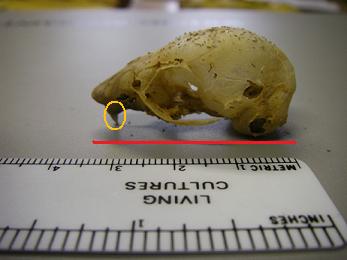
James Harmon, a White Memorial employee, found this Southern Flying Squirrel (Glaucomys volans) skull in the Carriage House attic.  I want to show you some of the features that helped us distinquish this skull from other squirrel species.  It is recommended that you use calipers to record measurements, but in this blog entry rather than emphasizing the measurements I want to clue you into the characters that we like to use in the field.  Further analysis is always best when you compare and contrast several skulls from known species, which are conserved at natural history collections.

The first thing that told us it was rodent was that it had only two front teeth with a large gap, where the canine teeth would have been located, before the rest of the cheek teeth (premolars and molars).  The red line delineates the total length of the skull.  The cheek teeth are rooted and several other subtle characters allowed us to focus on the tree squirrel species that live in this area. 
The yellow circles at the beginning of the cheek teeth delineate the presence of very small premolars, this character distinguishes Red Squirrels (Tamiasciurus hudsonicus) and Gray Squirrel (Sciurus carolinensis) from flying squirrels.  The total length of the skull tells us it is a Southern Flying Squirrel from a Northern Flying Squirrel (Glaucomys sabrinus).

Coyote and Bobcat Encounter at Cat Swamp

~30 degrees F, 0% cloud cover, wind NE 0-5 mph, 0.5 - 1 inch of snow

Elena Sasso accompanied me to look for tracks on the Cat Swamp boardwalk and along the western side of swamp.  We observed the following species' tracks:

bobcat
coyote (at least 2 individuals)
weasel species
red squirrel
grey squirrel
cottontail rabbit species
white-tailed deer

Along the trail on the western side of Cat Swamp we observed an interesting scene. 

We observed a older scat with some fresh urine marks (foreground of the above image), with long paw marks that lead to the scat, and coyote tracks walking away from the scat, but originating at the far end of the paw marks.  I suspect that a coyote encountered this scat in the trail, stopped urinated to leave it's scent, then pawed at the ground by kicking leafs and duff with it hind legs.  After it left its calling card, it then walked away. 

Another interesting encounter occurred when we were at the southern end of Cat Swamp.  We were walking around the edge of the water looking at bobcat tracks and fresh beaver gnawing on Red Maple trees.  We were about to start walking back to the truck when we observed in the distance a bobcat sauntering off into the dense undergrowth.