Showing posts with label Eastern Garter Snake. Show all posts

More Snakes Encountered Under Cover Boards

This summer’s second round of checking snake cover board grids yielded great results. At every grid, except two, James Fischer and I found snakes hiding under the piles of wood trying to escape from the hot and humid weather. We encountered Red-bellied snakes at three of the piles, which were not present last time we removed the boards. All the Red-bellied were small in size (about 7 inches), meaning that they were probably males, likely waiting for the larger females to arrive. We also came across many more Garter snakes, especially at the Ongley Pond site, where there was a total of six counted Garter snakes, one juvenile and five adults. We saw only one Ring-necked snake at the Apple Hill Lower Field, which was where we spotted one two weeks ago. At the two grids where we did not have snakes, Wamogo Field and Laurel Hill; we did find a Red-backed vole and a fairly intact snake skeleton approximately 12 inches long.  

Red-bellied snake
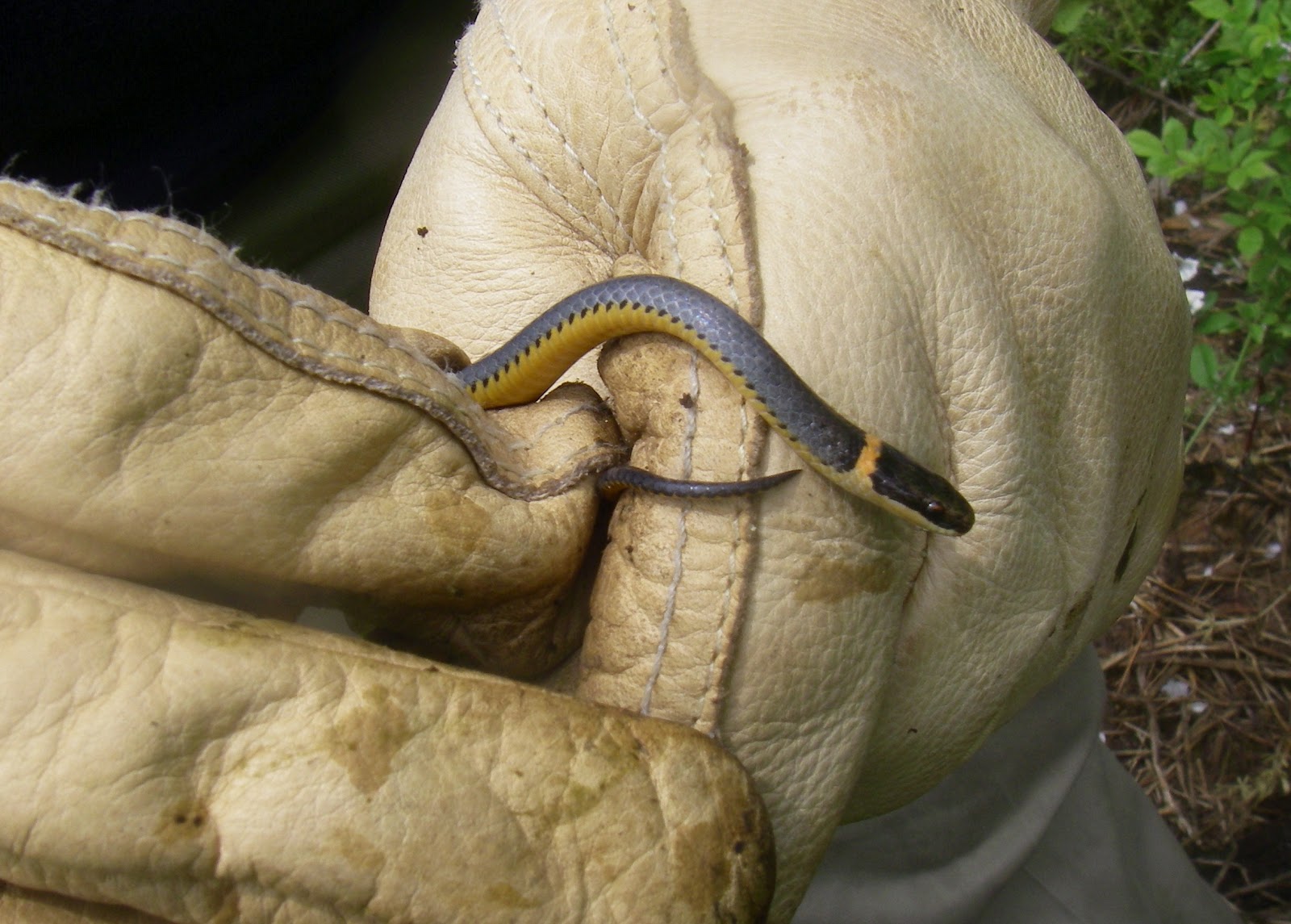
Ring-necked snake


Garter snake

Garter snake


Southern Red-backed vole
After checking all of the cover boards and noticing the dramatic increase in snake encounter rate we wondered if this could be due to the recent hot, humid weather, which would cause the snakes to seek cool coverage under the wood piles. Although it could also be due to the time of day we checked the grids. This time we started at 2:00 pm and received our highest snake numbers at the end of the day, around 5:00 pm. In my last blog about snake cover boards, we had the most snakes in the morning and I hypothesized that changing the time of day when the grids were inspected might reveal different abundances of snakes. Today’s result does develop this hypothesis that perhaps mornings and late afternoons are the best times to check cover boards. Since we will be checking the cover boards many more times this summer, we can further test this question.

Results of Monthly Snake Cover Board Inspection

Currently there are twelve snake cover board sites on White Memorial Conservation Center’s forested land. Over the next couple of weeks we plan on multiplying these cover board sites in order to really discover snake diversity and population status of established species at WMCC. Also, by setting the cover boards in varying habitats, such as at high elevations or sandy fields we can learn more about snake habitat and areas with high snake density.

The cover boards typically consist of about 45 pieces of 3-4 feet long hard or soft wood boards that are layered loosely on top of one another. The stacking of the boards creates a cool, dark, and damp habitat that snakes typically prefer to live in. The wood also attracts many insects, such as earthworms, slugs, and beetles, as well as salamanders that the snakes consume. 
Typical snake cover board pile.
On Thursday May 17th, Jamie Fischer, Jared Franklin, and I went to every pile and gently removed each piece of wood in hopes of finding snakes. The weather could not have been any more perfect, with clear skies, little wind, and temperatures in the upper 60s. Three of the cover board piles were successful and had snake inhabitants. The first cover board pile that we checked at the Apple Hill Lower Field had both an adult common garter snake (Thamnophis s. sirtalis) and an adult ring-necked snake (Diadophis punctatus edwardsii). At the Solnit Parcel we discovered one adult garter snake, one juvenile garter snake (less than 15 inches long), and pieces of an adult garter snake that was likely a leftover meal from a short-tailed shrew (Blarina brevicauda) that we found scurrying in the pile. Finally, the cover board pile at Old Camp Townsend generated one adult garter snake.

Adult common garter snake
Adult ring-necked snake
It is noteworthy that the piles we found snakes at were all checked between 9:30 and 11:30 am, when the air was cooler, in the low 60’s. The next time we check these piles, we thought it would be interesting to reverse the order, and check the piles in the mornings, that were checked this time in the afternoon. If we yield any snakes, then it can be hypothesized that time of day or temperature may affect the encounter rate of snakes. 

Late Season Reptile & Amphibian Activity

Northern Brown Snake photo from
Eastern Garter Snake photo by Dave Rosgen
Painted Turtle photo by Darlene Knox
Wood Frog photo by Ashley Hayes
Northern Spring Peeper photo by Ashley Hayes
Green Frog photo by Ashley Hayes
By the middle of November most reptiles and amphibians are starting to hibernate or brumate (a less deep sleep than hibernation). However, since part of this is temperature driven, and temperatures have fluctuated widely for the past 3 weeks, some of these animals have remained at least partially active. The majority of these have been Northern Spring Peepers, which are commonly heard peeping every fall well into November. Whether they are confused about the season or their peeping failed to get them a mate last spring is unknown. A Wood Frog, which is a species that hibernates under logs and other forest floor debris and emerges real early in the spring, was seen at Little Pond on the 13th. Green Frogs were seen on several occasions, including several hopping across White Hall Rd. by Pike Marsh on some of the recent mild, rainy evenings, and a few at Mallard Marsh. Last Tuesday, 11/15, Nicole Morin and I saw a Redback Salamander under a log along the Interpretive Trail and a Painted Turtle sunning itself at Ongley Pond. Later in the week, Jim Kandefer saw an Eastern Garter Snake along the Little Pond Boardwalk. The nearby Little Pond Trail produced our best herp find this month in the form of a baby Northern Brown Snake on the 12th. With the weather forecasted to continue to fluctuate between mild and chilly for the next 2 weeks, we may continue to see these animals for awhile.