Showing posts with label wood frog. Show all posts

Vernal Pool Season is Right Around the Corner

The best vantage point when assessing a vernal pool is to carefully wade through it.

Wood Frog egg mass are often found in the vernal pools where the sunlight reaches through the forest canopy.

Blue-spotted X Jefferson hybrid Salamanders use vernal pools for breeding habitat.
I was interviewed by John Torsiello TownVibe Litchfield.  You can read his article here

As the snow melts and spring rains blow in, the vernal pools fill with water.  Many wildlife species migrate through the forest in search of mates and safe places to lay their eggs.  Vernal pools provide a predator-free site that lets juveniles to fully develop before the pool dries. 

Amphibian Cover Board Monthly Check - July 2012

Red-backed Salamander with six newly hatched salamanders.
Photo by Erin Caruso 

Today’s monthly check of the amphibian cover board experiment grid revealed forty-six individual salamanders. The amphibians that Nicole Morin and I came across were mostly Red-backed Salamanders, although we did see five Red Eft, one Northern Two-lined Salamander, and one Wood Frog. Twenty-two Red-backed Salamanders were under the softwood cover boards and eighteen were discovered under the hardwood. Two of Red-backed Salamanders under the softwood were found coiled around their young. This was an exciting event to come across because this strengthens our theory that the cover boards provide a favorable habitat for salamander reproduction. In addition, their population growth signifies a healthy forest environment. When it comes to reproduction, Red-backed Salamanders are unique because they lay their eggs on land, while most other amphibians and salamanders such as the Blue-spotted Salamander attach their eggs to underwater twigs or vegetation. These underwater eggs hatch and go through an aquatic larva stage. In contrast, the Red-backed Salamander young go through the larva stage while still in the egg, and when they hatch, look like miniature adults. Since the month of August is usually when most salamanders emerge from their eggs, it will be interesting to return to the cover board experiment grid at the end of next month and see if we can find a higher abundance of baby salamanders.

Lead phase Red-backed Salamander with egg cluster.
Photo by Erin Caruso

Amphibian Cover Board Monthly Check - June 2012

On Tuesday, June 19th James Fischer and I went out to the Solnit Parcel to do the monthly check of the experimental amphibian cover board grid. We were able to encounter 93 salamanders; 45 under the softwood boards and 48 under the hardwood boards. The majority were Red-back salamanders, although we did see 2 Four-toed salamanders, 17 Red Eft, and one wood frog. We noticed that most of the salamanders that we found were located in areas of dense fern stands. These ferns provide lush habitat for amphibians by keeping moisture and leaf mold intact.


Four-toed Salamander (Hemidactylium scutatum)

We were lucky enough to find a female lead phase Red-backed salamander guarding her eggs underneath a hardwood board. This is not a common spectacle to come across because Red-backed salamanders only mate every other year. After laying her eggs the female will coil her body around them and protect the eggs for two months until they hatch. The eggs are laid in a cluster, so they are somewhat difficult to count, but I estimated there to be 30 eggs in the cluster. Once the eggs hatch the baby salamanders look like miniature adults and after two years will reach reproductive maturity.

Red-backed salamander (Plethodon cinereus) with eggs.

Vernal Pool Monitoring Workshop

Wood Frog
Photo by Donna Potwin

I am pleased to announce that the wood frogs are clucking!  Therefore, we need to schedule our Vernal Pool Monitoring Workshop.  The workshop will be Saturday, March 31, 2012 from 12:00 p.m. to 3:00 p.m. in the Mott-Van Winkle Classroom.  Come dressed for the weather and for walking in the water.  Bring your field guides, nets, and smiles!  See you then!

Late Season Reptile & Amphibian Activity

Northern Brown Snake photo from
Eastern Garter Snake photo by Dave Rosgen
Painted Turtle photo by Darlene Knox
Wood Frog photo by Ashley Hayes
Northern Spring Peeper photo by Ashley Hayes
Green Frog photo by Ashley Hayes
By the middle of November most reptiles and amphibians are starting to hibernate or brumate (a less deep sleep than hibernation). However, since part of this is temperature driven, and temperatures have fluctuated widely for the past 3 weeks, some of these animals have remained at least partially active. The majority of these have been Northern Spring Peepers, which are commonly heard peeping every fall well into November. Whether they are confused about the season or their peeping failed to get them a mate last spring is unknown. A Wood Frog, which is a species that hibernates under logs and other forest floor debris and emerges real early in the spring, was seen at Little Pond on the 13th. Green Frogs were seen on several occasions, including several hopping across White Hall Rd. by Pike Marsh on some of the recent mild, rainy evenings, and a few at Mallard Marsh. Last Tuesday, 11/15, Nicole Morin and I saw a Redback Salamander under a log along the Interpretive Trail and a Painted Turtle sunning itself at Ongley Pond. Later in the week, Jim Kandefer saw an Eastern Garter Snake along the Little Pond Boardwalk. The nearby Little Pond Trail produced our best herp find this month in the form of a baby Northern Brown Snake on the 12th. With the weather forecasted to continue to fluctuate between mild and chilly for the next 2 weeks, we may continue to see these animals for awhile.

Stream Salamander Survey, Van Winkle Rd., 9/13/11

Northern Dusky Salamander

photo from www.uga.edu

Northern Two-lined Salamander


Green Frog juvenile photo by Dave Rosgen


On Tuesday afternoon, 9/13/11, I surveyed the brooks that run between E. Shore Rd. and Van Winkle Rd. in Morris for salamanders and other amphibians. In most years these streams can be classified as seasonal since they largely dry-up during the months of July and August. Not this year! Even though dry conditions for awhile in July and early August reduced water flows in these streams to a trickle, they still held enough water to support amphibians and aquatic macroinvertebrates. The double whammy of Tropical Storms Irene and Lee in the past 2 weeks sent torrents of water down these streams. The embankments were scoured-out in several places and at least 25 trees were undermined to the point of falling across or along the stream channels. On 9/13 these streams continued to hold and flow a decent amount of water. Walking along them proved to be difficult, or even impossible, in a few places due to the downed trees and shrubs. Despite this, I was able to survey quite a good amount of habitat between the 2 roads. The smaller feeder streams didn't host any amphibians except Green Frogs, but the main stream really produced. I found 21 Northern Dusky Salamanders, 1 Northern Two-lined Salamander, 31 Green Frogs, 2 Wood Frogs, 2 Gray Treefrogs, and 1 Northern Spring Peeper in the 1/4 mile between the 2 roads. I only found Green Frogs in the short section of this stream between Van Winkle Rd. and Bantam Lake. Of the Dusky Salamanders, 19 were adults and 2 were juveniles. I didn't see any larvae. The N. Two-lined Salamander was an adult. All of the frogs were juveniles. It is also worthwhile to note that the water was crystal clear and quite cool. Sediment loads appeared to be less than had been present in previous visits this year and in the past 5 years. That boads well for amphibians.

Amphibian Cover-board Experiment -- Monthly Check

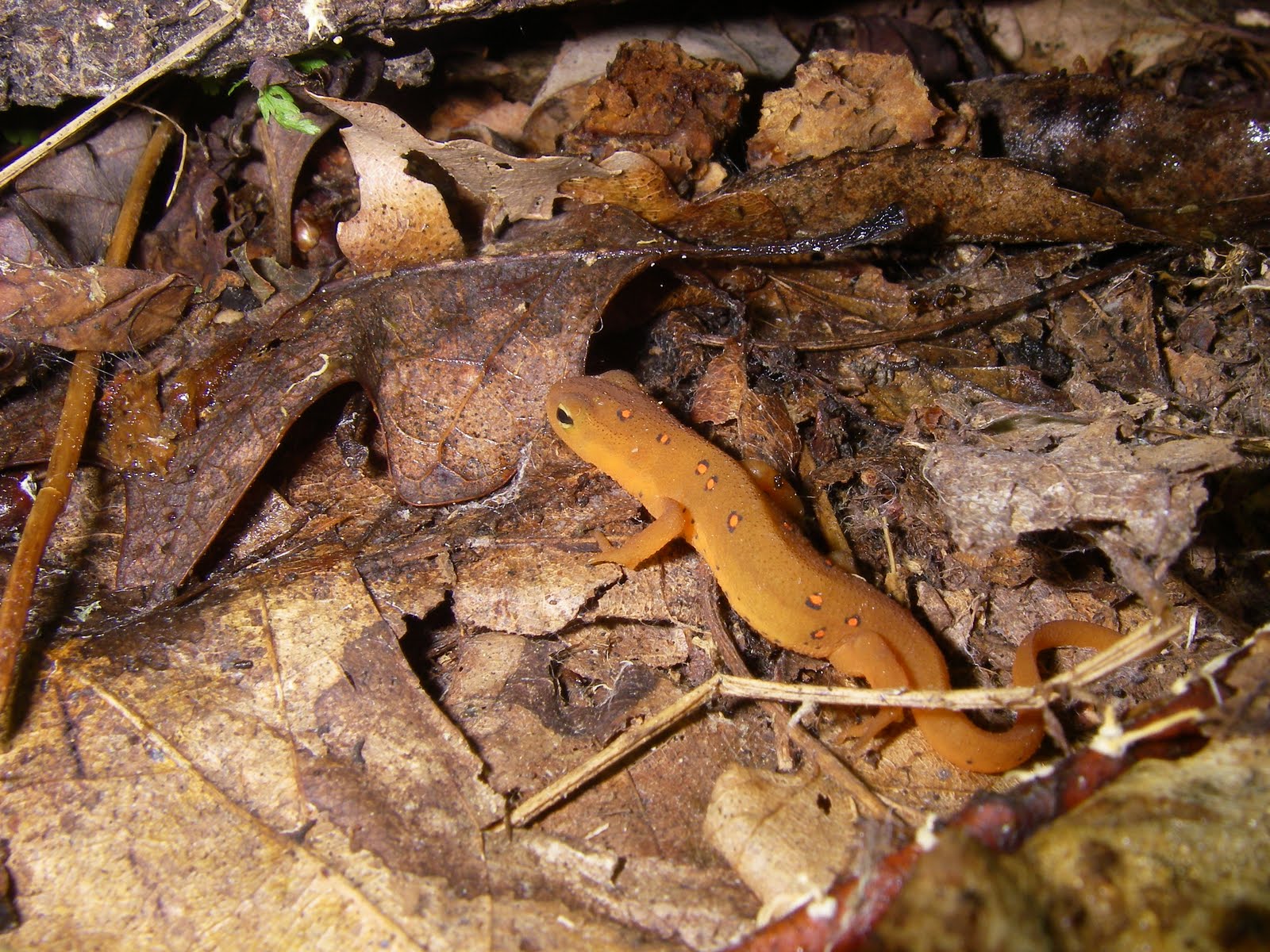
Red Eft Life Stage of the Red-spotted Newt
photo by James Fischer
We revisited the cover-board experiment grid and observed a few interesting patterns.  Faye Curran, a new student intern, helped us today with this project, please visit the blog in a couple days to read her introduction.  Recently, we have recorded almost 14 inches of rain from Hurricane/Tropical Storm Irene and Tropical Storm Lee.  Although most of the surface run-off has slowed, there is still quite a bit of water in the forest percolating into the soil column from vernal pools or bubbling out of springs.  The amphibian cover-boards encounter rate appears to have been affected by all of this precipitation.  A total of 65 of the 132 cover-board stations detected an amphibian, which is the second highest percentage of cover-board stations detecting amphibians since the project started 2.5 years ago.  We encountered a total of 79 Redback Salamander (Plethodon cinereus), 19 Red Eft (Notophthalmus viridescens), 2 Two-lined Salamander (Eurycea bislineata), 1 Four-toed Salamander (Hemidactylium scutatum), and 1 Wood Frog (Rana sylvatica).  The primary question of this project is to examine the differences between softwood and hardwood cover-boards amphibian detection rates using a pair-wise comparison experiment.  The softwood cover-boards detected a total of 57, while the hardwood boards detected 45 individuals.

Frogs Galore at White Memorial!

Northern Spring Peeper photograped by

Ashley Hayes at White Memorial's Museum Area

Wood Frog photographed by Ashley Hayes

at White Memorial's Mott-Van Winkle Area

Green Frog photographed by Dave Rosgen

at White Memorial's Duck Pond

Bullfrog photographed by Dave Rosgen

at White Memorial's Duck Pond


Northern Leopard Frog photographed by

Dave Rosgen in White Memorial's Ongley Field


Frogs are thriving at White Memorial, thanks in part to the massive amounts of rain that have fallen here this year. In many years frogs and other amphibians that breed in vernal pools face a race against the clock to grow-up, metamorphose into their adult form, and exit the pool before it dries up. Not this year! Ample amounts of rain kept water in vernal pools and other wetlands long enough for these animals to go through this process with time to spare. Even though there wasn't much rainfall in July, our wetlands retained a decent amount of water. Frogs, and especially juvenile ones, have found that the upper reaches of floodwaters are an ideal place to hang out, wait for invertebrate animal food to come close enough to be caught, and escape into the safety of the water if predators come after them. On several occasions since Tropical Storm Irene passed through this area I've gone out to look for amphibians, storm-blown birds, and other creatures. That includes trying to get reasonably accurate counts of frogs. I found that walking the upper reaches of the floodwaters was the ideal place to find these animals, whether it was in woods, fields, or wetlands. Frogs were in all of these places. On Tuesday, 8/30/11, I went around our Lake, Windmill Hill, Ongley Pond, and Mill Field Trails, following the border of the floodwaters. I counted a total of 225 Green Frogs, 16 Northern Leopard Frogs, 10 Wood Frogs, 10 Northern Spring Peepers, 2 Gray Treefrogs, 1 Pickerel Frog, and 1 American Toad. Surprisingly, I didn't see any Bullfrogs. I also saw a 3/4" wide Eastern Garter Snake attempting to swallow a 2" wide Green Frog, a fair-sized Northern Water Snake heading towards a group of Green Frogs, and 10 Painted Turtles foraging in the shallow water. Three Belted Kingfishers at the intersection of Lake and Windmill Hill Trails were undoubtedly looking for easy pickings in the shallow water. They will eat frogs just as readily as they'll eat fish. However, I also saw small fish in the water, so the kingfishers may have been after these, too. On Friday, 9/2/11, I checked the Mill Field and Interpretive Trails and counted 43 Green Frogs, 6 Bullfrogs, 5 Northern Leopard Frogs, and 2 Pickerel Frogs. Some of these were caught by student volunteer Nicole Morin and swabbed for Chytrid fungus as part of another one of our on-going research projects. The following day, student volunteer Marcus Johansson helped me lead a walk for 16 members of the public with the focus being on amphibians and reptiles. We visited Ongley Field and Pond and the Mill Field and Interpretive Trails, checking all of the flooded areas. We counted 150 Green Frogs, 12 Northern Leopard Frogs, 5 Northern Spring Peepers, 3 Wood Frogs, 3 Bullfrogs, 2 Pickerel Frogs, and 1 American Toad. Marcus caught 3 of them for swabbing. This was very educational for the attendees. A quick check of Pine Grove 2 after our latest flooding event today (at least 4" of rain fell yesterday and last night) revealed 75 Green Frogs around pools of water.


Amphibian Cover-Board Experiment Monthly Check -- June 2011

We checked our cover-board experiment comparing soft and hard wood types in a pair-wise comparison yesterday.  Olivia Riccio and Rebecca Solnit (granddaughter of the owners who donated the land that hosts this experiment) were cowhands by checking most of the boards and calling out the species identification as we progressed through the grid.  We observed 69 redback salamanders, 4 red efts, 1 spotted salamander, and 1 wood frog under the boards.  A total of 55 out of 132 stations detected an amphibian.

Spotted Salamander photo by James Fischer

Redback Salamander photo by James Fischer

Lead phase Redback Salamander photo by James Fischer

Red eft life stage of Red-spotted Newt photo by James Fischer

Adult Wood Frog photo by James Fischer

Frog and Toad Call Study Guide

We are surveying frogs and toads at White Memorial by call recognition.  This is a study guide for volunteers to become more familiar with the calls of the frogs and toads that we are searching for on the property.  If you are interested in volunteering to help our survey efforts please contact White Memorial for more information (860-567-0857).

How to use this study guide:  
Play each video and observe the animal vocalizing their call.  You can play more one video at the same time to hear each call in close proximity.  This could be useful for vocalizations that have similar qualities such as the American toad and Fowler's toad.  You can also hear in several of these videos the songs of other  species other than the focal species.  Can you identify the calls in the background?  Feel free to make a tape of the calls in the field at your survey points and compare them to the calls on this study guide.  Frogs and toads will have regional dialects to their vocalizations, just like songbirds.  Can you identify any of these variations?  

American toad

Fowler's toad


Bull frog

Northern leopard frog

Pickerel frog

Green frog

Spring peeper

Wood frog

Gray treefrog


2011 White Memorial Foundation Property-Wide Frog Call Survey Workshop


Saturday, March 19, 2011
5:00 p.m. to 8:00 p.m. 
A. B. Ceder Classroom

Wood frog Photo By Donna Potwin

We are continuing our property wide survey for frogs and toads by identifying their calls.  Laura Saucier, CT DEP, Wildlife Technician, will facilitate our workshop.  We will be discussing the importance of monitoring these species and their natural history.  Please dress for the weather and wear sturdy footwear because there will be activity in the field.  This program will be a rain or shine event.