 |
| Cerceris fumipennis with Emerald Ash Borer Photo by Phillip Careless www.cerceris.info |

Showing posts with label Olivia Riccio. Show all posts
Showing posts with label Olivia Riccio. Show all posts
Cerceris Wasp Biosurveillance of Emerald Ash Borer -- 2011 Initial Results

Chytrid Fungus Update!
 |
| Photo By: Olivia Riccio Green Frog |
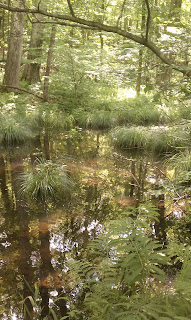 |
| Photo By: Olivia Riccio Near Ongley Pond |
 |
| Photo By: Olivia Riccio Swabbing a Smaller Green Frog |
 |
| Photo By: Olivia Riccio Swabbing the Stomach of a Green Frog |
 |
| Photo By : Olivia Riccio Releasing the Green Frog |
 |
| Photo By: Olivia Riccio Frog Prints |
 |
| Photo By: Olivia Riccio Bever Tracks |
For the past couple of weeks, the weather has been perfect for catching and sampling frogs; sunny, clear, and warm. However, catching them as always is the difficult part. I have seen anywhere from 30 to 40 green frogs at Ongley pond, Pike marsh, and Duck pond. But as of right now I have only caught and swabbed 16 of them (see above along with the swabbing technique)! I have learned along with my fellow volunteer, Rebecca Solnit, that frogs ( of any kind) have a tendency to speed up as the weather gets warmer (go figure, just as I get slower)! On June 30, with the help of the head research biologist, James Fischer, I had the pleasure of sampling a different (less jumpy) amphibian, the salamander. We uncovered and sampled 12 amphibian cover boards located at duck pond. We found and swabbed 8 red phase salamanders, 2 lead phase salamanders, and 1 red eft salamander. I learned very quickly that these slimy creatures are hard to hold and swab, due to the fact that if a salamander is held by the tail to tightly, the tail will actually fall off and eventually re-grow (I was not going to be part of that)! Even after catching 3 frogs and 11 salamanders, the day continued to have even more surprises. On our way back to white memorial, we found frog tracks and beaver tracks (see above) imprinted in mud. Overall, the question is chytrid fungus present in Connecticut is still being explored, but we hope that our continuous amphibian sampling will help answer this intriguing question.
Is Chytrid Fungus Present In Connecticut?
 |
| Photo By: Olivia Riccio On the way to Ongley Pond, A Female Painted Turtle |
 |
| Photo By: Olivia Riccio Tadpole Sampled for Chytrid Fungus |
 |
| Photo By: Olivia Riccio Green Frog |
 |
| Photo By: Olivia Riccio How to Hold A Green Frog for Swabbing |
 |
| Photo By: Olivia Riccio Catching a Leopard Frog |
 |
| Photo By: Olivia Riccio Identifying a Leopard Frog |
Recently Batrachonchytrium dendrobatidis or chytrid fungus was found worldwide causing stress and even death to various amphibians, in particular frogs. Chytrid fungus is an invasive fungus that is quickly spreading towards the Northeast section of the United States. At White Memorial we are testing for the presence of chytrid fungus on frogs and salamanders at Ongley Pond, Mallard Marsh, and Duck Pond. We hope that we will find an answer to why chytrid fungus affects frogs and specifically why chytrid fungus kills amphibians in other parts of the United States but seems at this time to only cause stress to these northeastern inhabitants?
Tuesday, June 21, I had the pleasure to sample Ongley Pond on White Memorial for green frogs, leopard frogs, or really any frogs I could find! The weather was perfect for catching frogs; it was a clear, sunny 85 degree day. The procedure used to sample is non-destructive to these amphibians. Once the frog is caught by a net, the frog is held by their legs (the legs are the strongest part of their body and are usually used to escape!) and then the smooth side of the toothpick is rubbed on the frog's stomach, back, and the inside and outside of the legs (where the majority of the chytrid fungus is found). The toothpick is then soaked in a vial of ethanol and labeled. Each frog sampled is then described with any additional information needed in my field notebook. So far, I have sampled 6 frogs (it is hard to catch frogs especially with mosquitoes flying around your head!). 5 out of the 6 sampled were green frogs. One leopard frog (less common than the green frog) was sampled along with a tadpole (See Above). Hopefully, these samples will lead to some answers when they are sent to Yale University to be tested in the lab by Kathryn Richards-Hrdlicka , head of this research project. But, don't worry more frog sampling is on the way (if this rain ever stops)!
Amphibian Cover-Board Experiment Monthly Check -- June 2011
We checked our cover-board experiment comparing soft and hard wood types in a pair-wise comparison yesterday. Olivia Riccio and Rebecca Solnit (granddaughter of the owners who donated the land that hosts this experiment) were cowhands by checking most of the boards and calling out the species identification as we progressed through the grid. We observed 69 redback salamanders, 4 red efts, 1 spotted salamander, and 1 wood frog under the boards. A total of 55 out of 132 stations detected an amphibian.
 |
| Spotted Salamander photo by James Fischer |
 |
| Redback Salamander photo by James Fischer |
 |
| Lead phase Redback Salamander photo by James Fischer |
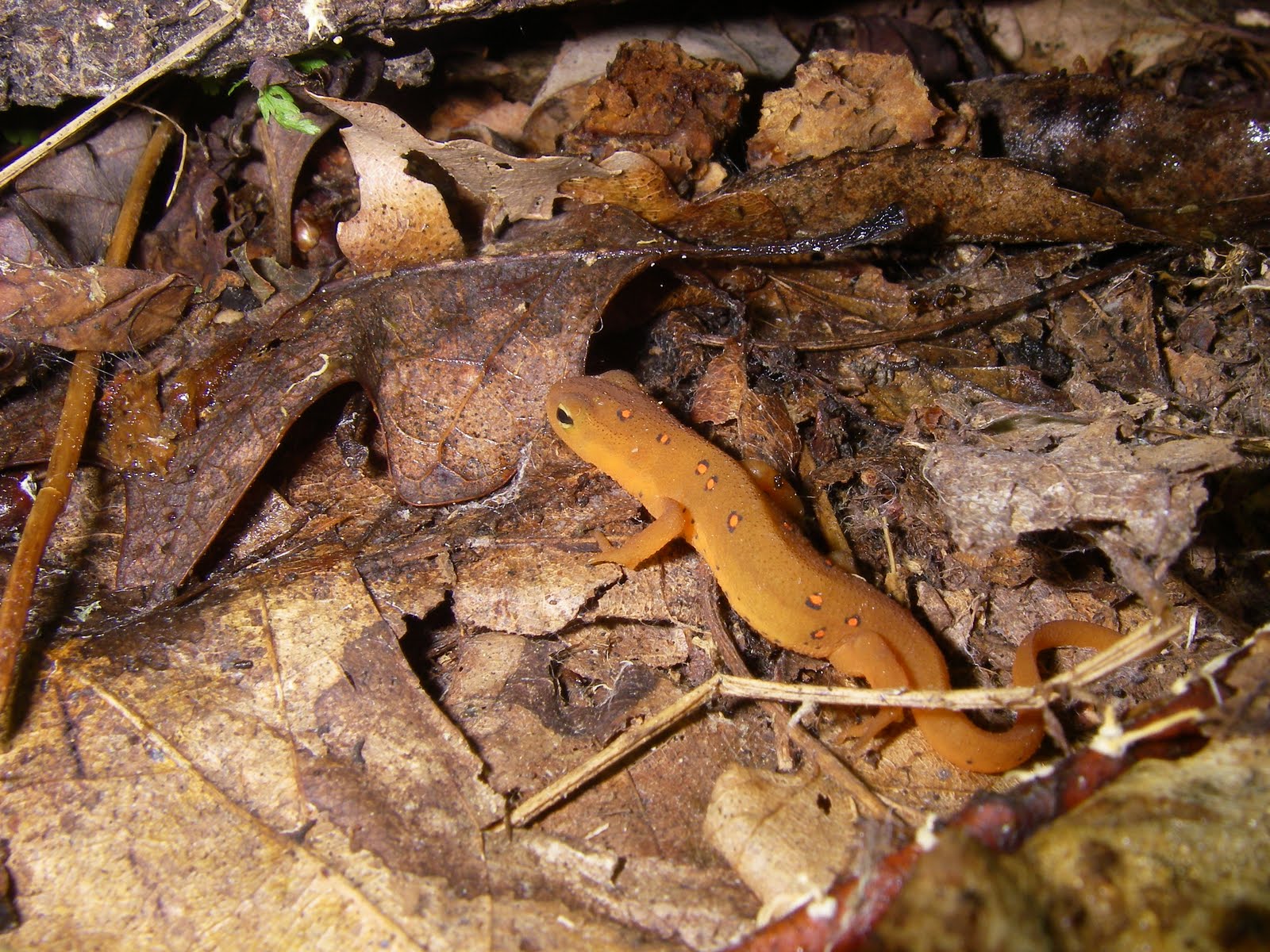 |
| Red eft life stage of Red-spotted Newt photo by James Fischer |
 |
| Adult Wood Frog photo by James Fischer |
Welcome Our New Intern, Olivia Riccio!
 |
| Olivia Riccio, Junior Bachelor of Science Biology Candidate at Saint Joseph College, West Hartford, CT |
Subscribe to:
Posts (Atom)