 |
| A possible case of scoliosis was observed in this red-backed salamander (Plethodon cinereus). The dimensions of the cells on our data sheet are 10 mm x 17 mm. The defomity I am pointing out is the curviture along the body length. There is a Eastern hemlock (Tsuga canadensis) needle stuck to the tail. |

Showing posts with label Red Eft. Show all posts
Showing posts with label Red Eft. Show all posts
Amphibian Cover Board Monitoring Detects Possible Case of Scoliosis in Red-backed Salamander

Amphibian Cover Board Experiment Monthly Check -- September 2012
Amphibian cover boards were checked Friday, September 7th
and revealed some great finds. First off, there were a total of twenty-nine Red-backed
Salamanders and seven Red Efts found underneath the cover boards. Also
uncovered was one Spotted Salamander. Spotted Salamanders do not usually reside
under the cover boards but are often found near vernal pools and in crevices of
rock walls and tunnels. Most importantly, there were two Blue-spotted x
Jefferson Salamanders at two different sites. Based on the small size of these
two salamanders, we assumed that they had just metamorphosed into the terrestrial
adult stage, which takes place by September.
The conditions for checking cover boards Friday were ideal due to the heavy rain at the beginning of the week. The warm, humid weather, also contributed in creating moist soil conditions that are favorable for amphibians. Since fall is around the corner we can expect drier, cooler conditions, but we can still anticipate to see some salamanders under the cover boards. During the winter months when temperatures reach close to freezing, (32-41° F) salamanders will go into hibernation on land and burrow under logs, rocks, and loose soil in order to maintain a stable body temperature. During this time the salamander’s metabolism is greatly reduced, thus decreasing the amount of calories burned to successfully make it through the winter. By early spring, rain and warmer temperatures wake the salamanders just in time for the breeding season.
 |
| Blue-spotted x Jefferson hybrid Salamander |
The conditions for checking cover boards Friday were ideal due to the heavy rain at the beginning of the week. The warm, humid weather, also contributed in creating moist soil conditions that are favorable for amphibians. Since fall is around the corner we can expect drier, cooler conditions, but we can still anticipate to see some salamanders under the cover boards. During the winter months when temperatures reach close to freezing, (32-41° F) salamanders will go into hibernation on land and burrow under logs, rocks, and loose soil in order to maintain a stable body temperature. During this time the salamander’s metabolism is greatly reduced, thus decreasing the amount of calories burned to successfully make it through the winter. By early spring, rain and warmer temperatures wake the salamanders just in time for the breeding season.
 |
| Spotted Salamander |
 |
| Juvenile Red-backed Salamander |
Amphibian Cover Board Monthly Check - July 2012
 |
| Red-backed Salamander with six newly hatched salamanders. Photo by Erin Caruso |
Today’s monthly check of the amphibian cover board experiment grid revealed forty-six individual salamanders. The amphibians that Nicole Morin and I came across were mostly Red-backed Salamanders, although we did see five Red Eft, one Northern Two-lined Salamander, and one Wood Frog. Twenty-two Red-backed Salamanders were under the softwood cover boards and eighteen were discovered under the hardwood. Two of Red-backed Salamanders under the softwood were found coiled around their young. This was an exciting event to come across because this strengthens our theory that the cover boards provide a favorable habitat for salamander reproduction. In addition, their population growth signifies a healthy forest environment. When it comes to reproduction, Red-backed Salamanders are unique because they lay their eggs on land, while most other amphibians and salamanders such as the Blue-spotted Salamander attach their eggs to underwater twigs or vegetation. These underwater eggs hatch and go through an aquatic larva stage. In contrast, the Red-backed Salamander young go through the larva stage while still in the egg, and when they hatch, look like miniature adults. Since the month of August is usually when most salamanders emerge from their eggs, it will be interesting to return to the cover board experiment grid at the end of next month and see if we can find a higher abundance of baby salamanders.
 |
| Lead phase Red-backed Salamander with egg cluster. Photo by Erin Caruso |
The Effects of Dry Weather & Salamanders
 |
| Red-backed Salamander |
Yesterday’s amphibian cover board check yielded a relatively small encounter rate of salamanders. A total of 23 Red-backed Salamanders were seen at fifteen cover board grids. Only one Red Eft was spotted as well as one White-footed Mouse. The low encounter rate could be due to the recent dry weather we have been having across the state. Although I checked the cover boards after yesterday morning’s heavy rain shower, the forest floor still seemed to be dry and what was once moving streams and filled vernal pools were now reduced to only mud. Moisture is necessary for the survival of many salamanders, especially the Red-backed Salamander which is born without lungs forcing it to breathe through its skin. Therefore the exchange of oxygen and waste gases through the skin demands a moist environment. The drought in Texas can be used as an example of how a long period of dry weather can diminish salamander populations. The already endangered Texas Blind Salamander population has dwindled due to the drought and was captured by the U.S. Fish & Wildlife Service to bring to a hatchery for a chance at preservation. As the summer progresses we hope to find a greater amount and diversity of amphibians underneath our cover boards. Whether or not this can be achieved can depend greatly on the amount of precipitation we receive.
 |
| A dry stream near Duck Pond. |
Amphibian Cover Boards Yield Blue-spotted x Jefferson Salamanders
Blue-spotted x Jefferson hybrid Salamanders
were encountered today while checking amphibian cover board grids. A total of
fifteen grids yielded 2 Blue-spotted x Jefferson hybrids Salamanders, 11 Red-backed
Salamanders, and 12 Red-spotted Newts (eft stage). The Blue-spotted hybrid
Salamander is always an exciting amphibian to come across due to its endangered
species status in Connecticut. The cover boards are used as a method to monitor
their population at White Memorial.
Seven newly constructed cover board grids
were checked today for the first time. Only three of the grids had salamanders
underneath them, indicating that the grids without any salamanders were either
not placed in appropriate amphibian habitat or the boards have not been there
long enough to attract any salamanders. The recent hot weather also seemed to
dry out the leaf litter under many cover boards, which is not favorable
conditions for the moisture-loving salamanders. As the summer progresses I will
be interested to see what other kinds of amphibians we find under cover boards
and if the Blue-spotted x Jefferson hybrid Salamanders will become more
prevalent.
 |
| Blue-spotted x Jefferson hybrid Salamander |
 |
| Red-spotted Newt |
 |
| Red-backed Salamander |
Amphibian Cover Board Monthly Check - June 2012
On Tuesday, June 19th James Fischer and I went out to the Solnit Parcel to do
the monthly check of the experimental amphibian cover board grid. We were able
to encounter 93 salamanders; 45 under the softwood boards and 48 under the
hardwood boards. The majority were Red-back salamanders, although we did see 2
Four-toed salamanders, 17 Red Eft, and one wood frog. We noticed that most of
the salamanders that we found were located in areas of dense fern stands. These
ferns provide lush habitat for amphibians by keeping moisture and leaf mold intact.
 |
| Four-toed Salamander (Hemidactylium scutatum) |
We were lucky enough to find a female lead phase
Red-backed salamander guarding her eggs underneath a hardwood board. This is
not a common spectacle to come across because Red-backed salamanders only mate
every other year. After laying her eggs the female will coil her body around them
and protect the eggs for two months until they hatch. The eggs are laid in a
cluster, so they are somewhat difficult to count, but I estimated there to be
30 eggs in the cluster. Once the eggs hatch the baby salamanders look like miniature
adults and after two years will reach reproductive maturity.
 |
| Red-backed salamander (Plethodon cinereus) with eggs. |
Amphibian Coverboard Experiment Monthly Check -- October 2011
 |
| Spotted Salamander (Ambystoma maculatum) discovered under a cover-board just as it emerged from it's mole-like tunnel. Photo by James Fischer |
 |
| A yellow-hued Spring Peeper (Pseudacris crucifer) camouflaged among newly fallen autumn leaves. Photo by James Fischer |
Just as I was beginning to get frustrated with having to pull out my sunglasses from my pocket each time I entered into the deciduous stand, the light hit my eyes and my skin began to feel warm! Yes, it was noteworthy moment but not the kind you may be thinking of. I began to think that the amount of sunlight penetrating the forest floor could have been one factor causing this pattern. It is now autumn in southern New England and many of the leaves have already fallen from the deciduous trees allowing more of the sunlight to reach the forest floor. The CB's under the deciduous trees should be warmer than their evergreen counterparts, which explains why so many amphibians were observed under these boards. But lets not rush to this conclusion too quickly! There could be several other explanations. I'll offer another possible process just to demonstrate how complex a walk in the woods can sometimes be to biologists and ecologists.
 |
| Northern Two-lined Salamander (Eurycea bislineata) found under a cover-board near a spring seep. Photo by James Fischer |
Who knew flipping cover-boards and a walk in the woods could be so complex...
Amphibian Cover-board Experiment -- Monthly Check
 |
| Red Eft Life Stage of the Red-spotted Newt photo by James Fischer |
Salamander Cover Boards
 Red-backed Salamander photographed by
Dave Rosgen at WMF's Duck Pond Trail
On Tuesday, 8/23/11, I checked all 174 salamander cover boards at White Memorial's Ongley Pond, Lake, Windmill Hill, Butternut Brook, Interpretive, Duck Pond, and Pine Island Trails, Mott-Van Winkle Area, and the east slope of Windmill Hill. The results were rather disappointing: 50 Red-backed Salamanders, 7 Red Eft-stage Red-spotted Newts, and 2 Northern Spring Peepers. This is despite wet conditions which would seem to favor amphibians. However, I did find huge numbers of earthworms; many of them being of nightcrawler size. Some concern has been expressed by herpetologists about the growing numbers of earthworms (most of which are non-native species) and their possibly ill effects on salamanders. I found at least 500 earthworms under our salamander boards. Five days after this survey, Tropical Storm Irene hit, dumping 8 inches of rain on this part of Litchfield, and flooding most of our salamander boards. Yesterday I found 21 of the 25 boards at the Interpretive Trail floating in the Pike Marsh's flooded backwater. Two boards were missing, and the 2 remaining boards on land harbored 4 Red-backed Salamanders. Of the 20 boards at Mott-Van Winkle, 6 were missing. The remaining 14 boards harbored 3 Red-backs. I'm heading out now to check on the fate of the rest of the cover boards.
Amphibian Cover-Board Experiment Monthly Check -- July 2011
 |
| Wall Flower A Grey Treefrog trying to blend into exterior of White Memorial's Green Barn. photo by James Fischer |
Amphibian Cover-Board Experiment Monthly Check -- June 2011
We checked our cover-board experiment comparing soft and hard wood types in a pair-wise comparison yesterday. Olivia Riccio and Rebecca Solnit (granddaughter of the owners who donated the land that hosts this experiment) were cowhands by checking most of the boards and calling out the species identification as we progressed through the grid. We observed 69 redback salamanders, 4 red efts, 1 spotted salamander, and 1 wood frog under the boards. A total of 55 out of 132 stations detected an amphibian.
 |
| Spotted Salamander photo by James Fischer |
 |
| Redback Salamander photo by James Fischer |
 |
| Lead phase Redback Salamander photo by James Fischer |
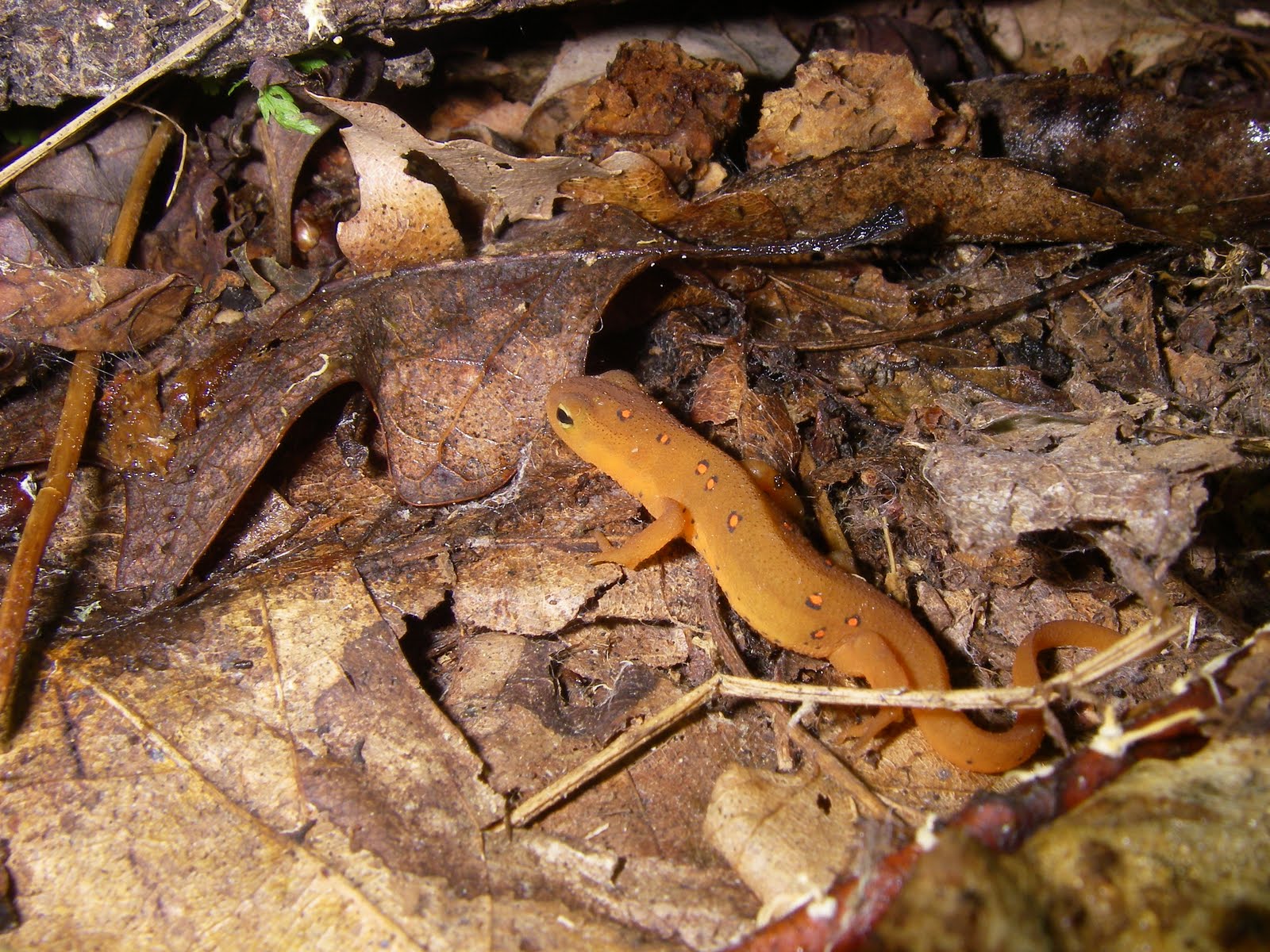 |
| Red eft life stage of Red-spotted Newt photo by James Fischer |
 |
| Adult Wood Frog photo by James Fischer |
Amphibian Cover-Board Experiment Monthly Check
 |
| Redback Salamander (Plethodon cinereus) observed under a cover-board. |
Subscribe to:
Posts (Atom)