Showing posts with label Duck Pond. Show all posts

The Effects of Dry Weather & Salamanders

Red-backed Salamander

Yesterday’s amphibian cover board check yielded a relatively small encounter rate of salamanders. A total of 23 Red-backed Salamanders were seen at fifteen cover board grids. Only one Red Eft was spotted as well as one White-footed Mouse. The low encounter rate could be due to the recent dry weather we have been having across the state. Although I checked the cover boards after yesterday morning’s heavy rain shower, the forest floor still seemed to be dry and what was once moving streams and filled vernal pools were now reduced to only mud. Moisture is necessary for the survival of many salamanders, especially the Red-backed Salamander which is born without lungs forcing it to breathe through its skin. Therefore the exchange of oxygen and waste gases through the skin demands a moist environment. The drought in Texas can be used as an example of how a long period of dry weather can diminish salamander populations. The already endangered Texas Blind Salamander population has dwindled due to the drought and was captured by the U.S. Fish & Wildlife Service to bring to a hatchery for a chance at preservation. As the summer progresses we hope to find a greater amount and diversity of amphibians underneath our cover boards. Whether or not this can be achieved can depend greatly on the amount of precipitation we receive.

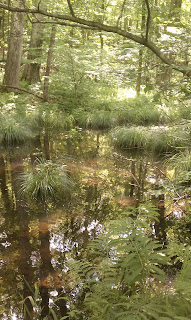
A dry stream near Duck Pond.

Amphibian Cover Board Results

Today the amphibian cover boards were checked for a second time this summer. Interestingly enough the total number of salamanders that were found, 28, was the exact same number as last time the cover boards were checked in the middle of May. Also, like last time, I was only able to encounter the Red-backed Salamander (Plethodon cinereus) and the Red-spotted Newt (Notophthalmus viridescens). However the major difference between this survey and May’s survey was that this time the salamanders discovered were less dispersed over all the grids. The Duck Pond and Pine Island grids, which are very close together in location, held the majority of salamanders, 10 and 11, while the Mott-Van Winkle Area had 4 salamanders, and the Interpretive Trail, Icehouse Marsh, and Butternut Brook, each had 1 salamander, respectively. In May, the total number of salamanders was spread out more evenly among almost all the grids, although Pine Island did have the majority of salamanders. The Duck Pond and Pine Island grids are located in a conifer dominated forest, next to a pond or vernal pool. Therefore we can hypothesize that the Red-backed Salamander and Red-spotted Newt prefer this type of habitat, which stays moist and cool from the conifers and harbors many invertebrates due to its proximity to water. 
Lead phase Red-backed Salamander
Red-backed Salamander


Typical Cover Board Grid
Red-spotted Newt (eft stage)
Over the past week we have added seven more amphibian cover board grids around White Memorial, focusing on the Catlin Woods area. We have also flagged three additional sites around the property to place more cover boards. These new grids will be left undisturbed for several weeks in order for salamanders to become established there. Hopefully by the end of the summer we will be able to survey all of the grids, both new and old, and really discover various amphibians’ ranges and will come across a population of Blue-spotted x Jefferson hybrid Salamanders. 

Wood Duck Nest Box Inspections, 1/6/2012

Wood Duck male photo by Paul Fusco
Wood Duck Successful Nest, showing egg shells,
membranes that surrounded the chicks when they
hatched, and down from the mother; all on a bed of
wood shavings which we provided.
Photo by Dave Rosgen
This past Friday, 1/6/2012, Nick Miofsky and I (Dave Rosgen) checked 6 of our duck nest boxes for usage in 2011. We visited all 3 boxes at Duck Pond, the one in Pine Island Marsh, and both of the boxes in Mallard Marsh. All of these boxes had been moved from dangerous deepwater locations to safe shoreline locations by Scott Dayton and me last winter. Still, 80" of rain in 2011 put these formerly shoreline spots under as much as 2' of water. Because of all the mild weather that our area has experienced in the past month, much of this water was coated with less than 1" of ice. We were able to break through this ice with a potato hook as we walked to every box except the one on the south side of Duck Pond. The ice there was over 2" thick and held us as we walked on it. If we had fallen through it wouldn't have been a big deal since the water was only about 6" deep. Another major reason to move these boxes to shoreline locations (which was discussed in a few blog postings last winter) was to eliminate flooding of the boxes as a cause of nest failures. It worked! None of these boxes came anywhere close to being flooded, despite massive amounts of rain last year. Coupled with relatively mild weather last spring and our PVC pipe predator guards effectively stopping Raccoons and other predators from raiding the boxes, all 6 of these boxes were successful in fledging young. They were all occupied by Wood Ducks, and leftover eggshell membranes indicated that a total of 46 young hatched from them. Subtracting the one dead baby that we found among the nest material, that means that 45 young successfully fledged from these boxes. That's excellent! We also found a total of 14 unhatched eggs in these boxes. They were probably the first ones laid by the hens last April, and they probably froze on a few cold nights before she commenced incubation of the full clutch. Unfortunately, that's common, but it is offset by the large clutch sizes. More often than not, at least half the eggs in any given clutch hatch. In these boxes it was 77%. Last summer, Marcus Johannson and I checked the 5 shoreline boxes at Ongley Pond, and N. Shore, Pike, and Icehouse Marshes. All of them had Wood Duck nests, with 4 successfully fledging a total of 38 young. The fifth, at Icehouse Marsh, failed due to freezing of the entire clutch of 18 eggs. This probably was a dump nest where more than one female lays her eggs in a box, but none of them settle down to incubate the clutch. It might indicate a need for another box in that area. Despite this one failure we are very pleased that 10 out of the 11 boxes checked so far have been successful. That makes for an excellent success rate of 91% so far. Nicole Morin and I plan to check the last 4 boxes in safe locations this afternoon. Then it will be a matter of waiting until prolonged cold temperatures make ice around the rest of the 19 boxes less dangerous for us to walk on so that we can go out and check them. If that doesn't happen, we will have to use a canoe to get to them when the ice is gone. Somehow, we will make sure that they are checked before the 2012 nesting season begins in April. Stay tuned.

Salamander Cover Boards

Red-backed Salamander photographed by


Dave Rosgen at WMF's Duck Pond Trail


On Tuesday, 8/23/11, I checked all 174 salamander cover boards at White Memorial's Ongley Pond, Lake, Windmill Hill, Butternut Brook, Interpretive, Duck Pond, and Pine Island Trails, Mott-Van Winkle Area, and the east slope of Windmill Hill. The results were rather disappointing: 50 Red-backed Salamanders, 7 Red Eft-stage Red-spotted Newts, and 2 Northern Spring Peepers. This is despite wet conditions which would seem to favor amphibians. However, I did find huge numbers of earthworms; many of them being of nightcrawler size. Some concern has been expressed by herpetologists about the growing numbers of earthworms (most of which are non-native species) and their possibly ill effects on salamanders. I found at least 500 earthworms under our salamander boards. Five days after this survey, Tropical Storm Irene hit, dumping 8 inches of rain on this part of Litchfield, and flooding most of our salamander boards. Yesterday I found 21 of the 25 boards at the Interpretive Trail floating in the Pike Marsh's flooded backwater. Two boards were missing, and the 2 remaining boards on land harbored 4 Red-backed Salamanders. Of the 20 boards at Mott-Van Winkle, 6 were missing. The remaining 14 boards harbored 3 Red-backs. I'm heading out now to check on the fate of the rest of the cover boards.


Chytrid Fungus Update!


Photo By: Olivia Riccio
 Green Frog
Photo By: Olivia Riccio
Near Ongley Pond
Photo By: Olivia Riccio
Swabbing a Smaller Green Frog


Photo By: Olivia Riccio
Swabbing the Stomach of a Green Frog

Photo By : Olivia Riccio
Releasing the Green Frog


Photo By: Olivia Riccio
Frog Prints

Photo By: Olivia Riccio
Bever Tracks


 For the past couple of weeks, the weather has been perfect for catching and sampling frogs; sunny, clear, and warm. However, catching them as always is the difficult part. I have seen anywhere from 30 to 40 green frogs at Ongley pond, Pike marsh, and Duck pond. But as of right now I have only caught and swabbed 16 of them (see above along with the swabbing technique)! I have learned along with my fellow volunteer, Rebecca Solnit, that frogs ( of any kind) have a tendency to speed up as the weather gets warmer (go figure, just as I get slower)! On June 30, with the help of the head research biologist, James Fischer, I had the pleasure of sampling a different (less jumpy) amphibian, the salamander. We uncovered and sampled 12 amphibian cover boards located at duck pond. We found and swabbed 8 red phase salamanders, 2 lead phase salamanders, and 1 red eft salamander. I learned very quickly that these slimy creatures are hard to hold and swab, due to the fact that if a salamander is held by the tail to tightly, the tail will actually fall off and eventually re-grow (I was not going to be part of that)! Even after catching 3 frogs and 11 salamanders, the day continued to have even more surprises. On our way back to white memorial, we found frog tracks and beaver tracks (see above) imprinted in mud. Overall, the question is chytrid fungus present in Connecticut is still being explored, but we hope that our continuous amphibian sampling will help answer this intriguing question.

Is Chytrid Fungus Present In Connecticut?

Photo By: Olivia Riccio
On the way to Ongley Pond, A Female Painted Turtle


Photo By: Olivia Riccio
Tadpole Sampled for Chytrid Fungus
Photo By: Olivia Riccio
Green Frog
Photo By: Olivia Riccio
How to Hold A Green Frog for Swabbing
Photo By: Olivia Riccio
Catching a Leopard Frog
Photo By: Olivia Riccio
Identifying a Leopard Frog


Recently Batrachonchytrium dendrobatidis or chytrid fungus was found worldwide causing stress and even death to various amphibians, in particular frogs. Chytrid fungus is an invasive fungus that is quickly spreading towards the Northeast section of the United States. At White Memorial we are testing for the presence of chytrid fungus on frogs and salamanders at Ongley Pond, Mallard Marsh, and Duck Pond. We hope that we will find an answer to why chytrid fungus affects frogs and specifically why chytrid fungus kills amphibians in other parts of the United States but seems at this time to only cause stress to these northeastern inhabitants?
         
Tuesday, June 21, I had the pleasure to sample Ongley Pond on White Memorial for green frogs, leopard frogs, or really any frogs I could find! The weather was perfect for catching frogs; it was a clear, sunny 85 degree day. The procedure used to sample is non-destructive to these amphibians. Once the frog is caught by a net, the frog is held by their legs (the legs are the strongest part of their body and are usually used to escape!) and then the smooth side of the toothpick is rubbed on the frog's stomach, back, and the inside and outside of the legs (where the majority of the chytrid fungus is found). The toothpick is then soaked in a vial of ethanol and labeled. Each frog sampled is then described with any additional information needed in my field notebook. So far, I have sampled 6 frogs (it is hard to catch frogs especially with mosquitoes flying around your head!). 5 out of the 6 sampled were green frogs. One leopard frog (less common than the green frog) was sampled along with a tadpole (See Above). Hopefully, these samples will lead to some answers when they are sent to Yale University to be tested in the lab by Kathryn Richards-Hrdlicka , head of this research project. But, don't worry more frog sampling is on the way (if this rain ever stops)!


Coyote Tracking in Duck Pond Vicinity

Friday, January 18, 2011, start time: 13:15 p.m., end time:16:30 p.m., temperature ~34 degrees F, wind: SW 0 - 10 mph, cloud cover 90% - 100%, snow cover 8 - 32 inches.

Nicki Hall and I observed coyote tracks in the Duck Pond Vicinity; which is located north of Bissell Rd., southeast of S.R. 202, and west of White Woods Road.  The tracks were actually quite tricky to identify because their gate appeared to demonstrate that they were running from the trail while maneuvering through some dense cover.  We were quite puzzled at first because these tracks could have been domestic dog that wandered a little far from it's owners, who remained on the trail.  After a little bit of exploring, we observed a small clue that helped us to determine that it was indeed a coyote.  The tracks became a little clearer as the animal continued to walk further away from the trail.  The following pictures illustrates what we observed:

Photo by James Fischer
The coyote was running and it grazed a multi-flora rose branch.  Notice the photograph above that we observed fur on the rose thorns.  A closer inspection of the branch is below.


Photo by James Fischer
 Although the tracking conditions were challenging, with a bit more careful observations we were able to confidently identify the species. 

Good Tracking!