
Showing posts with label White-footed Mouse. Show all posts
Showing posts with label White-footed Mouse. Show all posts
Game Camera Along Bantam River at Haight Parcel
A series of videos and images captured on a game camera set along the Bantam River at White Memorial Foundation's Haight Parcel in Litchfield, CT, USA

August 2017
Images recorded at White Memorial Conservation Center Bird Blind, unless stated otherwise on the White Memorial Foundation Property. Time stamped is Eastern Standard Time, daylight savings time is not used.
Mammals
 |
| Bobcat at Catlin Woods |
 |
| Black Bear at Cranberry Pond |
 |
| Eastern Chipmunk at Catlin Woods |
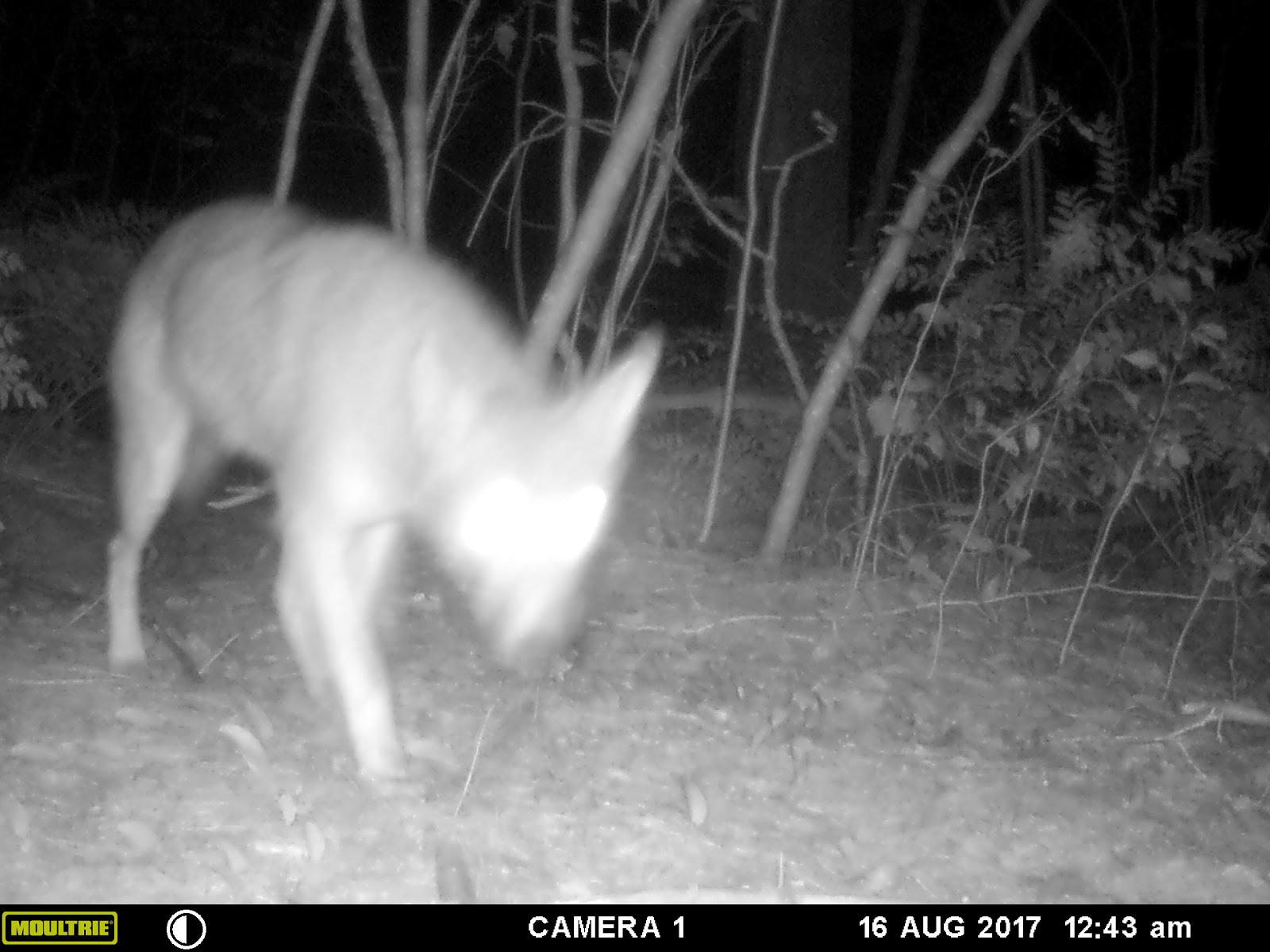 |
| Coyote at Catlin Woods |
 |
| Eastern Chipmunk at Catlin Woods |
 |
| Eastern Chipmunk scratching face at Catlin Woods |
 |
| White-tailed Deer at Catlin Woods |
 |
| Raccoon at Catlin Woods |
 |
| White-tailed Deer at Catlin Woods |
 |
| White-tailed Deer at Beaver Pond |
 |
| Gray-Squirrel at Catlin Woods |
 |
| White-footed Mouse at Catlin Woods |
 |
| White-footed Mouse at Catlin Woods |
 |
| White-footed Mouse at Pitch Road |
 |
| Gray-Squirrel at Catlin Woods |
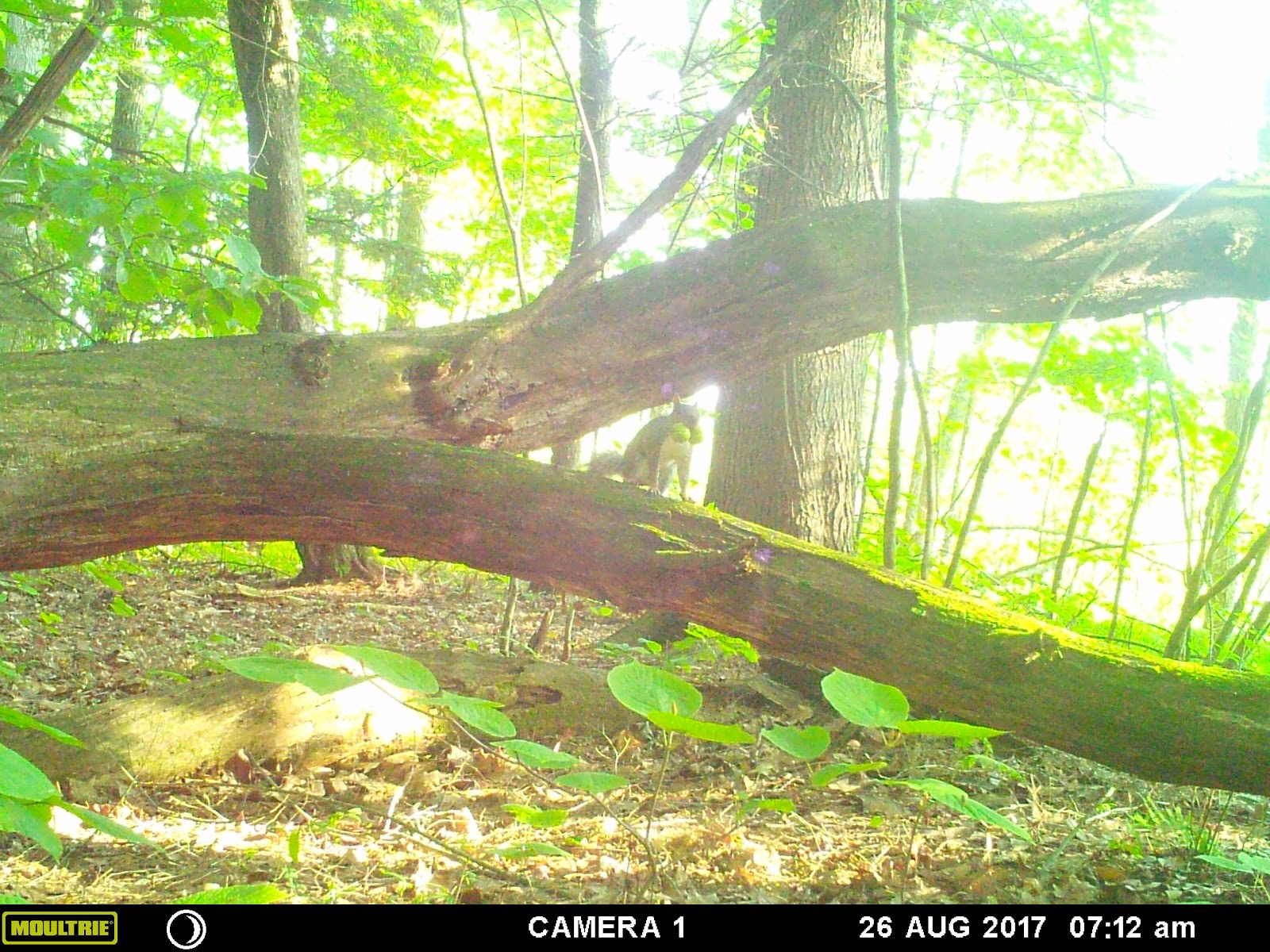 |
| Gray-Squirrel with two Acorns in his mouth at Catlin Woods |
 |
| White-tailed Deer Buck at Beaver Pond |
 |
| Two Raccoons at Catlin Woods |
 |
| White-tailed Deer Fawn and Doe at Catlin Woods Birds |
 |
| Wood Thrush at Pitch Road |
 |
| Gray Catbird at Catlin Woods |
 |
| Wood Thrush at Caitlin Woods |
Small mammal trapping to determine tick burdens on Lyme disease reservoir species
We have been setting nonlethal traps on sixteen plots throughout the property to catch small mammals. Traps are set for three consecutive nights, and are checked early in the morning. Each small mammal is weighed, measured, and tagged on the ear with a unique identification number that allows us to recognize individuals that have been caught more than once. The main objective of our small mammal trapping project is to determine the tick burden the mammals are carrying. This late in the summer, we are most likely to encounter larvae, although we have found that some nymphs are still present.
White-footed mice (Peromyscus leucopus) are the most common small mammals we catch, and they are also a major host species for black-legged or deer tick (Ixodes scapularis) larvae and a reservoir for Lyme disease (Borrelia burgdorfer). In order to pass from one life stage to another, ticks require a blood meal, after which they drop off to molt and must find a new host. Larvae often attach to small mammals or birds, and if a larva's host is carrying the bacterium B. burgdorfer, that larva will carry Lyme disease and spread it to future hosts. For more information on the tick life cycle and how they spread Lyme, click here.
When we catch a small mammal, we count and remove tick larvae and nymphs. If we catch the same small mammal more than once in a three-day period, it allows us to see how quickly they are picking up new ticks This can help us understand the abundance of ticks in each area. Trapping will also give us a better understanding of small mammal subpopulations, demographics, and diversity throughout the property.
Most of the ticks we find on small mammals are on the head, especially the ears. It is estimated that ticks found on the head make up about 40% of the animal's entire body tick burden. One unlucky individual had 31 tick larvae on one ear and 26 on the other, in addition to carrying a botfly larva. This was an extreme case, and tick burdens vary from one site to the next.
 |
| Left: A tick larva (above my thumb) and nymph (above my thumb and slightly to the right) Right: A close-up of the larva (note: larvae have six legs while nymphs and adults have eight) |
White-footed mice (Peromyscus leucopus) are the most common small mammals we catch, and they are also a major host species for black-legged or deer tick (Ixodes scapularis) larvae and a reservoir for Lyme disease (Borrelia burgdorfer). In order to pass from one life stage to another, ticks require a blood meal, after which they drop off to molt and must find a new host. Larvae often attach to small mammals or birds, and if a larva's host is carrying the bacterium B. burgdorfer, that larva will carry Lyme disease and spread it to future hosts. For more information on the tick life cycle and how they spread Lyme, click here.
When we catch a small mammal, we count and remove tick larvae and nymphs. If we catch the same small mammal more than once in a three-day period, it allows us to see how quickly they are picking up new ticks This can help us understand the abundance of ticks in each area. Trapping will also give us a better understanding of small mammal subpopulations, demographics, and diversity throughout the property.
 |
| White-footed mouse (Peromyscus leucopus) being checked for ticks. |
One of the white-footed mice we've caught is a veteran of last summer's mouse over water experiment. Last year he was caught, tagged, and kept for seven days in an enclosure over water until his ticks dropped off into the water and could be counted. The mice in that experiment were well-fed and released near where they were originally caught. This year, he was caught on three consecutive trapping days, and seems to have decided that having an easy meal is worth being handled.
So far we have finished trapping at three of our sixteen sites. Sadly, we had to say goodbye to #46 and leave him to forage for food like a real mouse. The data we have gained from this project will be used along with the tick phenology data and earthworm data from the same plots to better understand the relationship between tick populations and survivorship and the presence or absence of invasive earthworms.
 |
| Trap-happy #46, calmly enduring being handled |
Exotic Earthworm Inventory and Ecological Associations on the White Memorial Foundation, Inc. Poster at CCNR 2016
 |
| Poster presented at CCNR 2016 |
Eastern Screech-owl Pellet Examination
 |
| Sometimes you find other things in Waterfowl Nest Boxes, for example, Eastern Screech-owl pellets. |
We found Eastern Screech-owl pellets while checking the Waterfowl Nest Boxes on the property this year. The pellets were observed on top of the waterfowl nesting material and since waterfowl and Eastern Screech-owl breed at approximately the same time of year, it suggests that the owls used the boxes after the breeding season. Learn how owls produce pellets. A total of 3 boxes had pellets. The nest box in Hammill Marsh (box #5573) had 4 pellets, #3236 in Pine Island Ditches had only 1 pellet, and the box at Ice House Marsh (#8054) had a total of 5 pellets. Locate these boxes in the map at the bottom of the page. The habitat around these boxes varies widely. Hammill Marsh is primarily a herbaceous marsh north of Little Pond. Pine Island Ditches are located north of Bissell Rd. and east of Duck Pond. Pine Island refers to habitat because of the conifer trees and shrubby marsh but there are large herbaceous marshes to the north named Mallard Marsh. Ice House Marsh is a small shrubby-herbaceous marsh surrounded by mature forest and a small mowed field where the old Ice House ruins are located. This area is located north of Bantam Lake and east of North Shore Rd.
We expected to see different species of prey because of this habitat variability. Will Hafey and Heather Williams, Wamogo Regional High School students, dissected the pellets to examine what these owls were eating while using the property. The pellets found in Hammill Marsh and Pine Island Ditches had a total of 2 Meadow Voles (Microtus pennsylvanicus). Meadow Voles commonly inhabit open heraceous habitats like fields, marshes, and even many people's backyards. The Ice House Marsh nest box had pellets with the greatest abundance of prey items and two different species. These pellets yielded at least 6 White-footed Mouse (Peromyscus leucopus) and 1 Southern Flying Squirrel (Glaucomys volans). These prey species are abundant along forest edges and mature forests. We can differentiate the prey species by examining the skull, teeth, and long bone characteristics. We count and match mandibles and skulls, as well as long bones in the limbs and pelvic girdles to determine how many of each species were eaten. Review the photos below to see the similarity in size and other characteristics of the evidence we use to determine this diet analysis of Eastern Screech-owls on the property.
 |
| Meadow Vole rostrum, mandible, and a couple long bones. |
 |
| White-footed Mouse mandible and few long bones. |
 |
| Southern Flying Squirrel long bones. |
The Effects of Dry Weather & Salamanders
 |
| Red-backed Salamander |
Yesterday’s amphibian cover board check yielded a relatively small encounter rate of salamanders. A total of 23 Red-backed Salamanders were seen at fifteen cover board grids. Only one Red Eft was spotted as well as one White-footed Mouse. The low encounter rate could be due to the recent dry weather we have been having across the state. Although I checked the cover boards after yesterday morning’s heavy rain shower, the forest floor still seemed to be dry and what was once moving streams and filled vernal pools were now reduced to only mud. Moisture is necessary for the survival of many salamanders, especially the Red-backed Salamander which is born without lungs forcing it to breathe through its skin. Therefore the exchange of oxygen and waste gases through the skin demands a moist environment. The drought in Texas can be used as an example of how a long period of dry weather can diminish salamander populations. The already endangered Texas Blind Salamander population has dwindled due to the drought and was captured by the U.S. Fish & Wildlife Service to bring to a hatchery for a chance at preservation. As the summer progresses we hope to find a greater amount and diversity of amphibians underneath our cover boards. Whether or not this can be achieved can depend greatly on the amount of precipitation we receive.
 |
| A dry stream near Duck Pond. |
Small Mammal Inventory -- Cranberry Pond Mesic Forest
 |
| Male Southern Red-backed Vole (Myodes gapperi) |
 |
| Mesic forest dominated by Yellow Birch, Eastern Hemlock, Spicebush, and loads of mosses, skunk cabbage, and other plants in the herbaceous layer. |
Small Mammal Inventory -- Little Pond -- Swamp White Oak/Basswood Stand
 |
| Juan Sanchez measures the hind foot of a white-footed mouse. |
 |
| The animal was released after measurements were recorded. If high speed indicates alertness and health, then this animal was very alert and healthy! |
Small Mammal Live Trapping Yields a Few Animals
A wet meadow was surveyed for small mammals last week in the Apple Hill Lower field. A total of 28 Sherman Live Traps were set for 4 nights equaling 112 trap nights of effort. Several species were captured but overall yields were quite low indicating that small mammal abundance might be low this spring.
 |
| Wet Meadow in Late Winter/Early Spring |
 |
| Meadow Voles (Microtus pennsylvanicus) are commonly associated with Wet Meadows in Connecticut. |
 |
| This wet meadow abruptly changed into a wet shrubby herbaceous inland wetland. |
 |
| Male Mask Shrew (Sorex cinereus) |
 |
| White-footed Mouse (Peromyscus leucopus) |
Subscribe to:
Posts (Atom)