You can also see a video explaining the project at Apple Hill below.

Showing posts with label Apple Hill. Show all posts
Showing posts with label Apple Hill. Show all posts
New England Cottontail Habitat Management Project Articles and Media
New England Cottontail.org has published an article about the habitat management project on Apple Hill that is creating habitat for early succession species, with a special emphasis on the New England Cottontail (Sylvilagus transitionalis).
You can also see a video explaining the project at Apple Hill below.
You can also see a video explaining the project at Apple Hill below.

New England Cottontail Habitat Management Project -- Species Documentation
 |
| Cottontail scat was collected throughout the Habitat Management Project to determine the species and abundance of cottontails at Apple Hill on January 22, 2013. |
Nicki Hall and Alyce Walker helped collect cottontail scat at the Habitat Management Project at Apple Hill that targets the conservation of the New England Cottontail. We collected a total of 14 pellets throughout the study area after approximately 0.75 inches of snow accumulated yesterday evening. It was great conditions to collect scat samples for this project because it remained cold enough throughout the preceding evening and this morning that we could take our time following every trail that we encountered to observe scat. There was plenty of cottontail tracks and scat throughout the area, especially where the shrubby cover was very dense. The scat will be transported to our colleagues at CT DEEP, Wildlife Division, who have advised us throughout the term of this project. The scat will be used to extract molecular information that will tell us which species inhabits the Apple Hill area. Two species of cottontail reside in Connecticut. The native species that adapted and evolved to the ecological processes in our region is called the New England Cottontail (Sylvilagus transitionalis). The other species that was introduced to the state and has become more common is the Eastern Cottontail (Sylvilagus floridanus).
 |
| Cottontail Scat and Tracks in Snow. |
More Snakes Encountered Under Cover Boards
This summer’s second round of checking snake cover board
grids yielded great results. At every grid, except two, James Fischer and I
found snakes hiding under the piles of wood trying to escape from the hot and
humid weather. We encountered Red-bellied snakes at three of the piles, which
were not present last time we removed the boards. All the Red-bellied were
small in size (about 7 inches), meaning that they were probably males, likely
waiting for the larger females to arrive. We also came across many more Garter
snakes, especially at the Ongley Pond site, where there was a total of six
counted Garter snakes, one juvenile and five adults. We saw only one Ring-necked
snake at the Apple Hill Lower Field, which was where we spotted one two weeks
ago. At the two grids where we did not have snakes, Wamogo Field and Laurel
Hill; we did find a Red-backed vole and a fairly intact snake skeleton
approximately 12 inches long.
After checking all of the cover boards and noticing the
dramatic increase in snake encounter rate we wondered if this could be due to
the recent hot, humid weather, which would cause the snakes to seek cool
coverage under the wood piles. Although it could also be due to the time of day
we checked the grids. This time we started at 2:00 pm and received our highest
snake numbers at the end of the day, around 5:00 pm. In my last blog about
snake cover boards, we had the most snakes in the morning and I hypothesized
that changing the time of day when the grids were inspected might reveal different
abundances of snakes. Today’s result does develop this hypothesis that perhaps
mornings and late afternoons are the best times to check cover boards. Since we
will be checking the cover boards many more times this summer, we can further
test this question.
 |
| Red-bellied snake |
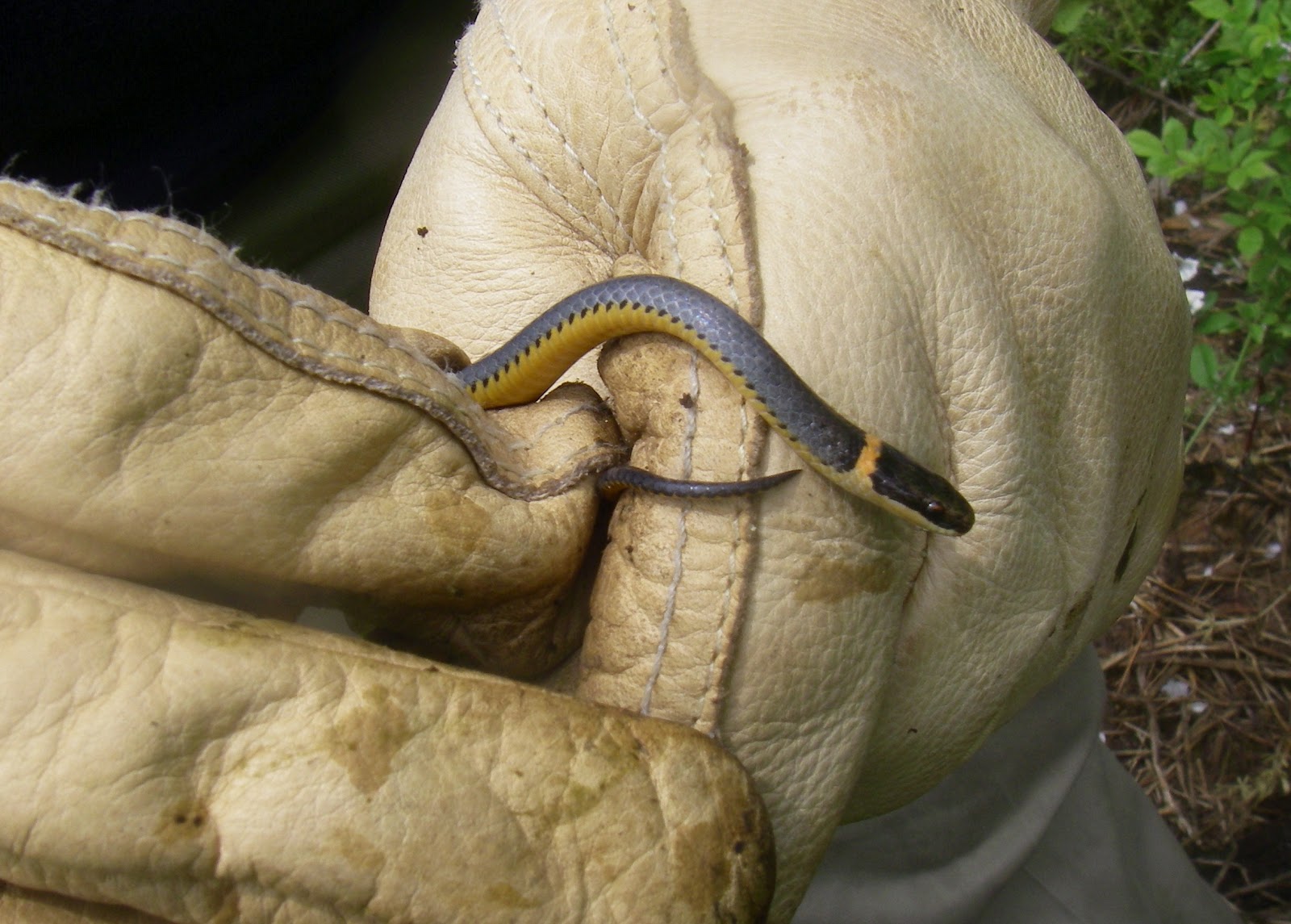 |
| Ring-necked snake |
 |
| Garter snake |
 |
| Garter snake |
 |
| Southern Red-backed vole |
Wildflowers In Bloom
As temperatures warm up and rain showers become more regular; I have noticed beautiful spots of bright colors dotting open, grassy fields and trail edges. It’s that time of the season for wildflowers to emerge and bloom. In my opinion, the occurrence of wildflowers officially marks the start of summer. Not only are wildflowers aesthetically pleasing, but they also provide medicinal uses, food, habitat, erosion control, and ecosystem stability for fish and wildlife. There are approximately 215 species of wildflowers listed in Connecticut, each with a distinctive appearance.
Since not everyone, including myself is a professional botanist; when identifying wildflowers you should try to observe the following characteristics. First, count the number of petals, which is usually three to seven or more. Next, note the flower arrangement. Is it a single flower on a stem or several flowers on a stem? The most obvious flower characteristic is color. Wildflower colors usually range from shades of blue, white, yellow, pink, purple, or green. Also, record the date that the flower blooms; although flowering time can vary based on weather fluctuations. For instance, last week, James Fischer and I spotted Mountain Blue-eyed Grass (Sisyrinchium montanum) flowering at Apple Hill. When we discovered its correct identification, we learned that it typically flowers during June and into July. Finally, measure or estimate plant height and flower size. Also note the leaf margin (entire, serrated, wavy), and arrangement; meaning whether they are compound (many leaves per stem) or simple (one leaf per stem). If possible, take a photograph, but try not pick or trample the flower.
Since not everyone, including myself is a professional botanist; when identifying wildflowers you should try to observe the following characteristics. First, count the number of petals, which is usually three to seven or more. Next, note the flower arrangement. Is it a single flower on a stem or several flowers on a stem? The most obvious flower characteristic is color. Wildflower colors usually range from shades of blue, white, yellow, pink, purple, or green. Also, record the date that the flower blooms; although flowering time can vary based on weather fluctuations. For instance, last week, James Fischer and I spotted Mountain Blue-eyed Grass (Sisyrinchium montanum) flowering at Apple Hill. When we discovered its correct identification, we learned that it typically flowers during June and into July. Finally, measure or estimate plant height and flower size. Also note the leaf margin (entire, serrated, wavy), and arrangement; meaning whether they are compound (many leaves per stem) or simple (one leaf per stem). If possible, take a photograph, but try not pick or trample the flower.
The Connecticut Botanical Society website (http://www.ct-botanical-society.org) is an excellent source to use when identifying Connecticut’s native wildflowers. Also, the Peterson Field Guide to Wildflowers is a handy book to own when out in the field. As wildflowers continue to bloom throughout the next several months, identifying them can be a fun way to get outside and learn about Connecticut’s flora.
The following pictures are some of the wildflowers that I found at various locations around White Memorial’s property. I walked through wetlands (Little Pond and Cranberry Swamp), grassland (Apple Hill), old growth forests (Catlin Woods), and even stopped the truck several times along curbs to take a photo or two of a roadside wildflower. |
| Yellow sedge Carex flava |
 |
| Robin-plantain Erigeron pulchellus |
 |
| True Forget-me-not Myosotis scorpioides |
 |
| Yellow Goat's-beard Tragopogon dubius |
 |
| Blueflag Iris versicolor |
 |
| Heart-leaved Alexanders Zizia aptera |
 |
| Wild Geranium Geranium maculatum |
Small Mammal Live Trapping Yields a Few Animals
A wet meadow was surveyed for small mammals last week in the Apple Hill Lower field. A total of 28 Sherman Live Traps were set for 4 nights equaling 112 trap nights of effort. Several species were captured but overall yields were quite low indicating that small mammal abundance might be low this spring.
 |
| Wet Meadow in Late Winter/Early Spring |
 |
| Meadow Voles (Microtus pennsylvanicus) are commonly associated with Wet Meadows in Connecticut. |
 |
| This wet meadow abruptly changed into a wet shrubby herbaceous inland wetland. |
 |
| Male Mask Shrew (Sorex cinereus) |
 |
| White-footed Mouse (Peromyscus leucopus) |
New England Cottontail Rabbit Survey
Alyce Walker and I ventured up Apple Hill to survey for cottontail rabbit spore. We found several tracks in the recent snow and more importantly we found and collected scat. The scat will be tested to identify which cottontail rabbit left it. New England Cottontail rabbit is our native cottontail species in southern New England, but the Eastern Cottontail has become more widespread after it's introduction to New England. Differentiating the species is very difficult unless you can can examine the skull. Tissue samples can be useful for identifying the species but cottontail rabbits are difficult to capture in live traps. Fortunately, the scat yields the kind of data we need but it has to be collected under precise conditions. We haven't had many days with very cold temperatures (below freezing) for 36 hours or more after it last snows this season. We had one day this season to take advantage of this season, fortunately we found one scat. This project will continue during subsequent seasons.
 |
| Scat is collected and stored in vials with silica gel (a drying agent) until laboratory analysis. |
 |
| Cottontail Rabbit Tracks in Snow. |
The Last Snowfall of the Season Yields Interesting Tracks
Apple Hill was a busy place after the last snow fall. Alyce Walker and I observed several tracks suggesting that spring was right around the corner. The coyotes and bobcats ranged all over the hill chasing after cottontail rabbits and gray squirrels. Striped Skunks and Eastern Chipmunk were awake from their long winter sleep to find a land covered in snow.
 |
| A Striped Skunk (smaller tracks with claws) was being followed by a Bobcat. |
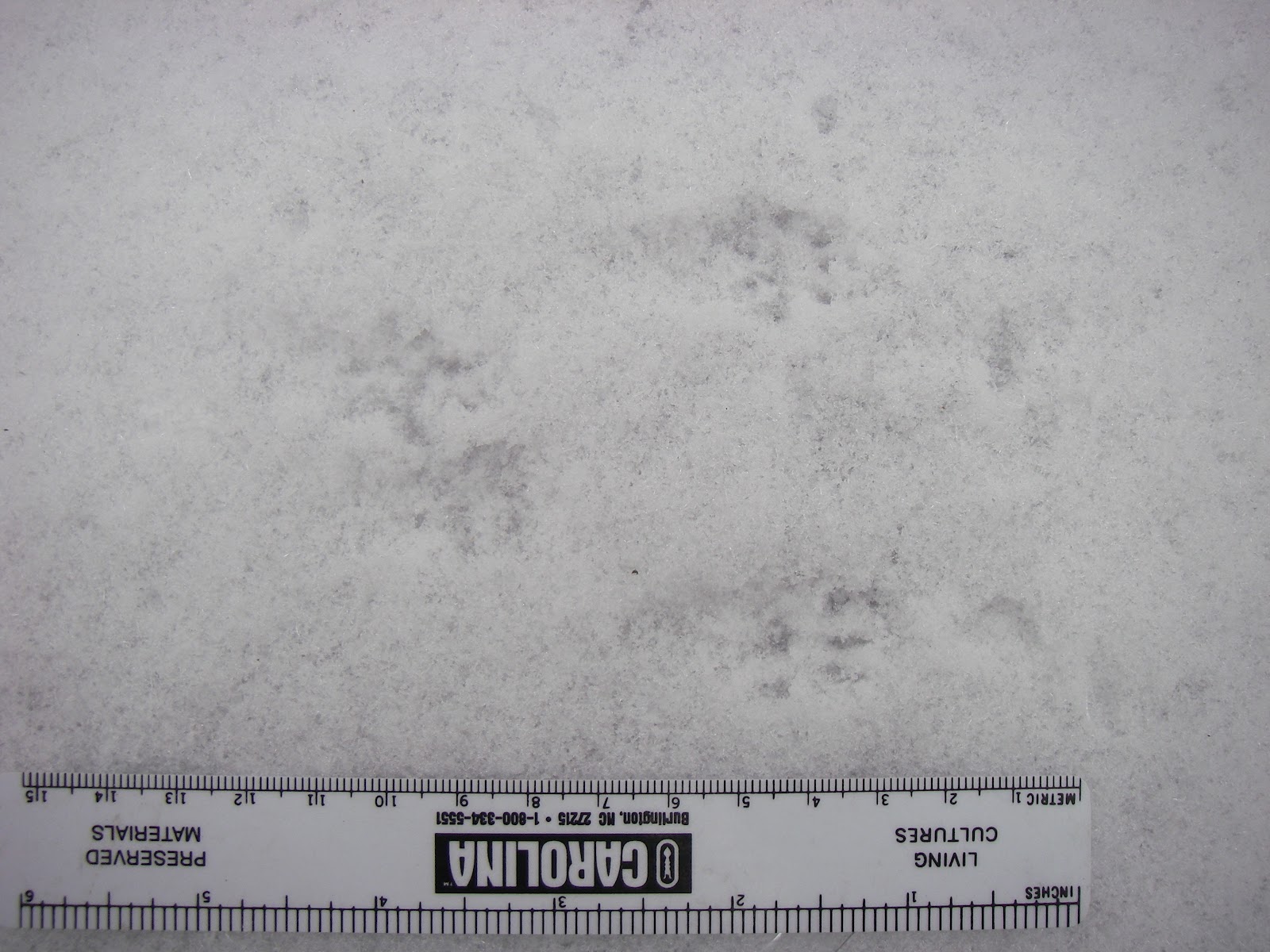 |
| Eastern Chipmunk Tracks in Snow. |
Small Mammal Inventory -- Apple Hill Lower Field
 |
| Nicole Morin helps to install a pit-fall trap array targeting Southern Bog Lemming and other small mammals that inhabit wet meadows. Photo by James Fischer |
We installed a small pit-fall trap array in the Apple Hill Lower Field to target the small mammals inhabiting shrubby/herbaceous inland wetland found along the south end of the field. The soils in the upland field were frozen while the soils closer to the wetland were not. We encountered a few problems with this array and so our efforts did not yield any captures. But it was a great first attempt for the season. Trapping will continue throughout the year in a variety of habitats.
Squirrels Communicating Over the Bridge
 |
| Northern Spicebush (Lindera benzoin) branch serving as a bridge for Eastern Gray Squirrel (Sciurus carolinensis) to cross over a small spring seep in a Connecticut woodland. Photo by James Fischer |
The evidence that I have had trouble collecting were ways that squirrels could communicate that these bypasses were frequently used by squirrels. Jared and I observed a sturdy Northern Spicebush branch leaning over a small wet area. The wet area was sparsely vegetated, which left little cover for a squirrel to use for protection. What drew our attention to how important this branch was to the local squirrel population was the tell tale bites found in the bark of this branch.
 |
| Eastern Gray Squirrel bites marking this branch serving as a bridge. Photo by James Fischer |
Wow! I wonder if this how they do it the tree canopies? Certain individuals may wound and scent mark specific trails that communicates that it is their trail by using their trail-blazes. Maybe the rest of their social structure could explain who and why certain squirrels use these pathways. Could social and genetic relatedness explain why some animals use the canopies byways? Could some canopy trails become legacy resources used by several generations of squirrels? So many questions...
Examining the Feasibility of New England Cottontail Habitat Management
 |
| (l to r) Jack Berlanda and Paul Rothbart (CT DEEP Wildlife Div. Habitat Unit) speak with Lukas Hyder (WMF Forester) during a visit to a potential New England Cottontail habitat management site. |
Subscribe to:
Posts (Atom)