Showing posts with label Wildlife Division. Show all posts

Hartford Courant Article "Resurgent Bobcats Prompt State To Study Habitat, Population"

Bobcat at Apple Hill
By Leo Kulinski, Jr.

Bobcats are frequently observed on the White Memorial Foundation property.  Volunteers who help with our Winter Track Monitoring Program have documented bobcat tracks in many of the critical habitats on the property.  Bobcat tracks are often observed walking along juxtaposed upland and wetland habitats, but they are observed in many other habitats.  Bobcats can predate larger mammals but often will kill small mammals, songbirds, and wild turkeys.  They are often observed scavenging white-tailed deer carcasses that die in the winter from car collisions.  A new project in Connecticut is exploring the current population size and habitat associations in the state.  The article below was published in the Hartford Courant on September 25, 2015.

Resurgent Bobcats Prompt State To Study Habitat, Population

Hartford Courant article "Connecticut Black Bear Sightings Increasing"

Black Bears are frequently observed on the White Memorial Foundation property and they are becoming more frequent each year.  Below is a Hartford Courant article link that describes the number of Black Bear observations in the state of Connecticut.  The article has a very interesting map that allows you to examine the number of sightings throughout the state throughout the years.  The number of sightings remain high in northwest Connecticut.  However the number of sightings are increasing south of Litchfield and Morris in the past 4 years.  

Hartford Courant "Connecticut Black Bear Sightings Increasing"

A hair sampling and camera trap that was used to detect black bears on the property as part of a
research project conducted by UCONN during summers of 2013 - 2014.


Federal government takes New England cottontail off list of species considered for protection

Recent habitat management efforts throughout Southern New England have ensured the long-term conservation of New England Cottontail Rabbit and many other species associated with early successional habitats.  White Memorial joined in with these efforts.  You can see the results of the habitat management at Apple Hill on the Foundation Property in Morris on East Shore Rd.

New England Cottontail Rabbit (Sylvilagus transitionalis)
John Huff/Foster's Daily Democrat via AP

DOVER, N.H. (AP) — Public and private conservation efforts have helped the New England cottontail rebound to the point where it can be taken off the list of species under consideration for protection, the federal government said Friday.
The small, brown rabbit has been threatened by a loss of habitat throughout its range in Maine, New Hampshire, Massachusetts, Connecticut, Rhode Island and New York. It's vanished from Vermont. It's endangered in Maine and New Hampshire, and the U.S. Fish and Wildlife Service had been studying whether to list it under the federal Endangered Species Act. Continue Reading

Determining the Presence of New England Cottontail on Apple Hill

Red balloons delineate the presence of New England Cottontail scat,
while blue balloons show where Eastern Cottontail scat was found at Apple Hill.
The presence of New England Cottontail (Sylvilagus transitionalis) was determined from cottontail scat pellets collected in January 2013.  A total of 14 scat samples were collected and only 3 were determined to be New England Cottontail while the remainder were from Eastern Cottontail (Sylvilagus floridanus).  A habitat management project is underway at Apple Hill to encourage early successional habitat that encourages cottontail rabbits and other species that inhabit dense shrubby habitats.  The loss of this habitat throughout New England has precipitated a loss of the wildlife that inhabit it.  New England Cottontail are an indigenous species that has adapted and evolved to the ecological processes that sustain early successional habitats in New England.  Eastern Cottontail were introduced to New England and also utilize the same habitat but can also inhabit smaller patches of shrubby habitats that are frequently observed in people's backyards.  New England Cottontail require larger habitat patches which need to be connected with other established populations to insure the species can be sustained for future generations.  Although few pellets yielded the presence of New England Cottontail in the habitat management project, we hope that as the vegetation regenerates and invasive species are controlled, they will flourish in this area of the property.  Future monitoring will determine if this occurs.

Songbird Nest Box Program Seeks Volunteer Monitors

Songbird Nest Box Volunteer training will occur on Saturday, March 23, 2013, 10:00 a.m. to 2:00 p.m. in the A. B. Ceder Classroom.  Please bring a lunch, paper, and pencil. Dress for the weather.!


Eastern Bluebird
Photo By Bob Stanowski
All wildlife populations are regulated by many things in their habitat. One factor that limits cavity nesting songbirds is the availability of appropriate nest sites. Certain species like woodpeckers create their own nest site by excavating wood with their chisel-like beaks. However, there are several cavity nesting birds that do not create their own cavities but use ones that are already present in their habitat. Eastern Bluebirds and Tree Swallows are a couple species that require pre-existing cavities before they can reproduce. Eastern Bluebirds experienced severe declines in Connecticut starting over 40 years ago. This was due in large part to ecological changes that succeeded open fields to forests and due to a lack of nest sites. A statewide program was coordinated by CT DEEP, Wildlife Division to restore Eastern Bluebird populations by installing nest boxes throughout the state. White Memorial has been part of this initiative since it’s inception by installing nest boxes throughout the property since approximately 1989. Since then the Bluebird population has responded to this conservation strategy quite well by steadily increasing in abundance (Figure 1). This year starts a new phase of White Memorial’s Songbird Nest Box Program. Volunteers are needed to monitor 75 nest boxes for success and productivity.

Figure 1:  Eastern Bluebirds Counted on USGS Breeding Bird Survey Routes 
that Traverse WMF (1967 - 2008), Trend-line Added.
Figure 2:  Eastern Bluebird Summer Distribution Map  from USGS Breeding Bird Survey (2006 - 2010).  Sauer, J. R., J. E. Hines, J. E. Fallon, K. L. Pardieck, D. J. Ziolkowski, Jr., and W. A. Link. 2011. The North American Breeding Bird Survey, Results and Analysis 1966 - 2010. Version 12.07.2011 USGS Patuxent Wildlife Research Center, Laurel, MD.

The Songbird Nest Box Program has proven a success for helping to restore Eastern Bluebirds to WMF but it only helps the birds a little. Eastern Bluebirds are not consistently successful at fledging young every year. Connecticut is found in the more northern portion of Eastern Bluebird distribution and southern populations are more abundant than northern populations (Figure 2). This suggests that Eastern Bluebirds are better adapted to a slightly warmer climate. Yet, Connecticut offers enough habitats to make it worth a Bluebird’s effort to still attempt to reproduce because some birds are successful at producing young even though some seasons do not offer the best conditions.  Bluebirds migrate as early as they can from winter habitats (April) so that they can locate a nest site, reproduce, incubate eggs, and raise young. This gives the young enough time to develop so they are physically capable of migrating to warmer climates by the next winter. Connecticut’s breeding Bluebird population is vulnerable to early spring weather conditions that could kill young birds due to exposure. Late frosts, extended cold rain, and freezing temperatures contribute to young birds dying. The nest boxes are designed to meet the needs of the birds while they need a nest site by providing as dry a micro-habitat as possible and protecting the birds from predators and non-native species.  The habitat around each nest box is managed by mowing and controlling the vegetation so that Bluebirds can find enough food for their chicks.  Check the map at the bottom of this page to see the Songbird Nest Box locations.  The boxes must be visited to collect data and to assess how the box is functioning. We have designed a program that provides the volunteers with the option of deciding how much time they can commit to the program. Each nest box must be visited at least twice a year but more frequent visits allow us to learn more about the population. If you have only a little bit of time then you can meet the minimum requirements, but if you have more time to commit then the program will benefit. There are several important things to learn about nest boxes and the birds that use them prior to volunteering with the program. Therefore, we require that if someone wishes to volunteer their time, they must attend a training session offered by WMCC Staff.

New England Cottontail Habitat Management Project -- Species Documentation

Cottontail scat was collected throughout the Habitat Management Project
 to determine the species and abundance of cottontails at Apple Hill on January 22, 2013. 

Nicki Hall and Alyce Walker helped collect cottontail scat at the Habitat Management Project at Apple Hill that targets the conservation of the New England Cottontail.  We collected a total of 14 pellets throughout the study area after approximately 0.75 inches of snow accumulated yesterday evening.  It was great conditions to collect scat samples for this project because it remained cold enough throughout the preceding evening and this morning that we could take our time following every trail that we encountered to observe scat.  There was plenty of cottontail tracks and scat throughout the area, especially where the shrubby cover was very dense.  The scat will be transported to our colleagues at CT DEEP, Wildlife Division, who have advised us throughout the term of this project.  The scat will be used to extract molecular information that will tell us which species inhabits the Apple Hill area.  Two species of cottontail reside in Connecticut.  The native species that adapted and evolved to the ecological processes in our region is called the New England Cottontail (Sylvilagus transitionalis).  The other species that was introduced to the state and has become more common is the Eastern Cottontail (Sylvilagus floridanus).

Cottontail Scat and Tracks in Snow.


Winter Waterfowl Survey--November 2012

A total of 292 Canada Goose were observed on Bantam Lake, Nov. 28, 2012.
Photo By Bob Stanowski.

Nicki Hall and I conducted the first Winter Waterfowl Survey for the winter season 2012-2013 on Wednesday, 28 Nov. 2012 from 10:08 a.m. - 2:02 p.m.  The sky was partly cloudy gradually become overcast with a gentle breeze mostly from the north and gradually changing from the north-northwest.  The temperature for most of the survey was in the high 40's degree Fahrenheit.  The water remained calm and the birds were not disturbed by any other factors, therefore counting the birds was quite easy.  We observed several large rafts of Canada Goose, Mallard, Hooded Merganser, and American Coot.  We did not observe any neck collars on the Canada Goose, which are applied and used by CT DEEP Wildlife Division for monitoring local goose populations.  Other noteworthy non-waterfowl species observed included 1 Great-Blue Heron, 1 American Bald Eagle juvenile, 1 Red-shouldered Hawk juvenile, and 1 Belted Kingfisher.  The only ice cover observed that affected the bird's usage of any water-body was at Cemetery Pond and Little Pond, where few if any birds were observed.  We count from a total of 8 other sites around Bantam Lake, of which the highest abundance of birds and greatest diversity of species were observed in the North Bay and the Bantam River Outlet, two favorite bird-watching locations among our birders.  Although not as many individual birds were observed in the South Bay, this location did produce 4 species, another noteworthy location among birders.

Species Grand Total
Canada Goose 292
Mute Swan 15
American Black Duck 19
Mallard 168
Ring-necked Duck 1
Bufflehead 39
Common Goldeneye 1
Hooded Merganser 120
Common Merganser 1
Ruddy Duck 12
Common Loon 1
American Coot 61
Ring-billed Gull 10
Herring Gull 2

Rail Callback Survey

On Wednesday, May 23rd James Fischer and I did a Rail Callback Survey for the CT D.E.E.P. at seven locations in White Memorial. The Rallidae family consists of predominately small to medium-sized wetland birds that are often seen walking along muddy areas or shallow water. The expression “thin as a rail” comes from the rails’ body form, which is laterally compressed, allowing them to escape into dense grass or reeds making them extremely difficult to visually spot. Recent wetland habitat loss and degradation has resulted in population declines in many wetland dependent species. In order to protect these birds and their habitats, biologists need to know which wetlands are being used by the birds. The survey that we conducted was targeted towards nine species of wetland birds that can be found in Connecticut. The species include Black Rail, Least Bittern, Sora, Virginia Rail, King Rail, Clapper Rail, American Bittern, Common Moorhen, and Pied-billed Grebe. The survey must be performed either during sunrise or sunset, which are when the rails are most vocal. Due to a forecast of unfavorable weather in the afternoon it was decided that sunrise, 5:26 a.m. would be best to take the survey. We could not have asked for better rail surveying weather; calm wind, temperature in the 60s, and foggy. Prior to the survey we mapped out possible locations at White Memorial to conduct the callback. The callback is a pre-recorded tape, 12 minutes long of each of the previously listed species calling for 30 seconds, then 30 seconds of silence in-between calls. During the 30 second silences we tried to listen for any calls. Wetlands birds are typically secretive and difficult to study, and it has been discovered that the callback method provokes a vocal response from them if they are in close proximity.
Collecting data at the first Little Pond survey point.

Three survey points were conducted at different parts of the boardwalk surrounding Little Pond. One of the points gave us our first response of a Virginia Rail, which is a wheezy, and accelerating wep wep wep grunt. Two other points, at Mallard Marsh and Cranberry Pond also had a callback from Virginia Rails. An individual Sora was heard multiple times as well at Cranberry Pond. The Sora call sounded very close to us, but we were still unable to see it, emphasizing its stealth. Other locations that were not successful for rail callbacks were Miry Brook and the North Bay observation tower. There are many other marshy rail habitat locations on White Memorial’s property, so hopefully before the breeding season is over we can conduct surveys there to get the most accurate population abundance and location of these elusive birds.
Virginia Rail
Photo by Gerry Ellis
http://ridgefieldnwr.wordpress.com

Sora
Photo by Gerry Ellis
http://ridgefieldnwr.wordpress.com

Waterfowl Nest Box Monitoring Continues

James Fischer, WMCC Research Director, checks the waterfowl nest box
at Beaver Pond to monitor the waterfowl breeding season productivity.
Notice the mink tracks that travel in front of the nest box from left to right.
Photo by Abby Conroy

We continue to take advantage of the short window of adequate ice covering the water under our waterfowl nest boxes on the property.  We want to thank our volunteers who are supporting us with this effort during the brief window of opportunity.  Abby Conroy, Marie Kennedy, Nick Miofsky (CT DEEP EnCon Police Officer), and Susan Spencer have made special efforts this winter season.  Marcus Johansson helped us with several boxes that can be approached via land in the autumn.

Bat Maternity Roost Microclimate Monitoring

(l to r) Ethan Toczko and Brian Blais (CT DEEP, Wildlife Division)
download data collected by datalogger.  

The datalogger is located in rafters of White Memorial's Green Barn
 and collects temperature and relative humidity reading periodically.  
Ethan Toczko and Brian Blais (CT DEEP, Wildlife Diversity Unit Technicians) downloaded some information that has been steadily collected for the past summer season.  Jenny Dickson (CT DEEP, Supervising Wildlife Biologist) is studying the microclimate of Big Brown Bat maternity roosts and associating this information with prevalence of White Nose Syndrome.  White Nose Syndrome (WNS) is an emerging infectious disease that kills bats primarily during the winter season while they are hibernating but has been observed in young animals who are dispersing from the roosts where they were born.  Recently, the disease causing agent was verified as a fungus that is native to Europe and brought to North America.  This invasive species has caused as much as 90% of the bats to die each year while hibernating in Connecticut's underground cave-like structures.  Fortunately, Big Brown Bats are the only hibernating bat species in CT not experiencing this level of mortality but some animals do die from WNS each year.  The datalogger is located in the rafters of White Memorial's Green Barn and collects temperature and relative humidity readings.  Although the data is collected continuously and culminates in thousands of data points, we only have to pull out our tallest extension ladder to download the data once a year!  Finally, technology that creates less work!

Examining the Feasibility of New England Cottontail Habitat Management

(l to r) Jack Berlanda and Paul Rothbart (CT DEEP Wildlife Div. Habitat Unit)
 speak with Lukas Hyder (WMF Forester) during a visit to a potential
 New England Cottontail habitat management site.  

The New England Cottontail (NEC) Initiative Team from the CT DEEP, Wildlife Division Habitat Unit visited the property today to explore the feasibility of managing habitat on the White Memorial Foundation.  The Team consisted of Paul Rothbart (Habitat Biologist), Lisa Wahle (Project Wildlife Specialist), and Jack Berlanda (Project Forester).  Several ideas were discussed including current management plans, invasive species management options, and NEC population monitoring.  The NEC is our only native cottontail rabbit in New England and is declining due to habitat loss/change and expanding Eastern Cottontail populations.  Eastern Cottontails were introduced to Southern New England for many years for hunting opportunities and adapt quickly to backyard habitats.  White Memorial Foundation property lies within a NEC Initiative Focus Area, where we can offer areas of suitable habitat larger than 25 acres for NEC conservation.  NEC requires large early successional habitats with high woody stem density.

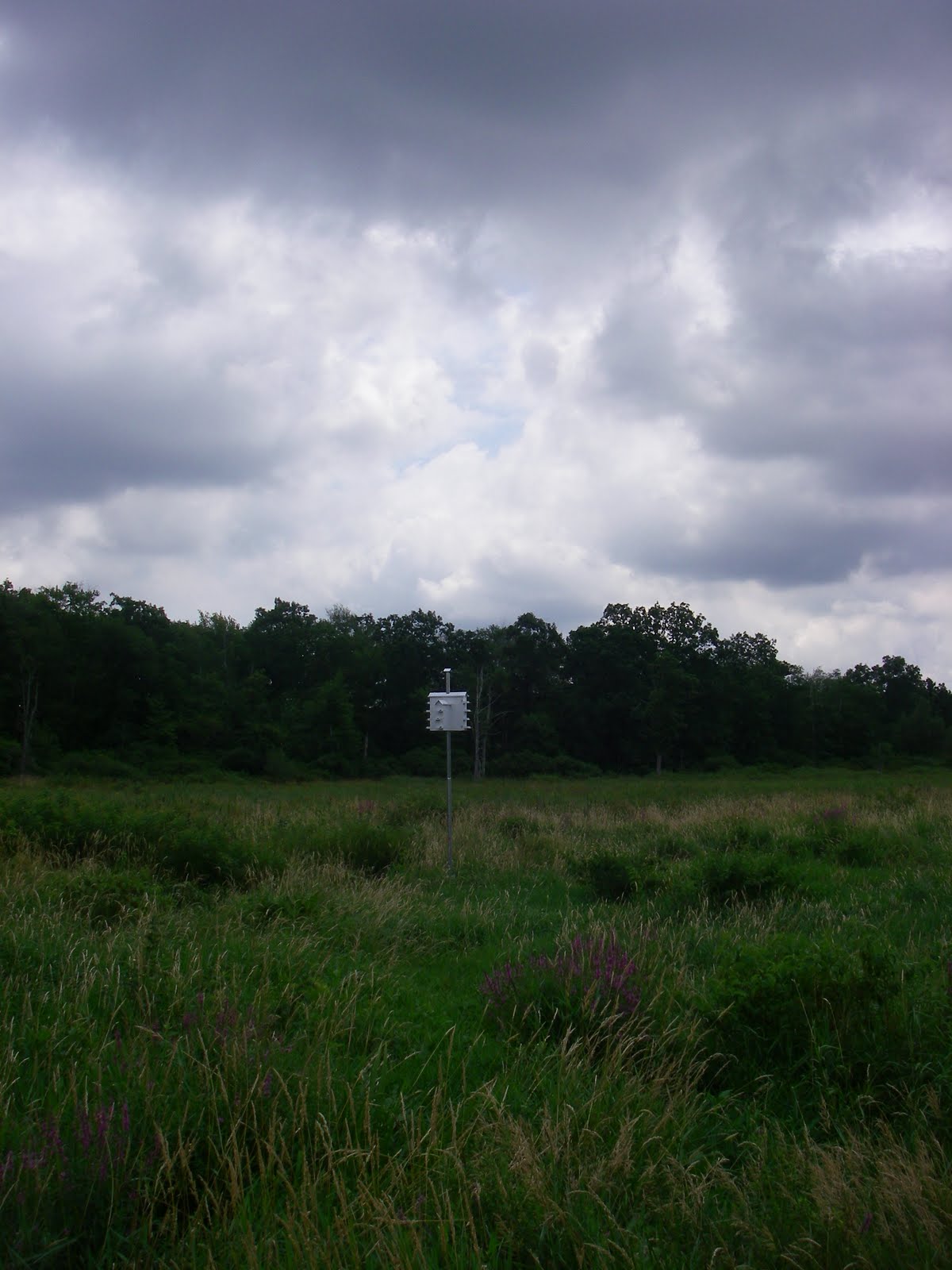
Purple Martin Nest Box Installation

Purple Martin Nest Box Installed at Little Pond Boardwalk
photo by James Fischer

(l to r) Nicole Morin, Marcus Johansson, Dave Rosgen (White Memorial Biologist),
Amanda Downey, and Geoff Krukar (CT DEEP Wildlife Division Technician)
 hoist the Purple Martin nest box into its final position.
photo by James Fischer

We are pleased to announce that a Purple Martin nest box has been installed on the Little Pond Boardwalk near Sutton's Bridge.  Geoff Krukar, CT DEEP Wildlife Division Technician, facilitated the next box installation today.  The nest boxes were purchased using funds from the CT Endangered Species/Wildlife Income Tax Check-off Fund.  Purple Martins are colonial nesting swallow that have high nest fidelity.  It is quite challenging to initiate and maintain appropriate habitat for Purple Martins.  Currently, Connecticut has only a few colonies.  Hopefully, there will be at least one more colony in the state through the efforts of CT DEEP Wildlife Division at White Memorial.  The habitat was a vital consideration in this effort.  The Little Pond vicinity boasts several critical habitats, the most important for Purple Martins is vast herbaceous inland wetland where very few shrubs or trees can grow.  We have observed Purple Martins migrating through the Little Pond vicinity before, so we are optimistic that a colony will start to nest in this new nest box.  The box and pole is specifically designed for them.  The nest box is constructed of aluminum and can be lowered by using a winch and pulley cable system.  So, keep your eyes open for Purple Martins the next time you walk the Little Pond Boardwalk.