 |
| Blue-spotted x Jefferson Salamander Hybrid is one species that we monitor when visiting vernal pools. |

Showing posts with label volunteer workshop. Show all posts
Showing posts with label volunteer workshop. Show all posts
Vernal Pool Monitors Annual Workshop
Vernal Pool Workshop will be held on Saturday 6 April, 2013 from 9:30 a.m. - 2:00 p.m. in the A. B. Ceder Classroom. Bring a lunch, water, and either shoes that you can get wet or knee-high rubber boots. Dress for the weather!
Once again, our Vernal Pool monitors will be gathering to learn about the plants and animals that inhabit vernal pools. Vernal Pools are ephemeral water bodies that fill with water in the spring and serve as predator-free habitats that several important species use for breeding. White Memorial has at least 120 vernal pools on the property, all of which must be visited at least twice per season. The collected data includes egg mass identification and counts, as well as identification of all the species that you find living in a vernal pool. We need your help, so join in on the fun this season.

Songbird Nest Box Program Seeks Volunteer Monitors
Songbird Nest Box Volunteer training will occur on Saturday, March 23, 2013, 10:00 a.m. to 2:00 p.m. in the A. B. Ceder Classroom. Please bring a lunch, paper, and pencil. Dress for the weather.!
 |
| Eastern Bluebird Photo By Bob Stanowski |
 |
Figure 1: Eastern
Bluebirds Counted on USGS Breeding Bird Survey Routes
that Traverse WMF (1967 -
2008), Trend-line Added.
|
 |
| Figure 2: Eastern
Bluebird Summer Distribution Map from USGS Breeding Bird Survey (2006 -
2010). Sauer, J. R., J. E. Hines, J. E. Fallon, K. L. Pardieck, D.
J. Ziolkowski, Jr., and W. A. Link. 2011. The
North American Breeding Bird Survey, Results and Analysis 1966 - 2010. Version
12.07.2011 |
The Songbird Nest Box Program has proven a success for helping to restore Eastern Bluebirds to WMF but it only helps the birds a little. Eastern Bluebirds are not consistently successful at fledging young every year. Connecticut is found in the more northern portion of Eastern Bluebird distribution and southern populations are more abundant than northern populations (Figure 2). This suggests that Eastern Bluebirds are better adapted to a slightly warmer climate. Yet, Connecticut offers enough habitats to make it worth a Bluebird’s effort to still attempt to reproduce because some birds are successful at producing young even though some seasons do not offer the best conditions. Bluebirds migrate as early as they can from winter habitats (April) so that they can locate a nest site, reproduce, incubate eggs, and raise young. This gives the young enough time to develop so they are physically capable of migrating to warmer climates by the next winter. Connecticut’s breeding Bluebird population is vulnerable to early spring weather conditions that could kill young birds due to exposure. Late frosts, extended cold rain, and freezing temperatures contribute to young birds dying. The nest boxes are designed to meet the needs of the birds while they need a nest site by providing as dry a micro-habitat as possible and protecting the birds from predators and non-native species. The habitat around each nest box is managed by mowing and controlling the vegetation so that Bluebirds can find enough food for their chicks. Check the map at the bottom of this page to see the Songbird Nest Box locations. The boxes must be visited to collect data and to assess how the box is functioning. We have designed a program that provides the volunteers with the option of deciding how much time they can commit to the program. Each nest box must be visited at least twice a year but more frequent visits allow us to learn more about the population. If you have only a little bit of time then you can meet the minimum requirements, but if you have more time to commit then the program will benefit. There are several important things to learn about nest boxes and the birds that use them prior to volunteering with the program. Therefore, we require that if someone wishes to volunteer their time, they must attend a training session offered by WMCC Staff.
Vernal Pool Volunteer Monitoring Workshop
 |
| Blue-spotted x Jefferson Salamander is frequently observed breeding in White Memorial's vernal pools. |
A total of 9 volunteers attended the Vernal Pool Monitoring workshop on Saturday, March 31, 2012. We explored a nearby pool to observe the life found inhabiting it. Amphipods, Isopods, and Fingernail Clams were quite abundant. A few Spotted Salamander egg masses were also observed. This work is important because several of these species are obligate most, if not all, of their breeding activity in vernal pools. The long-term conservation of these species depends on the conservation of this habitat. These habitats are difficult to classify because they can be ephemeral and isolated far away from other habitats used by these species.
Vernal Pool Monitoring Workshop
 |
| Wood Frog Photo by Donna Potwin |
I am pleased to announce that the wood frogs are clucking! Therefore, we need to schedule our Vernal Pool Monitoring Workshop. The workshop will be Saturday, March 31, 2012 from 12:00 p.m. to 3:00 p.m. in the Mott-Van Winkle Classroom. Come dressed for the weather and for walking in the water. Bring your field guides, nets, and smiles! See you then!
Aldo Leopold Inspired Conservation and Museum

Aldo Leopold inspired us to host a pop-up museum and conversation about conservation at our recent Adult Sleep-In Event. We created a Shack, like Aldo Leopold's Shack, complete with taxidermy and other household items that you would find in Aldo's shack. Check out the website that we created to highlight all of the activities. http://wmccleopoldshack.blogspot.com/
Cold Feet
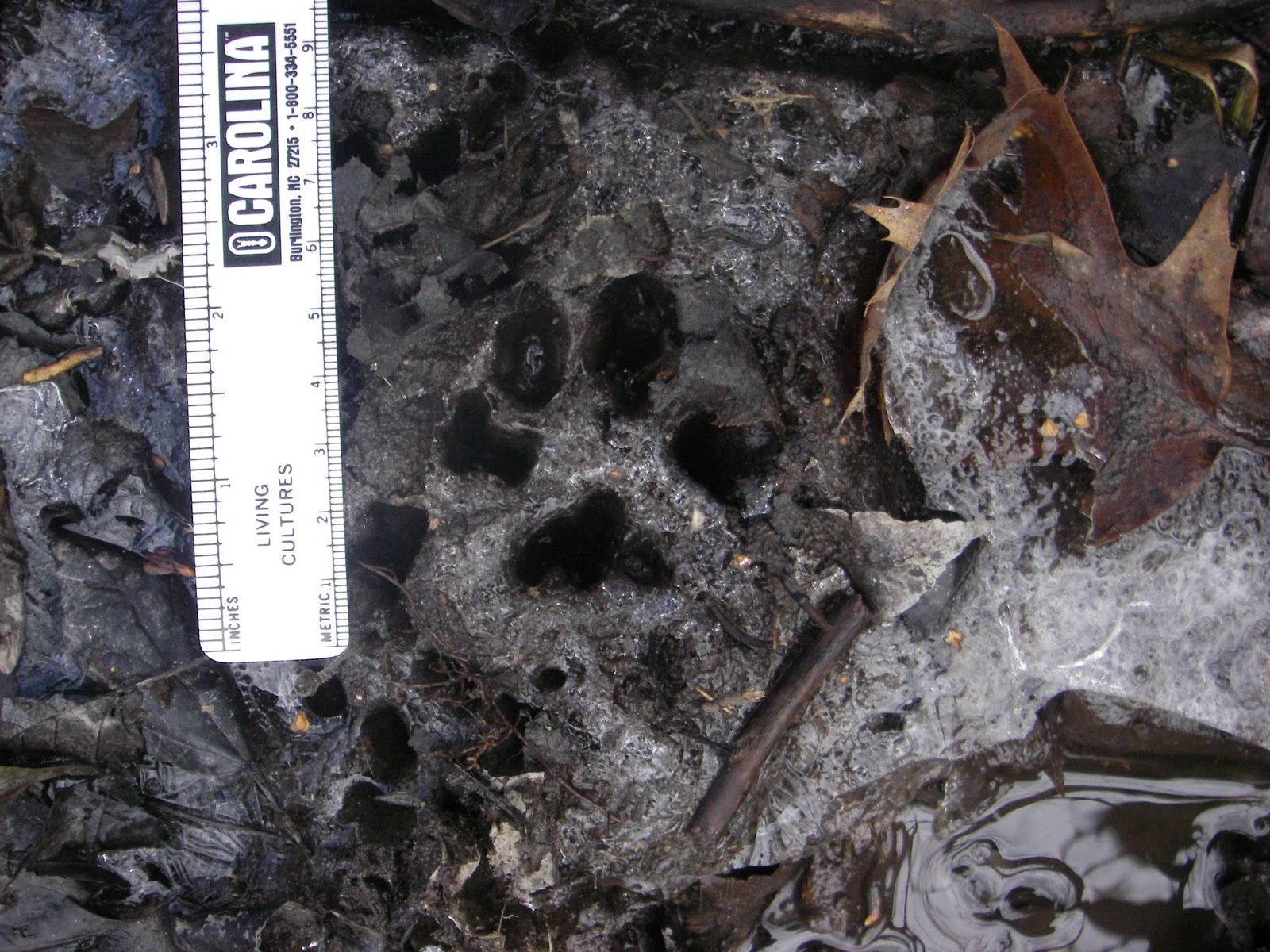 |
| Bobcat (Lynx rufus) track frozen in mud and ice. Photo by James Fischer |
Japanese Barberry Control Workshop Review
 |
| Jeff Ward, Chief Forester CT Ag. Exp. Station (CAES) and wearing white ball cap with plaid-flannel at left, introduces the topics that will be discussed during the workshop. |
I'm sure most of you understand that there is a problem when anything negatively
influences native trees and plants, but earthworms!
What's wrong with earthworms?!
Earthworms are not native to southern New England soils because our landscape was covered by glaciers only 15,000 years ago and these 1 mile thick ice blocks prevented earthworms from colonizing our soils. Although earthworms might be considered a positive thing in your garden, they are not a good thing in forests. Earthworms consume the leaf litter layer at an astonishing rate, which as you already know the lack of a healthy leaf litter layer encourages soil erosion. This workshop was a real lesson in forest ecology!
The principle investigators of this project are Jeff Ward (CAES), Scott Williams (CAES), Thomas Worthley (UCONN Coop. Ext.), and J. P. Barskey (CAES). They have discovered that managing Japanese Barberry is at least a two-step procedure. First, the healthy barberry shrub needs to be treated with herbicide, prescribed burning, propane torch, or is cut down with a mechanical method. After the plant sends up new shoots the following growing season, a second treatment is required by using a propane torch or herbicide. Safety equipment and considerations, costs of equipment, materials, and labor were also discussed. Further evidence was provided demonstrating that infected tick density decreases after these treatments are applied. As well as, evidence that showed how Japanese Barberry responded if the second treatment was not applied, it returns with gusto!
In the following images you can see the various methods that were demonstrated by Mike Short (CAES Technician) during this workshop, but also notice that the orange-red hue in the forest understory, all of this is Japanese Barberry!
 |
| Walk behind self propelled brush mower. |
 |
| Brush Saw |
 |
| Star brush blade on a brush saw. |
 |
| Yellow heart wood of a mulched Japanese Barberry shrub. |
 |
| Jeff Ward demonstrates the use of a propane torch burning Japanese Barberry clumps to kill buds. |
Japanese Barberry Control Workshop Announcement
 |
| Click Here to View a Printable Flyer |
Invasive plant species including Japanese Barberry have been found to increase the risk of exposure to Lyme Disease. Controlling Japanese Barberry can reduce the risk of exposure to Lyme Disease while also increasing growing space for native wildflowers and tree seedlings.
During this workshop, you will learn techniques for an integrated program of invasive plant control in forest understories including: treatment techniques (flame weeding, mechanical control, herbicide application), site evaluation, time estimations for treatments, and field safety. There will be a hands-on demonstration of techniques and equipment.
Instructors: Jeffrey Ward (CAES), Thomas Worthley (UCONN - Coop. Ext.), J. P. Barsky (CAES)
Date: Tuesday, November 15, 2011
Place: White Memorial Foundation, Point Folly Campground Entrance on N. Shore Rd., Litchfield, CT along Bantam Lake.
Time: 10:00 a.m. to 1:00 p.m.
Workshop is Free of Charge
Pre-Registration Required
Space is Limited, Register Early
Contact Thomas Worthley
Pre-Register or for more information
(860) 345-5232, thomas.worthley@uconn.edu
CEU Credits Approved for this Course include: CT Certified Forest Practitioner (1.0 hours)
3 credits for Forest Pest Control (2), Ornamentals and Turf (3A), Rights-of-Way (6)
Cerceris Wasp Field Trip Results
 White Memorial staff, interns, and volunteers
gathered around a Cerceris Wasp colony at
St. Anthony's Cemetery on White's Woods Rd.
On Thursday, 7/7/2011, 9 White Memorial staff, interns, and volunteers took a field trip to St. Anthony's Cemetery on White's Woods Rd. in Litchfield to learn more about Cerceris Wasps from Claire Rutledge of the CT. Agricultural Experiment Station. James Fischer had previously located a small colony of these wasps here, so it provided an ideal setting to learn more about them. We found 13 holes in the hard-packed soil along a little-used dirt driveway. These wasps seem to prefer hard soil over soft. The photo below shows a wasp peeking out of its hole.

The photo below shows a typical Cerceris wasp
hole with a pile of course-grained soil around it.


Claire supplied us with nets, collecting bags, hole collars, and other equipment that we can use to steal Buprestid beetles from the wasps when they return to their burrows with these prey items. The primary goal is to monitor for the non-native, invasive, and highly destructive Emerald Ash Borer beetle, which is in the Buprestid group, and which is readily captured by these wasps in the Great Lakes states. They haven't been found yet in Connecticut, but this is a relatively easy way to monitor for their presence.
Volunteer Workshop -- Cerceris Wasps as a Bio-surveillance for Emerald Ash Borer PART 2!
 |
| Cerceris fumipennis female defending nest from rival females. photo by Mike Bohne www.cerceris.info |
Part 1 was attended by 25 people, what an awesome audience! Now it's time for Part 2 (The Field Portion), which is scheduled for Thursday July 7, 2011, 11:30 a.m. to 1:00 p.m. We'll meet at the A. B. Ceder Classroom. Dress for the weather, hopefully warm and sunny so the wasps are out hunting! Please contact James Fischer james(at)whitememorialcc.org, if you are interested in attending. See you there!
Volunteer Workshop -- Cerceris Wasps as a Bio-surveillance for Emerald Ash Borer
 |
| Emerald Ash Borer photo by Phillip Careless www.cerceris.info |
Emerald Ash Borer is another invasive species threatening Connecticut's biological diversity. This insect feeds on and kills ash trees. One method used to detect Emerald Ash Borer as part of Connecticut's early warning system is to use Cerceris Wasps. Cerceris Wasps are a native species that predate buprestid beetles, which includes the Emerald Ash Borer. The efficacy of this surveillance method for EAB is better than many of the other methods that are being employed. Yet, the best survey scenario is when all of the surveillance methods are incorporated collectively. We need your help! We need volunteers to observe Cerceris Wasp colonies and collect the prey that they collect. These prey insects will be identified by entomologists to see if Emerald Ash Borers have invaded the state/region. Claire Rutledge, CT Agriculture Experiment Station Entomologist, will facilitate a workshop on Tuesday June 28 at 1:30 p.m. in the A. B. Ceder Classroom to teach us how to perform this work. This will be Part 1 of that 2 part workshop. The second session will include the field methods and will be scheduled at the first session. If you have any questions please contact James Fischer. james(at)whitememorialcc.org or 860-567-0857
 |
| Cerceris fumipennis with native buprestid prey photo by Mike Bohne www.cerceris.info |
Frog and Toad Call Study Guide
We are surveying frogs and toads at White Memorial by call recognition. This is a study guide for volunteers to become more familiar with the calls of the frogs and toads that we are searching for on the property. If you are interested in volunteering to help our survey efforts please contact White Memorial for more information (860-567-0857).
How to use this study guide:
Play each video and observe the animal vocalizing their call. You can play more one video at the same time to hear each call in close proximity. This could be useful for vocalizations that have similar qualities such as the American toad and Fowler's toad. You can also hear in several of these videos the songs of other species other than the focal species. Can you identify the calls in the background? Feel free to make a tape of the calls in the field at your survey points and compare them to the calls on this study guide. Frogs and toads will have regional dialects to their vocalizations, just like songbirds. Can you identify any of these variations?
American toad
Fowler's toad
Bull frog
Northern leopard frog
Pickerel frog
Green frog
Spring peeper
Wood frog
Gray treefrog
Northern leopard frog
Pickerel frog
Green frog
Spring peeper
Wood frog
Gray treefrog
2011 White Memorial Foundation Property-Wide Frog Call Survey Workshop
Saturday, March 19, 2011
5:00 p.m. to 8:00 p.m.
A. B. Ceder Classroom
|
| Wood frog Photo By Donna Potwin |
We are continuing our property wide survey for frogs and toads by identifying their calls. Laura Saucier, CT DEP, Wildlife Technician, will facilitate our workshop. We will be discussing the importance of monitoring these species and their natural history. Please dress for the weather and wear sturdy footwear because there will be activity in the field. This program will be a rain or shine event.
Winter Track Training

See all of the happy faces! They are returning from an excursion that found bobcat and coyote tracks!
This message has been sent using the picture and Video service from Verizon Wireless!
To learn how you can snap pictures and capture videos with your wireless phone visit www.verizonwireless.com/picture.
Note: To play video messages sent to email, Quicktime@ 6.5 or higher is required.
Winter Track Transect Workshop -- Saturday, 8 Jan. 2011

Saturday, 8 January 2011
9:00 a.m. to 3:00 p.m.
Free Workshop for Volunteers helping with Winter Track Transects!
Bring a lunch, water, and dress for the weather.
James Fischer will introduce the basics of snow track identification and how the transects are to be conducted for the season. Please make every effort to attend, even if you have participated in the past. The program has several new modifications to the protocols which address new program objectives. This workshop will be conducted rain, snow, or shine. There will be classroom
and field introductions. We will be developing our senses to encourage our awareness of our environment. We will also increase the accuracy and precision of our observational skills. This will be a workshop that you do not want to miss.
Topics include species natural history introductions, interpreting tracks and gait patterns, critical habitat introductions, track photography, and much more!
Please contact James Fischer if you are interested in participating in this year's Winter Track Transects.
Subscribe to:
Posts (Atom)