Showing posts with label Spotted Salamander. Show all posts

Amphibian Cover Board Experiment Monthly Check -- September 2012

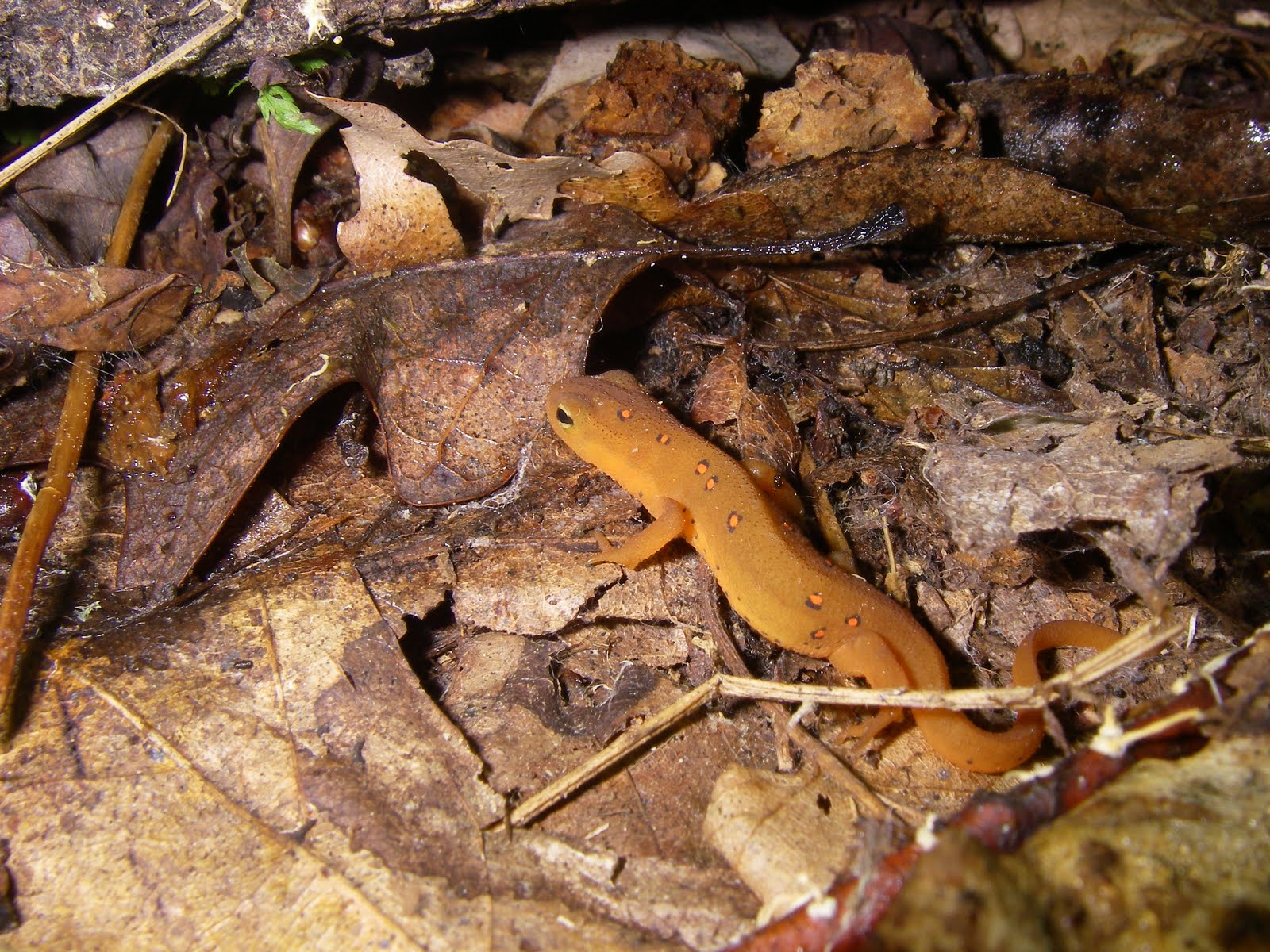
Amphibian cover boards were checked Friday, September 7th and revealed some great finds. First off, there were a total of twenty-nine Red-backed Salamanders and seven Red Efts found underneath the cover boards. Also uncovered was one Spotted Salamander. Spotted Salamanders do not usually reside under the cover boards but are often found near vernal pools and in crevices of rock walls and tunnels. Most importantly, there were two Blue-spotted x Jefferson Salamanders at two different sites. Based on the small size of these two salamanders, we assumed that they had just metamorphosed into the terrestrial adult stage, which takes place by September.  

Blue-spotted x Jefferson hybrid Salamander

The conditions for checking cover boards Friday were ideal due to the heavy rain at the beginning of the week. The warm, humid weather, also contributed in creating moist soil conditions that are favorable for amphibians. Since fall is around the corner we can expect drier, cooler conditions, but we can still anticipate to see some salamanders under the cover boards. During the winter months when temperatures reach close to freezing, (32-41° F) salamanders will go into hibernation on land and burrow under logs, rocks, and loose soil in order to maintain a stable body temperature. During this time the salamander’s metabolism is greatly reduced, thus decreasing the amount of calories burned to successfully make it through the winter. By early spring, rain and warmer temperatures wake the salamanders just in time for the breeding season.

Spotted Salamander
Juvenile Red-backed Salamander


Vernal Pool Volunteer Monitoring Workshop

Blue-spotted x Jefferson Salamander is frequently observed breeding in White Memorial's vernal pools.

A total of 9 volunteers attended the Vernal Pool Monitoring workshop on Saturday, March 31, 2012.  We explored a nearby pool to observe the life found inhabiting it.  Amphipods, Isopods, and Fingernail Clams were quite abundant.  A few Spotted Salamander egg masses were also observed.  This work is important because several of these species are obligate most, if not all, of their breeding activity in vernal pools.  The long-term conservation of these species depends on the conservation of this habitat.  These habitats are difficult to classify because they can be ephemeral and isolated far away from other habitats used by these species.

Spotted Salamander moving on Groundhog Day?!

This Spotted Salamander was observed on February 2, 2012 near
No Mans Land Swamp on Stoddard Rd. (a.k.a. Morris Hill Rd.), Morris, CT
by David and Gabby Peters.  An early date for observing these guys, indeed!

Geez it's warm outside!  Our winter has been a mild one so far with little snow and mild winter temperatures.  It looks more like the land of eternal spring rather than the winter of discontent!  Our first harbinger of spring was a Spotted Salamander observed by one of White Memorial's neighbors on February 2, 2012.  Rather early for these guys, but so far it is the only report. We are not observing anything that suggests migratory movements back to their breeding habitats, yet.  This guy suggests that we probably need to finish our Winter Track Monitoring and getting ready for the Vernal Pool Monitoring program.  Stay tuned for further details about the next training date!

Amphibian Coverboard Experiment Monthly Check -- October 2011

Spotted Salamander (Ambystoma maculatum) discovered under a
cover-board just as it emerged from it's mole-like tunnel.
Photo by James Fischer  
I observed an amphibian at 57.6% of the cover-board (CB) stations yesterday.  This is the highest proportion of stations that detected an amphibian ever observed during our monthly visits to this site over the past 2.5 years!  This is exciting news but I want to tell you about another interesting observation that I made.

A yellow-hued Spring Peeper (Pseudacris crucifer) camouflaged
among newly fallen autumn leaves.
Photo by James Fischer  
The CB grid spans across two stands of trees, one stand is dominated by deciduous trees while the other are evergreen trees.  The CB stations under the deciduous trees detected more amphibians than the stations under the evergreen canopy.  This puzzled me while I was traversing the grid from station to station.  I walk the grid a systematic fashion so that it takes less time.  I walk the grid along the lines within the grid from the evergreen stand to the deciduous stand and back again.  But that question kept bugging me. Why were more amphibians observed under the CB's in the deciduous stand rather than the conifer stand?  I think I may know but I need to tell you about another pattern that I observed whilst walking the line.  This was a new pattern for me this season.  I was wearing my sunglasses while I was in the deciduous stand and not in the evergreen stand.  Okay, if I lost you, please keep reading because there is a reason why this is important.

Just as I was beginning to get frustrated with having to pull out my sunglasses from my pocket each time I entered into the deciduous stand, the light hit my eyes and my skin began to feel warm!  Yes, it was noteworthy moment but not the kind you may be thinking of.  I began to think that the amount of sunlight penetrating the forest floor could have been one factor causing this pattern.  It is now autumn in southern New England and many of the leaves have already fallen from the deciduous trees allowing more of the sunlight to reach the forest floor.  The CB's under the deciduous trees should be warmer than their evergreen counterparts, which explains why so many amphibians were observed under these boards.  But lets not rush to this conclusion too quickly!  There could be several other explanations.  I'll offer another possible process just to demonstrate how complex a walk in the woods can sometimes be to biologists and ecologists.

Northern Two-lined Salamander  (Eurycea bislineata) found
under a cover-board near a spring seep.
Photo by James Fischer
Another explanation could be that the leaf litter on the forest floor could also be warmer and more importantly dryer under the deciduous trees while the conifer stand could be cooler and moister.  The amphibians in the deciduous stands would seek out shelter that offers a moister environment.  The amphibians inhabiting the evergreen stand would not have to seek out these micro-habitats.  Moisture is very important to a group of organisms that breathe through their skin.  Moist skin allows for more oxygen to transpire than drier skin.  Amphibians breathe through their skin as an adaptation which has allowed them to lower their metabolism as they evolved which means they require less energy to live.

Who knew flipping cover-boards and a walk in the woods could be so complex...

Amphibian Cover-Board Experiment Monthly Check -- July 2011

Wall Flower
A Grey Treefrog trying to blend into exterior of White Memorial's Green Barn.
photo by James Fischer
Becca Solnit and Ryan Gannon helped check amphibian cover-boards examining the differences of detection rates between soft and hard wood types.  We encountered 28 Redback Salamanders, 11 Red Efts, and 1 Spotted Salamander under the softwood boards.  A total of 20 Redback Salamanders, 17 Red Efts, and 1 Two-lined Salamander were observed under the hardwood boards.  We have a total of 132 stations examining the boards in a pairwise comparison, of which 45 (34%) stations had amphibians.  The weather was mild with temperatures in the mid 70's to low 80's (degrees Fahrenheit) and complete cloud cover.  Although the ambient relative humidity was high, the leaf litter and humus was fairly dry, which may explain why there were so few stations with amphibians today.

Amphibian Cover-Board Experiment Monthly Check -- June 2011

We checked our cover-board experiment comparing soft and hard wood types in a pair-wise comparison yesterday.  Olivia Riccio and Rebecca Solnit (granddaughter of the owners who donated the land that hosts this experiment) were cowhands by checking most of the boards and calling out the species identification as we progressed through the grid.  We observed 69 redback salamanders, 4 red efts, 1 spotted salamander, and 1 wood frog under the boards.  A total of 55 out of 132 stations detected an amphibian.

Spotted Salamander photo by James Fischer

Redback Salamander photo by James Fischer

Lead phase Redback Salamander photo by James Fischer

Red eft life stage of Red-spotted Newt photo by James Fischer

Adult Wood Frog photo by James Fischer