Showing posts with label Redback Salamander. Show all posts

Amphibian Cover Board Monitoring

Redback Salamander observed under a cover board.
Photo By James Fischer
I checked the cover board grids that we use to monitor amphibian populations in the Museum vicinity.  We monitor a total of 8 grids that are placed near or in critical habitats.  I observed a total of 46 Redback Salamanders (Plethodon cinereus) under the boards.  I observed a total of 32 salamanders under coniferous tree canopy and only 14 under the deciduous tree canopy.  I hypothesize this pattern is due to the difference in the forest floor under the two canopy types because the leaf phenology is different right now.  The deciduous trees' leaves are beginning to burst buds while the conifer trees are evergreen.  The forest floor under these two cover types differs a little bit.  The forest floor under the conifer cover was a little bit more damp and cooler while the deciduous forest floor was little bit drier and maybe warmer.  The lack of leaves in the deciduous cover is letting the sunlight penetrate the canopy and dry the forest floor. I wanted to know if this pattern was significantly different from a random or equal distribution.  I chose to use a chi-square analysis to detect if the observed pattern was statistically significantly different enough from the expected pattern (a random or equal number under each canopy type).  The chi-square analysis confirms that the pattern that I observed was significantly different from an equal distribution.  This statistical test does not necessarily confirm my hypothesis entirely but it tells me that I might be on the right track with my reasoning.

Amphibian Cover-board Experiment -- Monthly Check

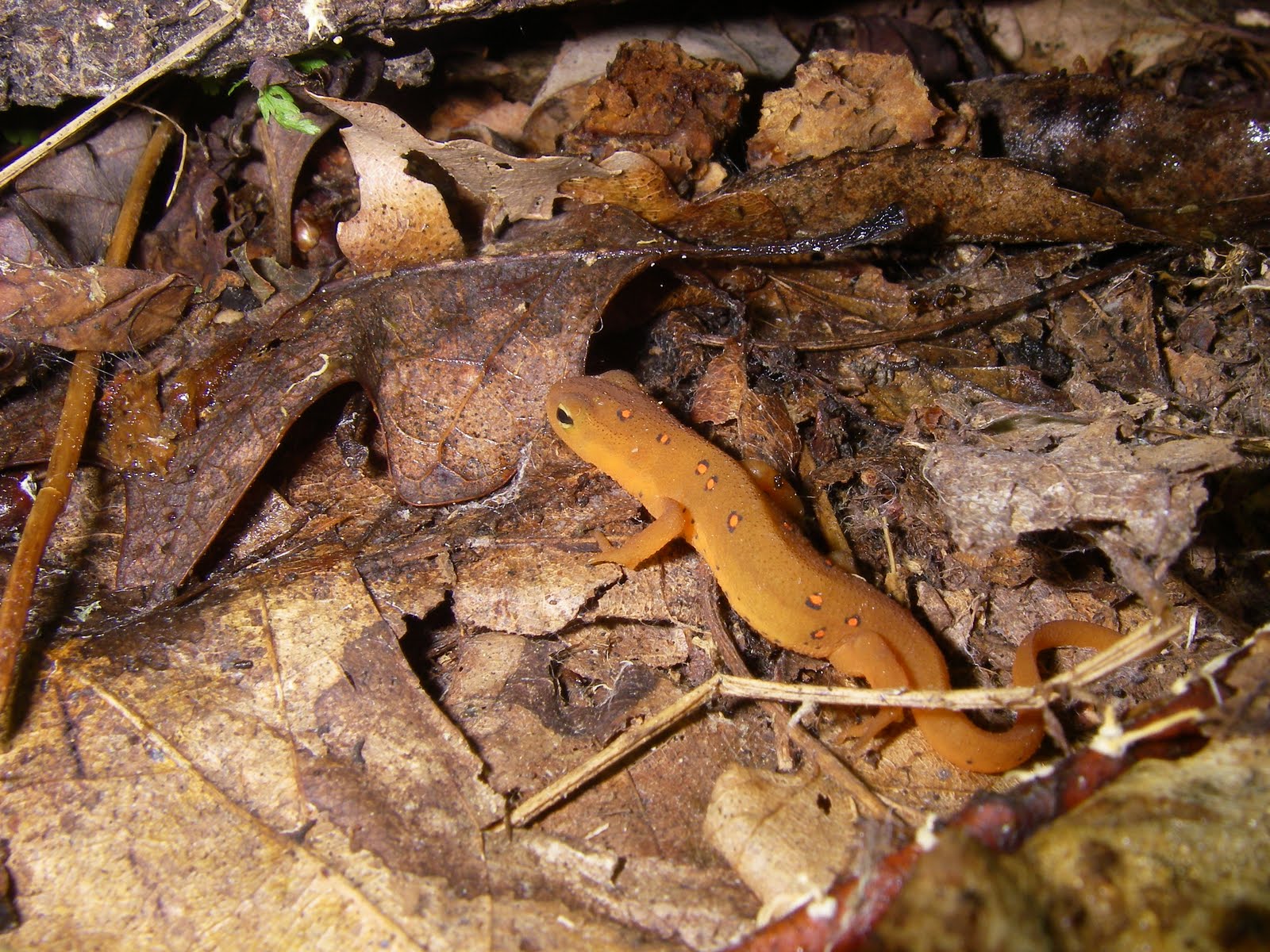
Red Eft Life Stage of the Red-spotted Newt
photo by James Fischer
We revisited the cover-board experiment grid and observed a few interesting patterns.  Faye Curran, a new student intern, helped us today with this project, please visit the blog in a couple days to read her introduction.  Recently, we have recorded almost 14 inches of rain from Hurricane/Tropical Storm Irene and Tropical Storm Lee.  Although most of the surface run-off has slowed, there is still quite a bit of water in the forest percolating into the soil column from vernal pools or bubbling out of springs.  The amphibian cover-boards encounter rate appears to have been affected by all of this precipitation.  A total of 65 of the 132 cover-board stations detected an amphibian, which is the second highest percentage of cover-board stations detecting amphibians since the project started 2.5 years ago.  We encountered a total of 79 Redback Salamander (Plethodon cinereus), 19 Red Eft (Notophthalmus viridescens), 2 Two-lined Salamander (Eurycea bislineata), 1 Four-toed Salamander (Hemidactylium scutatum), and 1 Wood Frog (Rana sylvatica).  The primary question of this project is to examine the differences between softwood and hardwood cover-boards amphibian detection rates using a pair-wise comparison experiment.  The softwood cover-boards detected a total of 57, while the hardwood boards detected 45 individuals.

Amphibian Cover-Board Experiment Monthly Check -- July 2011

Wall Flower
A Grey Treefrog trying to blend into exterior of White Memorial's Green Barn.
photo by James Fischer
Becca Solnit and Ryan Gannon helped check amphibian cover-boards examining the differences of detection rates between soft and hard wood types.  We encountered 28 Redback Salamanders, 11 Red Efts, and 1 Spotted Salamander under the softwood boards.  A total of 20 Redback Salamanders, 17 Red Efts, and 1 Two-lined Salamander were observed under the hardwood boards.  We have a total of 132 stations examining the boards in a pairwise comparison, of which 45 (34%) stations had amphibians.  The weather was mild with temperatures in the mid 70's to low 80's (degrees Fahrenheit) and complete cloud cover.  Although the ambient relative humidity was high, the leaf litter and humus was fairly dry, which may explain why there were so few stations with amphibians today.

Amphibian Cover-Board Experiment Monthly Check -- June 2011

We checked our cover-board experiment comparing soft and hard wood types in a pair-wise comparison yesterday.  Olivia Riccio and Rebecca Solnit (granddaughter of the owners who donated the land that hosts this experiment) were cowhands by checking most of the boards and calling out the species identification as we progressed through the grid.  We observed 69 redback salamanders, 4 red efts, 1 spotted salamander, and 1 wood frog under the boards.  A total of 55 out of 132 stations detected an amphibian.

Spotted Salamander photo by James Fischer

Redback Salamander photo by James Fischer

Lead phase Redback Salamander photo by James Fischer

Red eft life stage of Red-spotted Newt photo by James Fischer

Adult Wood Frog photo by James Fischer

Amphibian Cover-Board Experiment Monthly Check

Redback Salamander (Plethodon cinereus) observed under a cover-board.
This experiment compares softwood versus hardwood cover-boards to observe if there is a significant difference between the detection rates of amphibian species inhabiting our temperate forests.  Redback Salamander (Plethodon cinereus) and Red Eft juvenile form of the Red-spotted Newt (Notophthalmus viridescens) comprise the bulk of the amphibian species we observe in our study site.  We check the boards once a month when the weather conditions meet a specific set of criteria which insures the bulk of animals are found under the boards rather than wandering throughout the study area.  This experiment began two years ago and we are entering into our third season.  We hope to publish the results soon, but we observed 56 Redback salamanders under the softwood cover-boards and 41 under the hardwood cover-boards.  Only 2 Red Efts were found under the softwood boards while 5 were observed under the hardwood boards.  Considering that we had freezing temperatures most nights only a few weeks ago, these observations suggest that we have quite a few animals in our study site.  Check back to hear more about our progress with this experiment.