Showing posts with label small mammal. Show all posts

Small mammal trapping to determine tick burdens on Lyme disease reservoir species

     We have been setting nonlethal traps on sixteen plots throughout the property to catch small mammals.  Traps are set for three consecutive nights, and are checked early in the morning.  Each small mammal is weighed, measured, and tagged on the ear with a unique identification number that allows us to recognize individuals that have been caught more than once.  The main objective of our small mammal trapping project is to determine the tick burden the mammals are carrying. This late in the summer, we are most likely to encounter larvae, although we have found that some nymphs are still present.
Left: A tick larva (above my thumb) and nymph (above my thumb and slightly to the
right)  Right: A close-up of the larva (note: larvae have six legs while nymphs and
adults have eight)

     White-footed mice (Peromyscus leucopus) are the most common small mammals we catch, and they are also a major host species for black-legged or deer tick (Ixodes scapularis) larvae and a reservoir for Lyme disease (Borrelia burgdorfer).  In order to pass from one life stage to another, ticks require a blood meal, after which they drop off to molt and must find a new host.  Larvae often attach to small mammals or birds, and if a larva's host is carrying the bacterium B. burgdorfer, that larva will carry Lyme disease and spread it to future hosts.  For more information on the tick life cycle and how they spread Lyme, click here.
     When we catch a small mammal, we count and remove tick larvae and nymphs.  If we catch the same small mammal more than once in a three-day period, it allows us to see how quickly they are picking up new ticks  This can help us understand the abundance of ticks in each area.  Trapping will also give us a better understanding of small mammal subpopulations, demographics, and diversity throughout the property.
White-footed mouse (Peromyscus leucopus) being checked for ticks.
     Most of the ticks we find on small mammals are on the head, especially the ears.  It is estimated that ticks found on the head make up about 40% of the animal's entire body tick burden.  One unlucky individual had 31 tick larvae on one ear and 26 on the other, in addition to carrying a botfly larva.  This was an extreme case, and tick burdens vary from one site to the next.  
     One of the white-footed mice we've caught is a veteran of last summer's mouse over water experiment.  Last year he was caught, tagged, and kept for seven days in an enclosure over water until his ticks dropped off into the water and could be counted.  The mice in that experiment were well-fed and released near where they were originally caught.  This year, he was caught on three consecutive trapping days, and seems to have decided that having an easy meal is worth being handled.  
Trap-happy #46, calmly enduring being handled
     So far we have finished trapping at three of our sixteen sites.  Sadly, we had to say goodbye to #46 and leave him to forage for food like a real mouse.  The data we have gained from this project will be used along with the tick phenology data and earthworm data from the same plots to better understand the relationship between tick populations and survivorship and the presence or absence of invasive earthworms.    

White Memorial's Terrestrial Small Mammal Inventory

Juvenile Masked Shrew (Sorex cinereus)
Photo by James Fischer
Inventorying terrestrial small mammal species requires the use of multiple survey methods to insure a thorough assessment of all species.  We are preparing for this project during 2012 and will need help by a series of dedicated volunteers.  Every volunteer will receive training and advisement during the course of this project.  Our goal is to assess the species of terrestrial small mammal species that inhabit the critical habitats found on White Memorial Foundation property.  We will focus our survey efforts on the shrews and moles (Order Insectivora - insect eaters), as well as squirrels, mice, and voles (Order Rodentia - gnawing mammals or rodents).  These species are often overlooked by inventory efforts because they are secretive, even though they are abundant and widespread.  These species are important because they are prey species for many of our predators or serve as predators themselves to many invertebrate organisms.  Some of these species have been found to serve important ecological roles in the disease transmission that affect humans (i.e. Lyme Disease).  And their most important role of all is that they are challenging to work with, which forces you to put on your ecological detectives hat when you explore their lives.  Life's greatest gifts come from its biggest challenges and can be found in the smallest of packages.  If you are interested in helping with this survey please contact James Fischer, WMCC Research Director.  There is much to be done to get ready for the season, so every bit of help ahead of time is greatly appreciated.

Flying Squirrels in the Attic

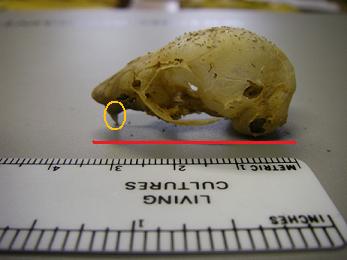
James Harmon, a White Memorial employee, found this Southern Flying Squirrel (Glaucomys volans) skull in the Carriage House attic.  I want to show you some of the features that helped us distinquish this skull from other squirrel species.  It is recommended that you use calipers to record measurements, but in this blog entry rather than emphasizing the measurements I want to clue you into the characters that we like to use in the field.  Further analysis is always best when you compare and contrast several skulls from known species, which are conserved at natural history collections.

The first thing that told us it was rodent was that it had only two front teeth with a large gap, where the canine teeth would have been located, before the rest of the cheek teeth (premolars and molars).  The red line delineates the total length of the skull.  The cheek teeth are rooted and several other subtle characters allowed us to focus on the tree squirrel species that live in this area. 
The yellow circles at the beginning of the cheek teeth delineate the presence of very small premolars, this character distinguishes Red Squirrels (Tamiasciurus hudsonicus) and Gray Squirrel (Sciurus carolinensis) from flying squirrels.  The total length of the skull tells us it is a Southern Flying Squirrel from a Northern Flying Squirrel (Glaucomys sabrinus).

Winter-time Owls at White Memorial

Photo By Darlene Knox
Owls are never easy to find, and are much more often heard than seen. However, during the winter, when they are stressed by hunger and by snow cover hiding their small mammal prey, they are more likely to be seen hunting during the daytime. The Barred Owl in the photo above was seen along the Windmill Hill Trail in a semi-open woodland situation where it had a good view of the trail and surrounding area. Any small mammal venturing out into the open here would surely be caught and eaten by this owl. Barred Owls aren't too vocal at this time of year. They become more territorial later in February. They are especially prone to hooting in March and April. There are several pairs of these birds found on White Memorial property, but the ones at Windmill Hill seem to be the least shy around people. Great Horned Owls are very vocal now as they firm-up their territorial boundaries. They will probably choose an old crow or hawk nest or hollow of a dead tree as a nest site next month, and mate and lay eggs some time in March. Anyone wishing to hear them hooting, and maybe even see one, should park in front of the Museum around 5 p.m. when it is clear and calm. A pair of GHO's has called the White Pine woods north of the Museum their territory for many years. Another pair can regularly be found along the western side of Catlin Woods. We know of 3 territorial Eastern Screech-Owls and a couple of Northern Saw-whet Owls on the Property, but we don't disclose their exact whereabouts because they are much more easily disturbed by people. The Screech-Owls are year-round residents, but the Saw-whets are only here for the winter. They most likely came from Canada or northern New England. It has been at least 15 years since a Long-eared Owl has been detected on the Property. They have become very rare. If you do come out to White Memorial to listen and look for owls, please do not use tape playback to elicit responses from them. It can disturb them to the point where they will abandon their territory; or even attack the person holding the tape player. We probably will offer an "owl prowl" for the public sometime this spring, so keep watch for an announcement in our next newsletter.