Showing posts with label Alyce Walker. Show all posts

New England Cottontail Habitat Management Project -- Species Documentation

Cottontail scat was collected throughout the Habitat Management Project
 to determine the species and abundance of cottontails at Apple Hill on January 22, 2013. 

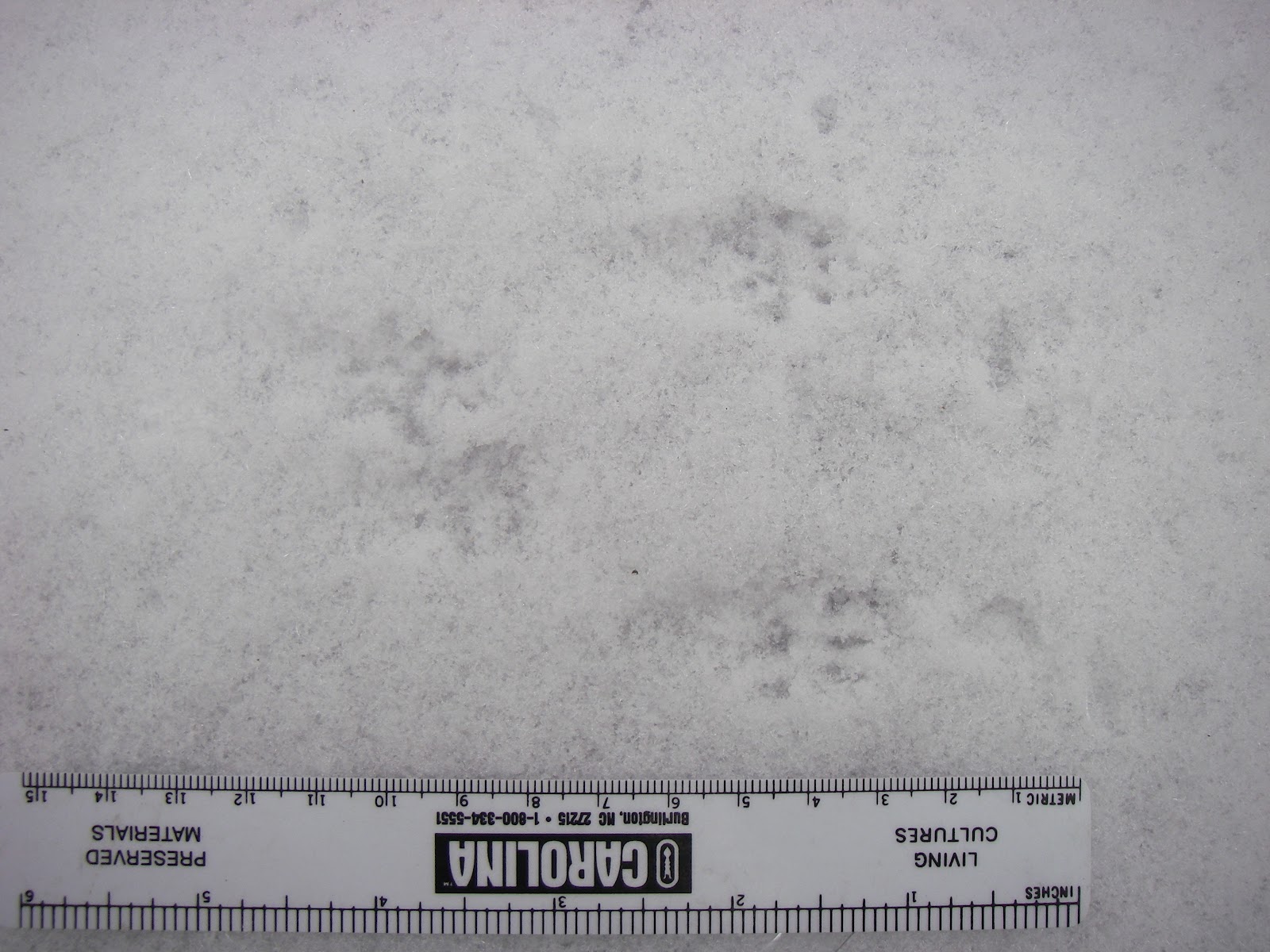
Nicki Hall and Alyce Walker helped collect cottontail scat at the Habitat Management Project at Apple Hill that targets the conservation of the New England Cottontail.  We collected a total of 14 pellets throughout the study area after approximately 0.75 inches of snow accumulated yesterday evening.  It was great conditions to collect scat samples for this project because it remained cold enough throughout the preceding evening and this morning that we could take our time following every trail that we encountered to observe scat.  There was plenty of cottontail tracks and scat throughout the area, especially where the shrubby cover was very dense.  The scat will be transported to our colleagues at CT DEEP, Wildlife Division, who have advised us throughout the term of this project.  The scat will be used to extract molecular information that will tell us which species inhabits the Apple Hill area.  Two species of cottontail reside in Connecticut.  The native species that adapted and evolved to the ecological processes in our region is called the New England Cottontail (Sylvilagus transitionalis).  The other species that was introduced to the state and has become more common is the Eastern Cottontail (Sylvilagus floridanus).

Cottontail Scat and Tracks in Snow.


Waterfowl Nest Boxes 2013 Breeding Season


Waterfowl Nest Boxes are checked every winter
to review success of each breeding season

We've nearly completed reviewing the breeding success of waterfowl that use the nest boxes located throughout the property.  We currently have a total of 25 nest boxes installed and functioning within normal parameters.  Breeding was attempted in 21 of the nest boxes.  Nicki Hall and Alyce Walker volunteered a great deal of time this year to aid in this process.  Ice conditions were suitable for a short period of time but we managed to reach the boxes that require more ice early on and then were able to access the other boxes soon afterwards.  We had only 8 hooded merganser eggs hatch and fledged, all of which were found in one nest box.  This box was in a pond over fairly deep water.  The wood ducks appeared to fare better with a total of 145 fledged ducklings.  This past spring season was very dry!  Several observations indicate that the drought impacted the waterfowl that use the nest boxes.  Several of the boxes were usurped by white-footed mice and grey squirrels, which rarely happens because the nest boxes are located in regularly flooded marshes and ponds.  The squirrels and mice were able to access the boxes while the marshes were dry for such a long period of time this spring.  We had one great-crested flycatcher nest in one box this season.  We also had 3 boxes with eastern screech owl pellets, indicating that this rarely observed small owl at least visited the property probably during their autumn migration.

New England Cottontail Rabbit Survey

Alyce Walker and I ventured up Apple Hill to survey for cottontail rabbit spore.  We found several tracks in the recent snow and more importantly we found and collected scat.  The scat will be tested to identify which cottontail rabbit left it.  New England Cottontail rabbit is our native cottontail species in southern New England, but the Eastern Cottontail has become more widespread after it's introduction to New England.  Differentiating the species is very difficult unless you can can examine the skull.  Tissue samples can be useful for identifying the species but cottontail rabbits are difficult to capture in live traps.  Fortunately, the scat yields the kind of data we need but it has to be collected under precise conditions.  We haven't had many days with very cold temperatures (below freezing) for 36 hours or more after it last snows this season.  We had one day this season to take advantage of this season, fortunately we found one scat.  This project will continue during subsequent seasons.

Scat is collected and stored in vials with silica gel (a drying agent) until laboratory analysis.


Cottontail Rabbit Tracks in Snow.

The Last Snowfall of the Season Yields Interesting Tracks

Apple Hill was a busy place after the last snow fall.  Alyce Walker and I observed several tracks suggesting that spring was right around the corner.  The coyotes and bobcats ranged all over the hill chasing after cottontail rabbits and gray squirrels.  Striped Skunks and Eastern Chipmunk were awake from their long winter sleep to find a land covered in snow.  

A Striped Skunk (smaller tracks with claws) was being followed by a Bobcat.  

Eastern Chipmunk Tracks in Snow.