Showing posts with label CT DEEP. Show all posts

Bantam Lake Bald Eagle Nesting Season 2018

Bald Eagle pair scoping out their nesting territory, February 2018.

The breeding pair of Bald Eagles have returned to Bantam Lake and are preparing for the 2018 breeding season.  It took the pair several years to construct the nest which was used to successfully fledge two chicks in 2017 for the first time.  They appear to be very active again this year and are frequently observed hunting around the Bantam Lake vicinity, especially where there is open water (ice free).  Occassionally they are observed peering down the holes that ice fisherman drill.  They have been observed bringing sticks to supplement their nest.  If everything goes according to a traditional schedule in this part of their breeding range, the female will lay the eggs at the end of February or early March. 

Connecticut's Bald Eagle breeding population has been increasing for the past 40 years due to conservation efforts implemented by the US Endangered Species Act and state agencies such as CT DEEP.  If you observe Bald Eagles in Connecticut, please report them here. 

Thanks to Leo Kulinski, Jr. for sharing all of his photographs and for all of the time he spends watching the Bald Eagles.

Bald Eagle ice fishing after fishermen left the lake.
Bald Eagle adult and two chicks at nest along Bantam Lake shoreline, 2017 breeding season.

New England Cottontail Monitoring at White Memorial and Throughout Their Range

New England Cottontail, Range and Population Monitoring Focus Areas
(Top image by John Huff Foster Daily Democrat via AP, bottom image by USFWS).
Habitat management performed throughout the range of New England Cottontail (NEC) and assessing the conservation status of the species is being partially measured during the winter of 2016 - 2017 at White Memorial.  A total of two plots were selected on the property, which are located at Apple Hill and on North Shore Road.  The Apple Hill plot is being managed to ensure adequate habitat for NEC and other early successional habitat species.  The North Shore Rd. plot is a grassland that has been permitted to revert to early successional habitat through ecological succession.
Transects were flagged using orange and yellow surveyor tape
on the Apple Hill Plot on East Shore Rd., Morris, Litchfield Co., CT, USA.
This project is coordinated by the NEC Technical Committee and researchers at the U.S. Geological Survey.  The monitoring objectives are to assess occupancy rates of both cottontail species (Eastern and NEC) throughout the NEC range, observe how this occupancy status changes through time, and to determine how management activities influence the changes in the occupancy status of both species.  White Memorial's two plots were part of a total of 283 plots selected throughout CT, MA, ME, NH, NY, and RI.  Connecticut currently conserves the largest number of NEC populations in the habitats of highest priority and is surveying the bulk of the total plots (83 plots).  The plots consist of 200 meter long transects that are spaced every 30 meters, ultimately sampling piece of land approximately 2 hectares in size.  The plots were visited at least 24 hours after a fresh snowfall, when the temperature remained below 30 degrees Fahrenheit, and with very little wind or no rain.  Each plot was visited a total of 4 times within a 4 - 6 week time period.  The location of cottontail scat was georeferenced and collected for future molecular analysis to determine the species.  
Cottontail scat and tracks observed in fresh snow.
Various habitat measurements were recorded throughout the plot that described the vegetation density at various heights, land management, and land cover types.  Generally, the vegetation favored by both cottontail species is very dense and can consist of several thorny plant species, which makes working in them very labor intensive and at times dangerous.
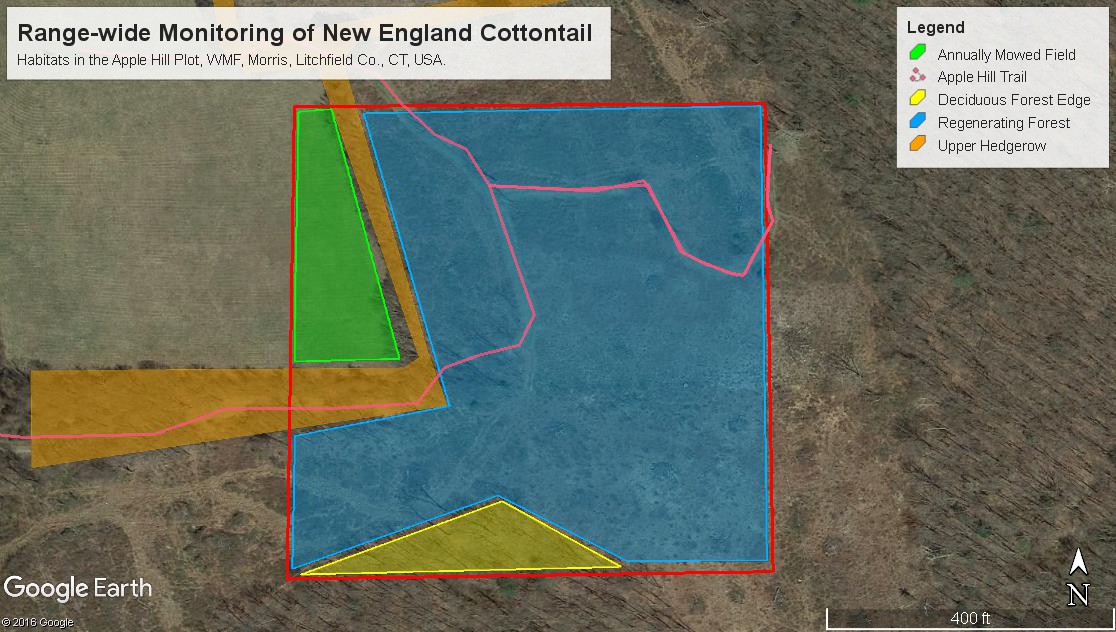
Habitats in the Apple Hill Plot on East Shore Rd., Morris, Litchfield Co., CT, USA
We wore protective clothing consisting of chainsaw chaps, leather gloves, and heavy winter coats.  Several volunteers supported this project at every stage.  Jared Franklin, Ireland Kennedy, Rachelle Talbot, and Ben Vermilyea helped with the initial plot layouts in the autumn.  Jared couldn't get enough of walking through the pucker-brush so he returned to help with the surveillance portion.  Liyanna Winchell, Naomi Robert, and Nicki Hall decided to brave the single digit temperatures and searched for cottontail spore.  We observed several areas within the plots where scat was deposited very densely while other areas had little to no spore, all of which was deposited within approximately 36 hours of the snowfall cessation.  Initially, there did not appear to be strong relationship between the habitat characteristics and spore density within each plot, which suggests that animals congregated in these microhabitats.
Nicki Hall (front) and Naomi Robert were a couple of the brave souls who bushwhacked through some of the densest, thorniest habitats and during days when the daily high temperature remained in the single digits.

Surveying White Memorial's Bat Population


 This summer, White Memorial adds its efforts to an ongoing survey of Connecticut's bat species. Begun in 2010 by the Department of Energy and Environmental Protection, the survey uses sound recordings to monitor bat activity. Starting a half-hour after sunset and continuing until late at night, White Memorial's research technicians drive a 24-mile route through the woods roads of the property, using a truck-mounted microphone to record high-pitched sounds. The microphone is sensitive to sounds well above the range of human hearing, and records the calls of bats as they seek out insects for food, along with any high-pitched background noise from nearby telephone wires, insects, and radio transmissions. We'll pass these recordings on to the DEEP, where computer analysis will distinguish the bat calls from surrounding noise and identify the bats by species based on their unique sound patterns. We'll likely find evidence of big brown bats (Eptesicus fuscus), little brown bats (Myotis lucifugus), and northern long-eared bats (Myotis septentrionalis), all known to inhabit White Memorial's property.


     Relying on acoustic recordings of bats allows us to form a much more detailed picture of bat populations, distributions, and activity than do older methods such as counting bats caught in mist nets. Furthermore, as white nose syndrome continues to decimate bat populations in the eastern United States, bat monitoring has become increasingly important. The white nose fungus (Pseudogymnoascus destructans) has been present in Connecticut since the winter of 2007-2008, when it was found among hibernating bats in northern Litchfield county. Bats affected by the fungus exhaust their fat reserves and die during their winter hibernation. Monitoring efforts at White Memorial and in towns around Connecticut will help measure surviving bat populations, determine which species are affected and not affected, and provide long-term data against which management efforts can be judged.

Hartford Courant Article "Resurgent Bobcats Prompt State To Study Habitat, Population"

Bobcat at Apple Hill
By Leo Kulinski, Jr.

Bobcats are frequently observed on the White Memorial Foundation property.  Volunteers who help with our Winter Track Monitoring Program have documented bobcat tracks in many of the critical habitats on the property.  Bobcat tracks are often observed walking along juxtaposed upland and wetland habitats, but they are observed in many other habitats.  Bobcats can predate larger mammals but often will kill small mammals, songbirds, and wild turkeys.  They are often observed scavenging white-tailed deer carcasses that die in the winter from car collisions.  A new project in Connecticut is exploring the current population size and habitat associations in the state.  The article below was published in the Hartford Courant on September 25, 2015.

Resurgent Bobcats Prompt State To Study Habitat, Population

Six New Snail Species Recorded in Bantam Lake

The wetland habitats across the White Memorial Foundation are home to a vast array of plants and animals. Some, such as sunfish and red-winged blackbirds, are quite noticeable and attract a great deal of attention.  There are other less noticeable groups of species, however, that play a very important role in wetland ecosystems.  One of these groups are freshwater snails.

The large Chinese Mystery Snail was introduced from Asia as
a source of food.  It is now established across North America,
and can be found in the Bantam Lake watershed.


The slow-moving, dull-colored snails can be easily overlooked, but they play a vital role in wetland ecosystems.  They eat algae, plankton, and decaying plant and animal material, recycling nutrients back into the animal community.  Snails, in turn, are eaten by turtles, fish and birds, providing them with an important source of food.  Snails are also intermediate hosts for parasitic flukes, a type of flatworm that can infect both people and wild animals. (In the Northeastern US, snails serve as intermediate hosts to Swimmer's itch and Lung fluke.  There are many more that affect people in the tropics, including schistosomiasis, which is  the second most socioeconomically devastating parasitic disease after malaria.)

Because snails are so easily overlooked, we know relatively little about their distribution in the State.  Eileen Jokinen, a former University of Connecticut researcher, conducted a statewide snail survey in the late 1970s.  However, snails can easily move from one waterbody to another by attaching to boats or animals.  With so much boating and wildlife activity on the property, we thought, it was only a matter of time before new snail species moved into the Bantam Lake watershed, making Jokinen's inventory obsolete.  To get more recent data on our snail species, we decided to join Laura Saucier, a CT DEEP wildlife biologist, in collecting and identifying some local snails.

A bladder snail (Physella sp.) This is one of two snails that
both Eileen Jokinen and ourselves found in Bantam Lake.

As soon as we started collecting snails, we knew that things had changed since Jokinen's work several decades ago.  Jokinen had collected five snail species from Bantam Lake.  On our first day collecting at the Litchfield Town Beach, we collected six species.  Out of these six, only two were recorded by Jokinen. 

Over several visits, we recorded six new species for the Bantam Lake watershed.  One of these, the banded mystery snail (Viviparus georgianus) had previously been found in only two lakes in Connecticut, East Twin Lake and Lake Waramaug.

Banded Mystery Snail
(Viviparus georgianus)
 
There are several features we look for in identifying snails.  One of these features is an operculum.  An operculum is a hard disc-like trapdoor structure that protects the snail when it retreats into its shell.  The operculum is visible in the picture of the Banded Mystery Snail above (the brownish structure in the lower part of the shell's opening, or aperture).  However, the Bladder snail in the top picture has no operculum. 

Another feature we look at is the aperture, or opening, of the shell.  In some snail families, the opening is on the right side of the shell.  This is called a dextral aperture, and can be seen in the Banded Mystery Snail above.  When the opening is on the left side of the shell, as in the Bladder snail, it is referred to as "sinistral".

Shell shape can vary between types of snails.  The Planorbidae family, for example, has a shell shaped like a ram's horn, while most other snails have a cone-shaped shell.


Marsh Ramshorn
 (Planorbella trivolvis)

We also decided to sample several other ponds on the property in addition to Bantam Lake.  We found several species of snails in Ongley Pond, Heron Pond, Plunge Pool, and Beaver Pond.


The Pointed Campeloma (Campeloma decisum) was very common in
Bantam Lake, Ongley Pond, and Beaver Pond.  However, Jokinen had
no record of this species in Bantam Lake when she conducted her survey.
 
Even though we only spent a couple days collecting aquatic snails, we more than doubled the previous number of known snail species on the property.  Imagine what we could learn if we invested several weeks into this process!  On top of the aquatic snails we were collecting, we also have terrestrial snails and marsh-dwelling snails that we know very little about.  There is so much we don't know about these common but unassuming creatures. 

Hartford Courant article "Connecticut Black Bear Sightings Increasing"

Black Bears are frequently observed on the White Memorial Foundation property and they are becoming more frequent each year.  Below is a Hartford Courant article link that describes the number of Black Bear observations in the state of Connecticut.  The article has a very interesting map that allows you to examine the number of sightings throughout the state throughout the years.  The number of sightings remain high in northwest Connecticut.  However the number of sightings are increasing south of Litchfield and Morris in the past 4 years.  

Hartford Courant "Connecticut Black Bear Sightings Increasing"

A hair sampling and camera trap that was used to detect black bears on the property as part of a
research project conducted by UCONN during summers of 2013 - 2014.


Federal government takes New England cottontail off list of species considered for protection

Recent habitat management efforts throughout Southern New England have ensured the long-term conservation of New England Cottontail Rabbit and many other species associated with early successional habitats.  White Memorial joined in with these efforts.  You can see the results of the habitat management at Apple Hill on the Foundation Property in Morris on East Shore Rd.

New England Cottontail Rabbit (Sylvilagus transitionalis)
John Huff/Foster's Daily Democrat via AP

DOVER, N.H. (AP) — Public and private conservation efforts have helped the New England cottontail rebound to the point where it can be taken off the list of species under consideration for protection, the federal government said Friday.
The small, brown rabbit has been threatened by a loss of habitat throughout its range in Maine, New Hampshire, Massachusetts, Connecticut, Rhode Island and New York. It's vanished from Vermont. It's endangered in Maine and New Hampshire, and the U.S. Fish and Wildlife Service had been studying whether to list it under the federal Endangered Species Act. Continue Reading

Bat Count at the Barn

If you like bats, counting, or counting bats, this project may interest you. The Connecticut Department of Energy and Environmental Protection is coordinating with volunteers in order to perform bat colony emergence counts. These counts take place in the later evening and start exactly a half an hour before sunset. In order to do a successful bat count, the temperature can't be too cold and it can't be too windy. 
The goal of the counts is to approximate the size of bat roosts before and after the pups are able to fly. The process of counting the bats is actually very straightforward and simple to do. All you need is a couple of lawn or folding chairs, some bug spray (trust me. You don't want to forget this!) and a means to record the number of bats you see fly out of the roost. Our intern David and myself have already done one bat count at the green barn which yielded an average count of 130 Big Brown Bats. The process will be complete when we do another count after the pups are able to fly (sometime in July). 
The Big Brown Bat roosting area in the barn
The necessity to estimate bat colony size comes from the threat that is currently facing the bat populations of Connecticut: White Nose Syndrome (WNS). WNS is the name given to the disease that is killing off hibernating bats in eastern North America. It has already been documented in 26 states and in 5 Canadian provinces. The disease is named for the white-colored fungus (Pseudogymnoascus destructans) that can appear on the muzzles and wings of affected bats, though it doesn't have to be present in every case. 
Individuals affected by WNS can exhibit erratic behavior in and around their hibernacula (caves where bats hibernate for the winter). WNS causes the bats to become unnecessarily active in the winter, making them lose their fat reserves more quickly. As winter carries on, these bats end up dying off in large numbers. Thus, it's important for us to keep track bat populations to see which ones are at most risk. And because of the high mortality rates seen in other bat populations, being able to save reproducing pairs may be necessary in order to prevent a population collapse.


Determining the Presence of New England Cottontail on Apple Hill

Red balloons delineate the presence of New England Cottontail scat,
while blue balloons show where Eastern Cottontail scat was found at Apple Hill.
The presence of New England Cottontail (Sylvilagus transitionalis) was determined from cottontail scat pellets collected in January 2013.  A total of 14 scat samples were collected and only 3 were determined to be New England Cottontail while the remainder were from Eastern Cottontail (Sylvilagus floridanus).  A habitat management project is underway at Apple Hill to encourage early successional habitat that encourages cottontail rabbits and other species that inhabit dense shrubby habitats.  The loss of this habitat throughout New England has precipitated a loss of the wildlife that inhabit it.  New England Cottontail are an indigenous species that has adapted and evolved to the ecological processes that sustain early successional habitats in New England.  Eastern Cottontail were introduced to New England and also utilize the same habitat but can also inhabit smaller patches of shrubby habitats that are frequently observed in people's backyards.  New England Cottontail require larger habitat patches which need to be connected with other established populations to insure the species can be sustained for future generations.  Although few pellets yielded the presence of New England Cottontail in the habitat management project, we hope that as the vegetation regenerates and invasive species are controlled, they will flourish in this area of the property.  Future monitoring will determine if this occurs.

Songbird Nest Box Program Seeks Volunteer Monitors

Songbird Nest Box Volunteer training will occur on Saturday, March 23, 2013, 10:00 a.m. to 2:00 p.m. in the A. B. Ceder Classroom.  Please bring a lunch, paper, and pencil. Dress for the weather.!


Eastern Bluebird
Photo By Bob Stanowski
All wildlife populations are regulated by many things in their habitat. One factor that limits cavity nesting songbirds is the availability of appropriate nest sites. Certain species like woodpeckers create their own nest site by excavating wood with their chisel-like beaks. However, there are several cavity nesting birds that do not create their own cavities but use ones that are already present in their habitat. Eastern Bluebirds and Tree Swallows are a couple species that require pre-existing cavities before they can reproduce. Eastern Bluebirds experienced severe declines in Connecticut starting over 40 years ago. This was due in large part to ecological changes that succeeded open fields to forests and due to a lack of nest sites. A statewide program was coordinated by CT DEEP, Wildlife Division to restore Eastern Bluebird populations by installing nest boxes throughout the state. White Memorial has been part of this initiative since it’s inception by installing nest boxes throughout the property since approximately 1989. Since then the Bluebird population has responded to this conservation strategy quite well by steadily increasing in abundance (Figure 1). This year starts a new phase of White Memorial’s Songbird Nest Box Program. Volunteers are needed to monitor 75 nest boxes for success and productivity.

Figure 1:  Eastern Bluebirds Counted on USGS Breeding Bird Survey Routes 
that Traverse WMF (1967 - 2008), Trend-line Added.
Figure 2:  Eastern Bluebird Summer Distribution Map  from USGS Breeding Bird Survey (2006 - 2010).  Sauer, J. R., J. E. Hines, J. E. Fallon, K. L. Pardieck, D. J. Ziolkowski, Jr., and W. A. Link. 2011. The North American Breeding Bird Survey, Results and Analysis 1966 - 2010. Version 12.07.2011 USGS Patuxent Wildlife Research Center, Laurel, MD.

The Songbird Nest Box Program has proven a success for helping to restore Eastern Bluebirds to WMF but it only helps the birds a little. Eastern Bluebirds are not consistently successful at fledging young every year. Connecticut is found in the more northern portion of Eastern Bluebird distribution and southern populations are more abundant than northern populations (Figure 2). This suggests that Eastern Bluebirds are better adapted to a slightly warmer climate. Yet, Connecticut offers enough habitats to make it worth a Bluebird’s effort to still attempt to reproduce because some birds are successful at producing young even though some seasons do not offer the best conditions.  Bluebirds migrate as early as they can from winter habitats (April) so that they can locate a nest site, reproduce, incubate eggs, and raise young. This gives the young enough time to develop so they are physically capable of migrating to warmer climates by the next winter. Connecticut’s breeding Bluebird population is vulnerable to early spring weather conditions that could kill young birds due to exposure. Late frosts, extended cold rain, and freezing temperatures contribute to young birds dying. The nest boxes are designed to meet the needs of the birds while they need a nest site by providing as dry a micro-habitat as possible and protecting the birds from predators and non-native species.  The habitat around each nest box is managed by mowing and controlling the vegetation so that Bluebirds can find enough food for their chicks.  Check the map at the bottom of this page to see the Songbird Nest Box locations.  The boxes must be visited to collect data and to assess how the box is functioning. We have designed a program that provides the volunteers with the option of deciding how much time they can commit to the program. Each nest box must be visited at least twice a year but more frequent visits allow us to learn more about the population. If you have only a little bit of time then you can meet the minimum requirements, but if you have more time to commit then the program will benefit. There are several important things to learn about nest boxes and the birds that use them prior to volunteering with the program. Therefore, we require that if someone wishes to volunteer their time, they must attend a training session offered by WMCC Staff.

New England Cottontail Habitat Management Project -- Species Documentation

Cottontail scat was collected throughout the Habitat Management Project
 to determine the species and abundance of cottontails at Apple Hill on January 22, 2013. 

Nicki Hall and Alyce Walker helped collect cottontail scat at the Habitat Management Project at Apple Hill that targets the conservation of the New England Cottontail.  We collected a total of 14 pellets throughout the study area after approximately 0.75 inches of snow accumulated yesterday evening.  It was great conditions to collect scat samples for this project because it remained cold enough throughout the preceding evening and this morning that we could take our time following every trail that we encountered to observe scat.  There was plenty of cottontail tracks and scat throughout the area, especially where the shrubby cover was very dense.  The scat will be transported to our colleagues at CT DEEP, Wildlife Division, who have advised us throughout the term of this project.  The scat will be used to extract molecular information that will tell us which species inhabits the Apple Hill area.  Two species of cottontail reside in Connecticut.  The native species that adapted and evolved to the ecological processes in our region is called the New England Cottontail (Sylvilagus transitionalis).  The other species that was introduced to the state and has become more common is the Eastern Cottontail (Sylvilagus floridanus).

Cottontail Scat and Tracks in Snow.


Winter Waterfowl Survey--November 2012

A total of 292 Canada Goose were observed on Bantam Lake, Nov. 28, 2012.
Photo By Bob Stanowski.

Nicki Hall and I conducted the first Winter Waterfowl Survey for the winter season 2012-2013 on Wednesday, 28 Nov. 2012 from 10:08 a.m. - 2:02 p.m.  The sky was partly cloudy gradually become overcast with a gentle breeze mostly from the north and gradually changing from the north-northwest.  The temperature for most of the survey was in the high 40's degree Fahrenheit.  The water remained calm and the birds were not disturbed by any other factors, therefore counting the birds was quite easy.  We observed several large rafts of Canada Goose, Mallard, Hooded Merganser, and American Coot.  We did not observe any neck collars on the Canada Goose, which are applied and used by CT DEEP Wildlife Division for monitoring local goose populations.  Other noteworthy non-waterfowl species observed included 1 Great-Blue Heron, 1 American Bald Eagle juvenile, 1 Red-shouldered Hawk juvenile, and 1 Belted Kingfisher.  The only ice cover observed that affected the bird's usage of any water-body was at Cemetery Pond and Little Pond, where few if any birds were observed.  We count from a total of 8 other sites around Bantam Lake, of which the highest abundance of birds and greatest diversity of species were observed in the North Bay and the Bantam River Outlet, two favorite bird-watching locations among our birders.  Although not as many individual birds were observed in the South Bay, this location did produce 4 species, another noteworthy location among birders.

Species Grand Total
Canada Goose 292
Mute Swan 15
American Black Duck 19
Mallard 168
Ring-necked Duck 1
Bufflehead 39
Common Goldeneye 1
Hooded Merganser 120
Common Merganser 1
Ruddy Duck 12
Common Loon 1
American Coot 61
Ring-billed Gull 10
Herring Gull 2

Fish Kill Reported at Bantam Lake

On Thursday, August 23rd James Fischer and I traveled to the North Bay area of Bantam Lake following reports of dead fish washing up on shore. We walked approximately 75 yards along the edge of North Bay and found several species of dead fish in varying degrees of decay. Most of the dead fish were Sunfish, but we also saw Largemouth Bass, Brown Bullhead, Tench, and White Perch. Since we did not see a large quantity of dead fish, this fish kill was likely due to natural events, such as the record high temperatures we’ve had this summer. When a lake heats up, water holds less oxygen. Therefore during a very hot summer, oxygen levels decline, creating stressful conditions for fish. Also, if shallow waters become too densely occupied by fish, these areas can become more susceptible to disease outbreaks. High levels of turbidity could also be to blame. Turbidity is the haziness of water caused by suspended solids, which can affect the ability of fish gills to absorb oxygen.


A Sunfish that just washed on shore. 
A heavily decayed Largemouth Bass.


Fish kills that are natural and localized are typically no reason for alarm, but tests still should be done to test if levels of toxicity exist. CT DEEP Fisheries Biologist, Ed Machowski concluded that warm water temperature, low oxygen levels, and algae blooms are causing the fish stress. The algae bloom is limiting light penetration, therefore affecting photosynthesis and causing oxygen levels to drop. Dead fish were found at several regions of the lake, but most were found at the North Bay, due to the southwesterly breeze pushing fish to the northeast section of the lake. It should be noted that the fish kill is not related to the August 15th herbicide treatment on selected areas of Bantam Lake.   

Emerald Ash Borer Detection Efforts

Today DEEP Service Forester Larry Rousseau paid a visit to White Memorial to girdle several ash trees (Fraxinus spp.) to detect the presence of the invasive Emerald Ash Borer (Agrilus planipennis).

The Emerald Ash Borer (EAB) is a small, metallic green color beetle native to eastern Asia. The EAB was officially identified in the U.S. in 2002, and since has been responsible for the death of millions of ash trees. It currently is found in thirteen states and in parts of Canada. Ash trees infested with EABs are typically dead within one to three years. At this stage, the goal of USDA is not to eradicate the EAB, but to prevent additional spread throughout the entire country. Strict quarantines have been authorized to prohibit the movement of firewood out of states where EABs are known to live, as well as the transportation of firewood intrastate. 
Emerald Ash Borer
Photo by the University of Kentucky
http://www.ca.uky.edu/forestryextension/eab/EABindex.php

A technique used to indicate the presence of EABs is girdling ash trees. At White Memorial, four trees were girdled at various points around the property. Girdling is a cost-effective forestry management technique used to cut off the flow of nutrients inside an individual tree, eventually killing it. Girdling is used for this project because although EABs will occupy any Ash tree, they are most attracted to dead or dying ash trees in which to lay their eggs. When looking for the proper tree to girdle, Larry Rousseau and Lukas Hyder tried to find an intermediate size tree, with a DBH (diameter at breast height) of about 7 to 10 inches. They also wanted the ash tree to have a large canopy, reaching above most of the surrounding vegetation. Finally, it was important to locate a tree that far enough from roads and people so that if it was to fall it would not harm anyone and would remain undisturbed during the girdling process.  
Service Forester Larry Rousseau with ash tree after being girdled.
The first step when girdling a tree is to record the DBH using a measuring tape. Next, a shallow ring is cut around the circumference of the tree, which aids in the next step of shaving off the bark to the cambium layer. By the end of this stage there is an approximate 10 inch long ring of bare cambium around the tree. Tape is wrapped around the trunk to indicate that the tree is dangerous and to stay clear of it. Finally coordinates of the site are charted using a GPS. The tree will be left alone until mid-September. At that time it will be cut down, then sawed into bolts (short logs), and stripped of its bark. The logs and bark will be thoroughly analyzed to find if EAB larvae exists on the tree. If it is detected then the proper management techniques will be enacted to contain the EAB from spreading any further. Currently there is not a cure for EAB infestation, only pesticides to serve as a control measure. Therefore early detection is the obvious key factor to successfully contain the EAB.

Bat Maternity Colony Monitoring

A bat maternity colony monitoring project was held Wednesday, May 30th at White Memorial. The survey’s purpose is to identify and evaluate the size of bat maternity roosts. This is achieved by conducting an emergence count of a specific roost before the pups begin to fly and an additional count after the pups begin to fly (sometime during the month of July). The emergence count started at 7:30 pm right before dusk, when the bats start to leave their den to feed. James Fischer and I, the surveyors, stood on either side of the barn and counted all of the bats that emerge.

The site that we decided would be most appropriate to monitor a bat colony is the two-story, open barn, known as the Green Barn, that holds White Memorial’s truck, van, and miscellaneous landscaping tools. There is a well-known roost of Big Brown bats (Eptesicus fuscus) that occupy the ceiling of the barn. From 7:30 to 9:09 pm we counted a total of 127 bats emerging from gaps at the top edge of the barn. Big Brown bats have black wings with a brown furry back and paler fur below. They are a very common bat in Connecticut, and typically are found in forests, but they can also live in crevices of buildings and caves.
Green Barn where bat survey took place.

Big Brown Bat
Photo by Jim White
http://02b93fb.netsolhost.com/
Opening from which most of the bats emerged.


It is important to document colony declines and losses to accurately track population change, especially to monitor the effects of White-Nose Syndrome, which since 2006, has killed over 5.7 million bats in Eastern North America. Bats play a crucial role in maintaining an ecosystem balance and consume thousands of mosquitoes and other insects every night.
This project is hosted by Connecticut DEEP Wildlife Division, who encourage volunteers to make counts wherever a bat colony is known to exist. Researching a wildlife disease is expensive, therefore more committed volunteers will help DEEP retain and use grant money to help combat this destructive disease.  

Rail Callback Survey

On Wednesday, May 23rd James Fischer and I did a Rail Callback Survey for the CT D.E.E.P. at seven locations in White Memorial. The Rallidae family consists of predominately small to medium-sized wetland birds that are often seen walking along muddy areas or shallow water. The expression “thin as a rail” comes from the rails’ body form, which is laterally compressed, allowing them to escape into dense grass or reeds making them extremely difficult to visually spot. Recent wetland habitat loss and degradation has resulted in population declines in many wetland dependent species. In order to protect these birds and their habitats, biologists need to know which wetlands are being used by the birds. The survey that we conducted was targeted towards nine species of wetland birds that can be found in Connecticut. The species include Black Rail, Least Bittern, Sora, Virginia Rail, King Rail, Clapper Rail, American Bittern, Common Moorhen, and Pied-billed Grebe. The survey must be performed either during sunrise or sunset, which are when the rails are most vocal. Due to a forecast of unfavorable weather in the afternoon it was decided that sunrise, 5:26 a.m. would be best to take the survey. We could not have asked for better rail surveying weather; calm wind, temperature in the 60s, and foggy. Prior to the survey we mapped out possible locations at White Memorial to conduct the callback. The callback is a pre-recorded tape, 12 minutes long of each of the previously listed species calling for 30 seconds, then 30 seconds of silence in-between calls. During the 30 second silences we tried to listen for any calls. Wetlands birds are typically secretive and difficult to study, and it has been discovered that the callback method provokes a vocal response from them if they are in close proximity.
Collecting data at the first Little Pond survey point.

Three survey points were conducted at different parts of the boardwalk surrounding Little Pond. One of the points gave us our first response of a Virginia Rail, which is a wheezy, and accelerating wep wep wep grunt. Two other points, at Mallard Marsh and Cranberry Pond also had a callback from Virginia Rails. An individual Sora was heard multiple times as well at Cranberry Pond. The Sora call sounded very close to us, but we were still unable to see it, emphasizing its stealth. Other locations that were not successful for rail callbacks were Miry Brook and the North Bay observation tower. There are many other marshy rail habitat locations on White Memorial’s property, so hopefully before the breeding season is over we can conduct surveys there to get the most accurate population abundance and location of these elusive birds.
Virginia Rail
Photo by Gerry Ellis
http://ridgefieldnwr.wordpress.com

Sora
Photo by Gerry Ellis
http://ridgefieldnwr.wordpress.com

CT DEEP Fisheries Northern Pike Management

Northern Pike have been a integral sport fish in Bantam Lake for many years.  The success of this introduction effort is largely due to using the local herbaceous inland wetlands on the White Memorial Foundation property as spawning areas for adult fish every spring.  Once the adults have spawned, the adults are captured so they can be returned to the Bantam Lake where they are important predator and game fish. 

Jason and Abby (CT DEEP Fisheries Division) deploy a gill net to capture adult Northern Pike. 

Several of White Memorial's herbaceous inland wetlands are used for spawning areas for
Northern Pike that are released into other lakes throughout the state.  
Abby removed the fish from the gill net and
Jason waits with a net to quickly transport the fish to a holding tank. 

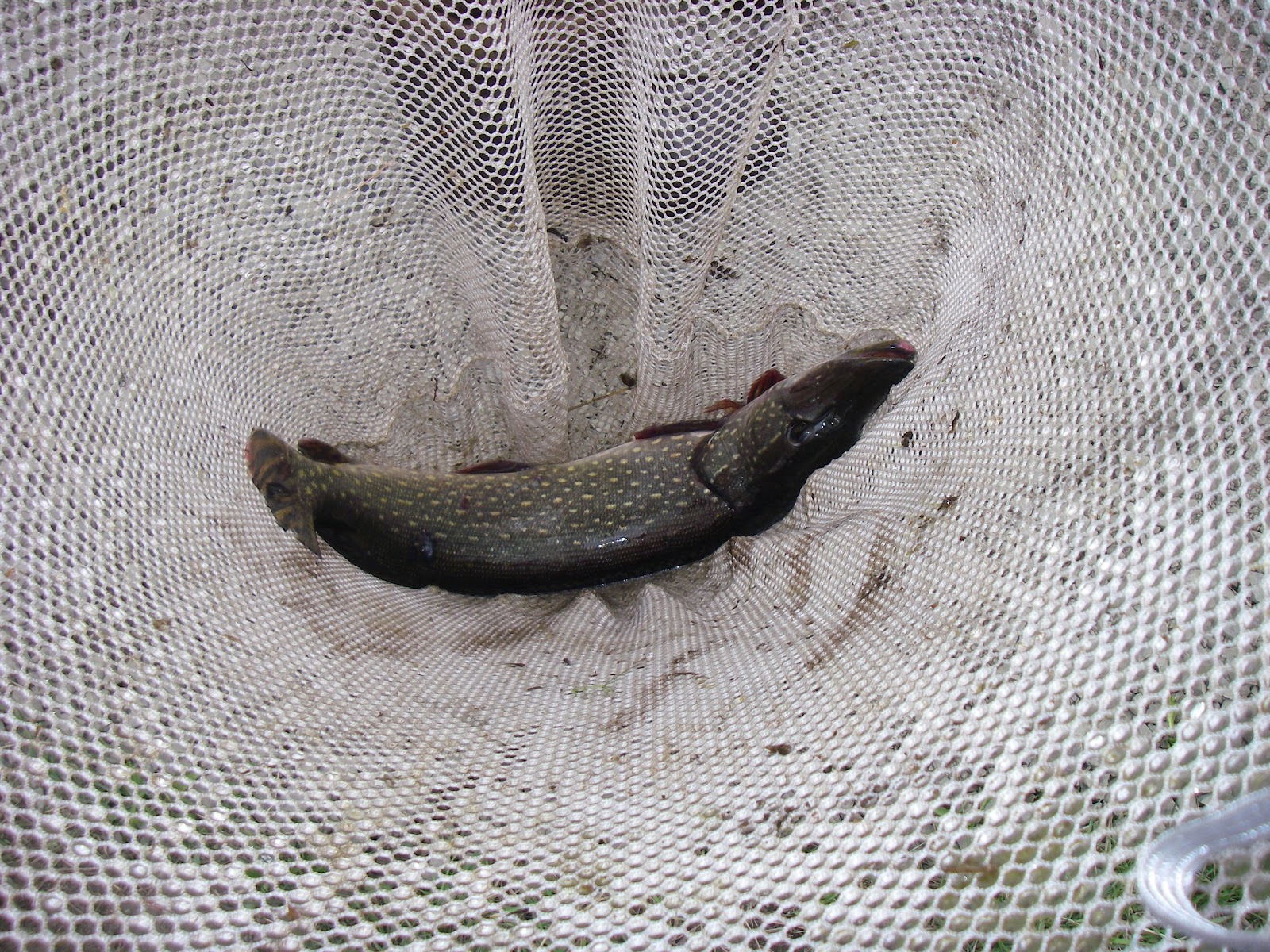
Northern Pike in net and about to be released into Bantam Lake.  


Once the juvenile fish grow and develop into a size class referred to as fingerlings, they will try to swim into Bantam Lake.  A weir has been installed at a culvert under the road to capture the fingerlings so that they can be measured and released into other lakes in CT.

This gate traps fingerlings that try to disperse from the spawning area.  

Fish Kill Observed Along North Shore of Bantam Lake

Dead fish can be observed along the north shore of Bantam Lake.
How did this happen?

Several hundred dead fish can be observed along the north shore of Bantam Lake, Litchfield & Morris, Litchfield Co., Connecticut, USA.  Several people have made this observation and have asked how this happened.  My sources at CT DEEP have explored this and state that the water column became depleted of oxygen for a short period of time.  After a preliminary investigation, they observed that an algal bloom occurred in the northern portion of the lake near the Bantam Lake Inlet.  The depleted oxygen was also encouraged by the mild winter and low rainfall/snow melt which is contributing to overall low water levels in the lake.  The phenomenon appears to be localized to the north bay of the lake because the algal bloom occurred near the Bantam Lake Inlet.  This observation is considered normal for the spring season and can be observed in other lake systems.  If larger quantities of dead fish are observed in Bantam Lake, please contact CT DEEP to report your observation.  The lake is a very important fishery and contributes several important resources to this region.

Small Mammal Inventory State Permit Approved

Eastern Chipmunk (Tamias striatus)
Photo by Robert Scholl

I am pleased to announce the state of CT, DEEP, Bureau of Natural Resources has approved our permit for inventorying small mammals at White Memorial for the 2012 season.  The goal of this project is to inventory the small mammal species and to explore their habitat associations.  Click here to read previous posts.  If you are interested in volunteering with this project, please contact James Fischer, WMCC Research Director.