Showing posts with label Nicki Hall. Show all posts

Game Camera on Coyote Carcass


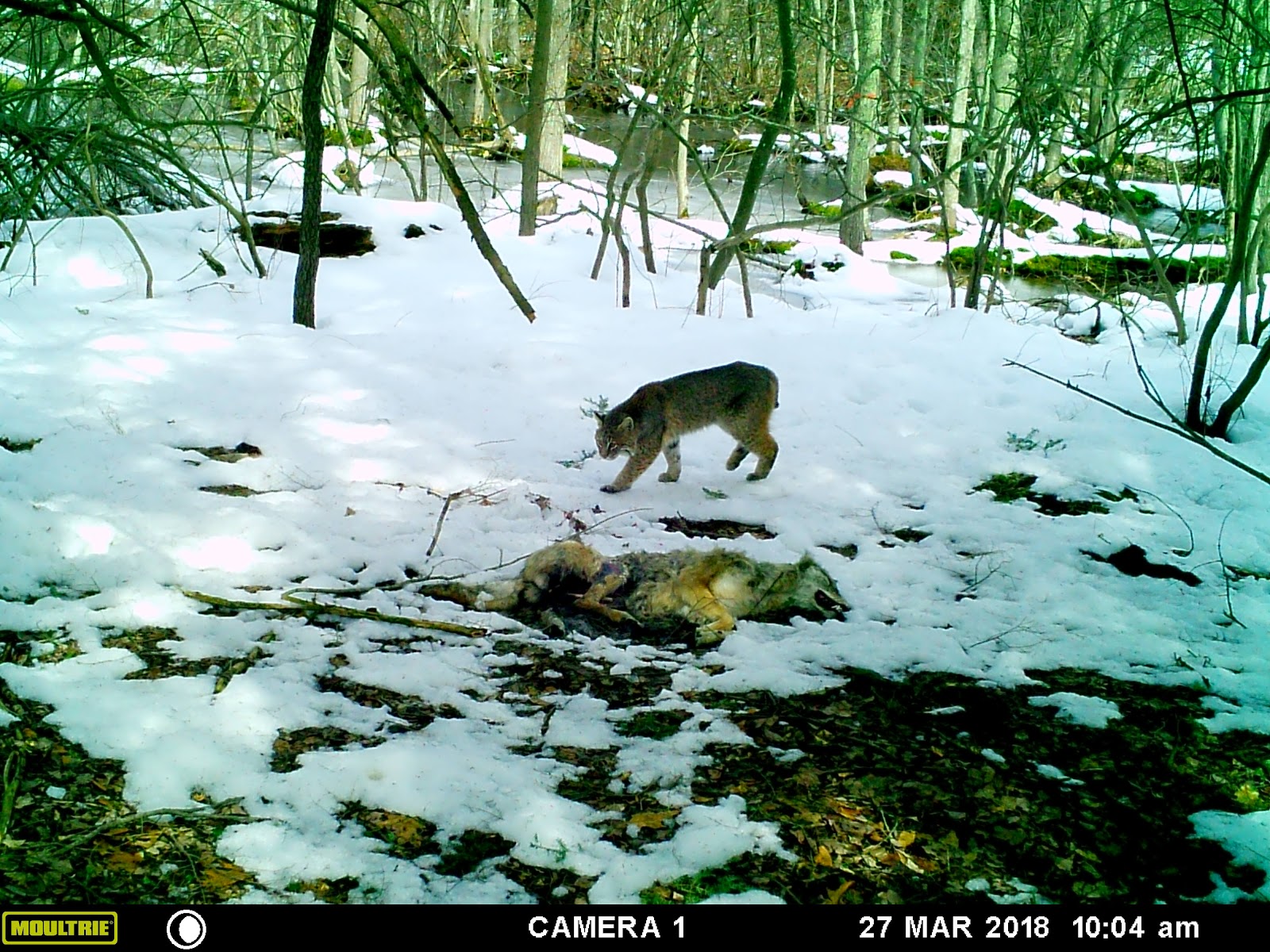
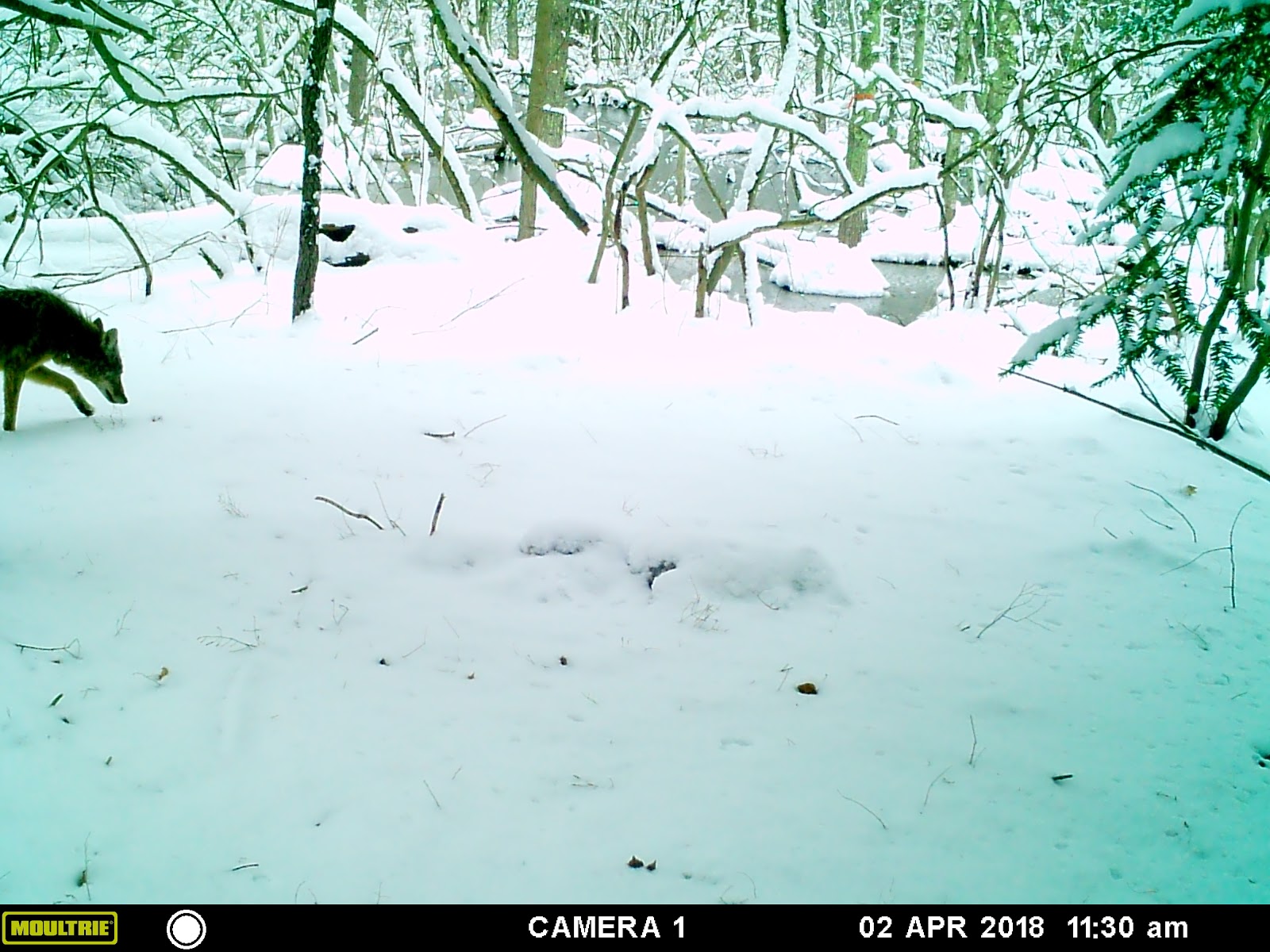
This motion-detect trail camera was set by volunteer Sarah McQuade with the help of Research Director James Fischer. The center of these photographs is a coyote that was struck and killed by traffic on route 202 in Litchfield in late-December. Its carcass was transported by Mr. Fischer to this site off North Shore Road in the Bantam River Field. The photgraphs taken by the camera give some insight into the life history and behaviours of certain species. Please enjoy some of these interesting photographs and make some inferences about the ecological relationships at play here.

Four Virginia Opossums (Didelphis virginiana) surround the carcass in the early evening

A Bobcat (Lynx rufus) entering the frame on the Left, seems to be approaching the carcass.


The carcass is covered in snow, and a(n) Opossum has burrowd an access hole through the snow to the body. 


Opossum appears to be approaching the access hole through the snow to the carcass


Bobcat approaching the carcass from the right 
Bobcat on top of the carcass

Bobcat approaching carcass from behind

Raccoon, left of the carcass, rolling around in the flesh. 
Coyote appraching snow coverd carcass from the left. 

Waterfowl Nest Box Monitoring

Waterfowl Nest Boxes are checked after the breeding season to monitor productivity and for maintenance.
We took advantage of the short window of adequate ice coverage to check our waterfowl nest boxes on the property.  We want to thank our volunteers who are supporting us with this effort during the brief window of opportunity.  Nicki Hall, Shannon Smith, and Anthony Cianciolo were a big help this season.  Nest producitivity was lower than average which is likely due to the cooler and wetter breeding season.  If we get another stretch of time when ice coverage is adequate for safely approaching the boxes, then several boxes require some minor maintanence.  We also need to re-install one nest box at Heron Pond which fell over this past summer due to broken post. 

New England Cottontail Monitoring at White Memorial and Throughout Their Range

New England Cottontail, Range and Population Monitoring Focus Areas
(Top image by John Huff Foster Daily Democrat via AP, bottom image by USFWS).
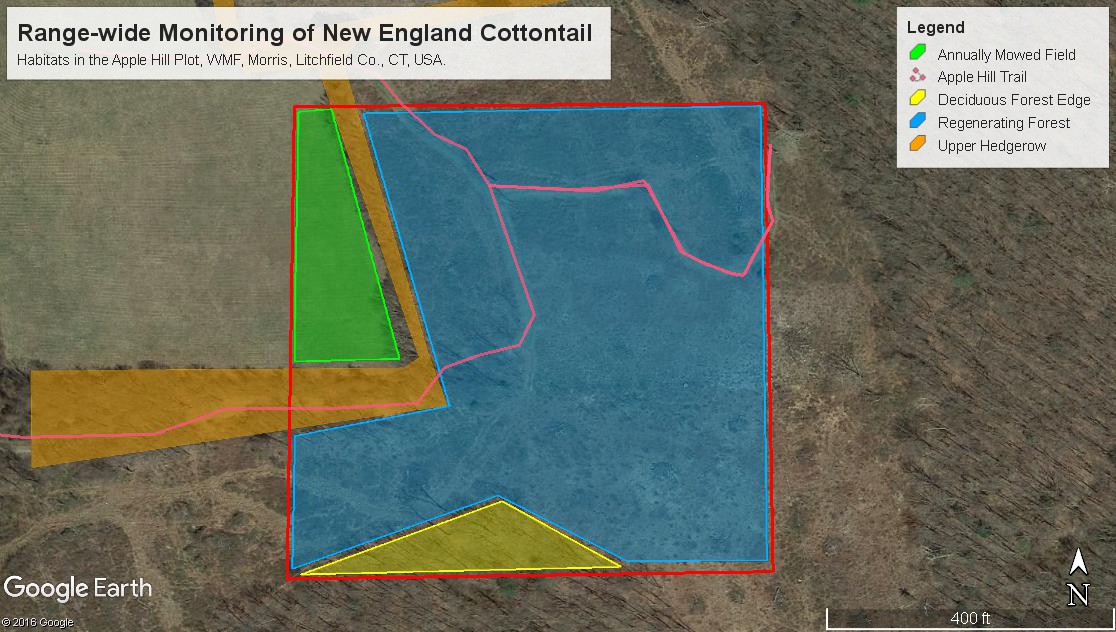
Habitat management performed throughout the range of New England Cottontail (NEC) and assessing the conservation status of the species is being partially measured during the winter of 2016 - 2017 at White Memorial.  A total of two plots were selected on the property, which are located at Apple Hill and on North Shore Road.  The Apple Hill plot is being managed to ensure adequate habitat for NEC and other early successional habitat species.  The North Shore Rd. plot is a grassland that has been permitted to revert to early successional habitat through ecological succession.
Transects were flagged using orange and yellow surveyor tape
on the Apple Hill Plot on East Shore Rd., Morris, Litchfield Co., CT, USA.
This project is coordinated by the NEC Technical Committee and researchers at the U.S. Geological Survey.  The monitoring objectives are to assess occupancy rates of both cottontail species (Eastern and NEC) throughout the NEC range, observe how this occupancy status changes through time, and to determine how management activities influence the changes in the occupancy status of both species.  White Memorial's two plots were part of a total of 283 plots selected throughout CT, MA, ME, NH, NY, and RI.  Connecticut currently conserves the largest number of NEC populations in the habitats of highest priority and is surveying the bulk of the total plots (83 plots).  The plots consist of 200 meter long transects that are spaced every 30 meters, ultimately sampling piece of land approximately 2 hectares in size.  The plots were visited at least 24 hours after a fresh snowfall, when the temperature remained below 30 degrees Fahrenheit, and with very little wind or no rain.  Each plot was visited a total of 4 times within a 4 - 6 week time period.  The location of cottontail scat was georeferenced and collected for future molecular analysis to determine the species.  
Cottontail scat and tracks observed in fresh snow.
Various habitat measurements were recorded throughout the plot that described the vegetation density at various heights, land management, and land cover types.  Generally, the vegetation favored by both cottontail species is very dense and can consist of several thorny plant species, which makes working in them very labor intensive and at times dangerous.
Habitats in the Apple Hill Plot on East Shore Rd., Morris, Litchfield Co., CT, USA
We wore protective clothing consisting of chainsaw chaps, leather gloves, and heavy winter coats.  Several volunteers supported this project at every stage.  Jared Franklin, Ireland Kennedy, Rachelle Talbot, and Ben Vermilyea helped with the initial plot layouts in the autumn.  Jared couldn't get enough of walking through the pucker-brush so he returned to help with the surveillance portion.  Liyanna Winchell, Naomi Robert, and Nicki Hall decided to brave the single digit temperatures and searched for cottontail spore.  We observed several areas within the plots where scat was deposited very densely while other areas had little to no spore, all of which was deposited within approximately 36 hours of the snowfall cessation.  Initially, there did not appear to be strong relationship between the habitat characteristics and spore density within each plot, which suggests that animals congregated in these microhabitats.
Nicki Hall (front) and Naomi Robert were a couple of the brave souls who bushwhacked through some of the densest, thorniest habitats and during days when the daily high temperature remained in the single digits.

New England Cottontail Habitat Management Project -- Species Documentation

Cottontail scat was collected throughout the Habitat Management Project
 to determine the species and abundance of cottontails at Apple Hill on January 22, 2013. 

Nicki Hall and Alyce Walker helped collect cottontail scat at the Habitat Management Project at Apple Hill that targets the conservation of the New England Cottontail.  We collected a total of 14 pellets throughout the study area after approximately 0.75 inches of snow accumulated yesterday evening.  It was great conditions to collect scat samples for this project because it remained cold enough throughout the preceding evening and this morning that we could take our time following every trail that we encountered to observe scat.  There was plenty of cottontail tracks and scat throughout the area, especially where the shrubby cover was very dense.  The scat will be transported to our colleagues at CT DEEP, Wildlife Division, who have advised us throughout the term of this project.  The scat will be used to extract molecular information that will tell us which species inhabits the Apple Hill area.  Two species of cottontail reside in Connecticut.  The native species that adapted and evolved to the ecological processes in our region is called the New England Cottontail (Sylvilagus transitionalis).  The other species that was introduced to the state and has become more common is the Eastern Cottontail (Sylvilagus floridanus).

Cottontail Scat and Tracks in Snow.


Waterfowl Nest Boxes 2013 Breeding Season


Waterfowl Nest Boxes are checked every winter
to review success of each breeding season

We've nearly completed reviewing the breeding success of waterfowl that use the nest boxes located throughout the property.  We currently have a total of 25 nest boxes installed and functioning within normal parameters.  Breeding was attempted in 21 of the nest boxes.  Nicki Hall and Alyce Walker volunteered a great deal of time this year to aid in this process.  Ice conditions were suitable for a short period of time but we managed to reach the boxes that require more ice early on and then were able to access the other boxes soon afterwards.  We had only 8 hooded merganser eggs hatch and fledged, all of which were found in one nest box.  This box was in a pond over fairly deep water.  The wood ducks appeared to fare better with a total of 145 fledged ducklings.  This past spring season was very dry!  Several observations indicate that the drought impacted the waterfowl that use the nest boxes.  Several of the boxes were usurped by white-footed mice and grey squirrels, which rarely happens because the nest boxes are located in regularly flooded marshes and ponds.  The squirrels and mice were able to access the boxes while the marshes were dry for such a long period of time this spring.  We had one great-crested flycatcher nest in one box this season.  We also had 3 boxes with eastern screech owl pellets, indicating that this rarely observed small owl at least visited the property probably during their autumn migration.

Winter Waterfowl Survey--November 2012

A total of 292 Canada Goose were observed on Bantam Lake, Nov. 28, 2012.
Photo By Bob Stanowski.

Nicki Hall and I conducted the first Winter Waterfowl Survey for the winter season 2012-2013 on Wednesday, 28 Nov. 2012 from 10:08 a.m. - 2:02 p.m.  The sky was partly cloudy gradually become overcast with a gentle breeze mostly from the north and gradually changing from the north-northwest.  The temperature for most of the survey was in the high 40's degree Fahrenheit.  The water remained calm and the birds were not disturbed by any other factors, therefore counting the birds was quite easy.  We observed several large rafts of Canada Goose, Mallard, Hooded Merganser, and American Coot.  We did not observe any neck collars on the Canada Goose, which are applied and used by CT DEEP Wildlife Division for monitoring local goose populations.  Other noteworthy non-waterfowl species observed included 1 Great-Blue Heron, 1 American Bald Eagle juvenile, 1 Red-shouldered Hawk juvenile, and 1 Belted Kingfisher.  The only ice cover observed that affected the bird's usage of any water-body was at Cemetery Pond and Little Pond, where few if any birds were observed.  We count from a total of 8 other sites around Bantam Lake, of which the highest abundance of birds and greatest diversity of species were observed in the North Bay and the Bantam River Outlet, two favorite bird-watching locations among our birders.  Although not as many individual birds were observed in the South Bay, this location did produce 4 species, another noteworthy location among birders.

Species Grand Total
Canada Goose 292
Mute Swan 15
American Black Duck 19
Mallard 168
Ring-necked Duck 1
Bufflehead 39
Common Goldeneye 1
Hooded Merganser 120
Common Merganser 1
Ruddy Duck 12
Common Loon 1
American Coot 61
Ring-billed Gull 10
Herring Gull 2

Bipalium adventitium -- An Introduced Soil Invertebrate

Bipalium adventitium is an introduced terrestrial flatworm that inhabits soils and predates earthworms.
I observed Bipalium adventitium for the second time on the property, yesterday.  I was checking amphibian cover boards and observed two individuals in what looked as if they were copulating.  I collected the specimens and ran back to the office to confirm my identification.  My colleague Jeff Greenwood, WMCC Education Director, ran an errand on the property shortly afterwards and found another individual.  This brought us up to 3 specimens in one day (April 26, 2012) and we weren't even focusing a search for them!

I am not an invertebrate zoologist, so I was quite surprised to learn about this animal last year.  Nicki Hall and I were checking snake cover boards for the last monitoring visit of the season (October 2011) and discovered what looked like a brown "leech".  We didn't think much of it at the time, except that it was on land and that it was after all of the rain we received after Hurricane Irene.  About a week later some colleagues in the state asked me if I had seen this mystery animal and in fact I had!  After a short review from the internet, I found that this organism is introduced to North America from Asia and it is a predator to other soil invertebrates, especially earthworms.  There are a few investigators trying to search for these animals in North America to document the spread.  Peter Ducey, SUNY Cortland, is examining the natural history and the ecological role of Bipalium adventitium as potential competitor to native herpetofauna that consume earthworms.

Blue-spotted x Jefferson Salamander is a state endangered species in CT
 that inhabits White Memorial and eats earthworms.

All of the earthworms that inhabit Connecticut's soils are considered introduced because our region was covered in glaciers only 15,000 years ago.  Therefore, earthworms were not able to colonize this region until humans introduced them.  Several of these species originated from other continents and are now changing our soils.  In forest habitats, these animals are consuming the leaf litter layer that blankets the forest floor so fast that the entire layer is consumed and the soil is exposed to rain, thereby causing extensive erosion.  This lowers water quality and decreases the ability of the forest to regenerate after other disturbances.  Many species of forest dwelling plants depend on the leaf layer as part of their natural history and these species are declining as result of this ecological damage.  I briefly mentioned in a previous blog post how Japanese Barberry, an invasive shrub, is also contributing to this scenario.

If introduced earthworms are doing damage to the forest leaf layer, then wouldn't another predator controlling earthworm populations be a good thing?  John Gorsuch, an undergraduate student at the University of Cincinnati, is examining the effectiveness of B. adventitium as a predator to various earthworm species.  John's preliminary observations suggest that B. adventitium can be an effective predator to some earthworm species but not all.  Amynthas agrestis is an introduced earthworm from Asia and it is one of the few dirty words among forest ecologists (please pardon the pun).  A. agrestis in one of those aforementioned earthworms that are aggressively consuming the leaf litter, but it also has several defense mechanisms to predators, B. adventitium and herpetofauna alike.  Therefore, we are potentially left with several predator species that are generalists consuming every earthworm species except for one species that is causing severe ecological damage to a critical habitat!

What can you do?

Report all of your sightings of B. adventitium to Peter Ducey.  Since these species (earthworms and flatworms) have been introduced to North America from the horticultural industry, it is best to use native species in your garden raised by local growers using local stock for their plants, soils, and amendments.  If you use worms as bait for fishing, throw any remaining worms into the garbage NOT YOUR GARDEN!  And finally, learn as much as you can about this topic (soil, earthworms, invasive species, forest ecosystems, etc.) on your own because soil is one of our vital natural resources that we all need, so take care of it.


Herbarium Specimen Preparation -- Invasive Species Vouchers


Nicki Hall mounting preserved invasive plant
specimens collected on White Memorial Foundation.

The specimens and labels are mounted to the herbarium paper
by laying them into a thin layer of adhesive that is spread over a flat surface.  


Every specimen has data that needs to be digitized and stored in a database. 

We have collected specimens from several invasive plant species that inhabit White Memorial Foundation.  These specimens voucher their existence on the property.  Scientists and policy makers can use these specimens in their work when these specimens are stored at Research Herbarium in Connecticut.  This past growing season (2011) was our first year for collecting specimens and we will continue this work until every invasive plant species has a voucher specimen.  This work will help the White Memorial staff prioritize species and habitats that are affected by invasive plants.  

Coyote Tracking in Duck Pond Vicinity

Friday, January 18, 2011, start time: 13:15 p.m., end time:16:30 p.m., temperature ~34 degrees F, wind: SW 0 - 10 mph, cloud cover 90% - 100%, snow cover 8 - 32 inches.

Nicki Hall and I observed coyote tracks in the Duck Pond Vicinity; which is located north of Bissell Rd., southeast of S.R. 202, and west of White Woods Road.  The tracks were actually quite tricky to identify because their gate appeared to demonstrate that they were running from the trail while maneuvering through some dense cover.  We were quite puzzled at first because these tracks could have been domestic dog that wandered a little far from it's owners, who remained on the trail.  After a little bit of exploring, we observed a small clue that helped us to determine that it was indeed a coyote.  The tracks became a little clearer as the animal continued to walk further away from the trail.  The following pictures illustrates what we observed:

Photo by James Fischer
The coyote was running and it grazed a multi-flora rose branch.  Notice the photograph above that we observed fur on the rose thorns.  A closer inspection of the branch is below.


Photo by James Fischer
 Although the tracking conditions were challenging, with a bit more careful observations we were able to confidently identify the species. 

Good Tracking!