Showing posts with label Black-capped Chickadee. Show all posts

Wildlife Camera Images -- February 2017

Birds

American Crow at Pine Island Ditches

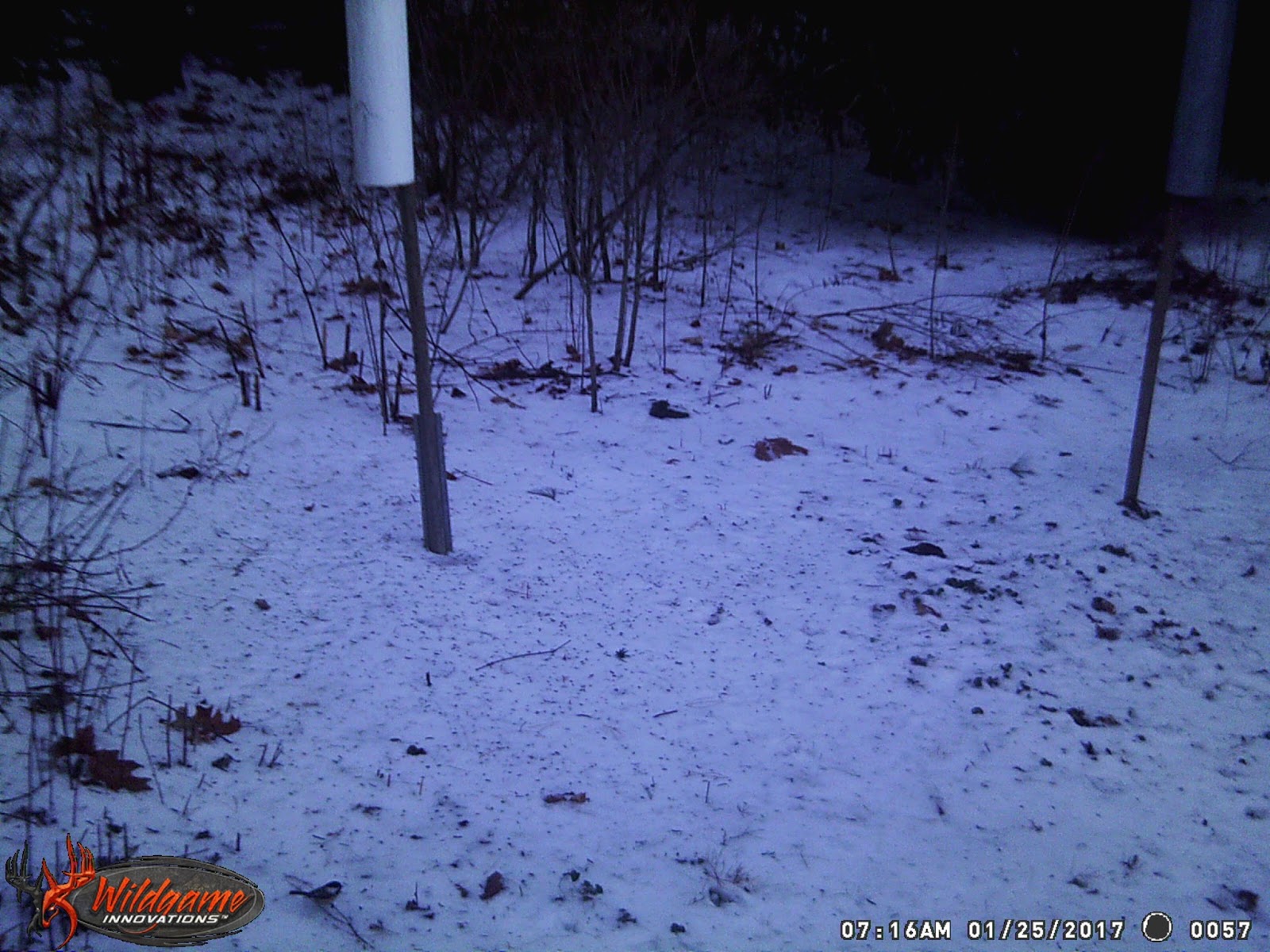
Black-capped Chickadee at Pine Island Ditches

Black-capped Chickadee at Pine Island Ditches


Adult Cooper's Hawk at Museum Bird Blind

Dark-eyed Juncos at Museum Bird Blind

Fox Sparrows at Museum Bird Blind

Mourning Dove at Museum Bird Blind

Northern Cardinal at Museum Bird Blind

Brown-headed Cowbird at Museum Bird Blind

Mixed flock of blackbirds including male and female Red-winged Blackbird, Purple Grackle, Brown-headed Cowbird, & Rusty Blackbird.

Mammals
Eastern Chipmunk at Apple Hill

Eastern Chipmunk at Apple Hill

Eastern Coyote at Pine Island Ditches

Eastern Gray Squirrel at Museum Bird Blind


Raccoon at Pine Island Ditches

Red Squirrel at Museum Bird Blind


Striped Skunk at Museum Bird Blind


Virginia Opossum at Museum Bird Blind


White-footed Mouse (eye shine in center of image) at Apple Hill

Yearling Buck White-tailed Deer at Apple Hill

Adult Doe White-tailed Deer at Apple Hill

Adult Doe White-tailed Deer at Apple Hill

Adult Doe White-tailed Deer at Apple Hill


Wildlife Camera Images -- January 2017

I have set several remotely triggered wildlife cameras along trails and near feeders to record wildlife.  Wildlife cameras have become an important tool for assessing population abundance, habitat associations, and other ecological questions for a variety of wildlife organisms.  White Memorial can use this information as an additional source of species inventory data and I'll periodically post images of wildlife captured using this technology.  

Birds

American Crow and Morning Dove

Black-capped Chickadee

Blue Jay


Dark-eyed Junco

Northern Cardinal

Mourning Dove

Mammals

Eastern Gray Squirrel

White-tailed Deer

Red Fox
Red Fox

Virginia Opossum

Striped Skunk


Red Squirrel

Summary of Bluebird Nest Box Usage at White Memorial in 2011

Eastern Bluebird photo by Bob Stanowski
Eastern Bluebird Used Nest that Successfully
Fledged 3 Young from a Nest Box in
White Memorial's Mill Field
photo by Dave Rosgen
Tree Swallow photo by Darlene Knox
House Wren photo by Ann Cook
The 2011 nesting season was a record-breaking success for Eastern Bluebirds, but a near disaster for Tree Swallows using CT. Bluebird Restoration Project nest boxes on White Memorial Foundation land. Weather was a major player in these results. While Bluebirds either timed their nesting activity right or just got lucky, they managed to avoid the worst of the awful cold, wet weather that plagued Northwest Connecticut for parts of May and June. Many of White Memorial's Bluebirds made their first nesting attempt and successfully fledged young during a nice stretch of weather in May, then delayed making their second nesting attempt until nice weather returned in July. One pair even nested successfully 3 times this year!


Connecticut Bluebird Restoration Project
Summary of bluebird box usage at: The White Memorial Foundation
Towns: Litchfield & Morris
Year: 2011 Number of boxes: 82
SPECIES
# of Pairs
# of Active Nests
# (%) Successful
# Failed
# of Young Fledged
# Fledged per Active Nest
Eastern Bluebird
19
25
23 (92%)
2
91
3.6
Tree Swallow
50
51
39 (76%)
12
170
3.3
House Wren
5
6
6 (100%)
0
20
3.3
Black-cap Chickadee
2
1
1 (100%)
0
5
5.0
Tufted Titmouse
0
-
-
-
-
-
White-br Nuthatch
0
-
-
-
-
-
TOTALS
76
83
69 (83%)
14
286
3.4

Unwelcome Nest Box Tenants
SPECIES
# of Boxes Occupied
# of Nests Removed
# of Successful
Nests
# of Young Fledged
House Sparrow
6
5
3
7
White-footed/ Deer Mice
3
3
-
-
Paper Wasp
6
12
-
-
Dominion Wasp
-
-
-
-
Ants
4
8
-
-
TOTALS
19
28
3
7


A record-high total of 19 pairs of Bluebirds used our nest boxes this year. Of their total of 25 active nests, 23 were successful in fledging a record-high total of 91 young. That made for an excellent success rate of 92% and productivity rate of 3.6 young fledged per active nest. They only suffered 2 nest failures: 1 due to a House Wren destroying a clutch of eggs and the other due to a huge Raccoon eating a clutch of eggs. More on him later. Tree Swallows started their nesting activity slowly in April and May and plugged along trying to nest and bring-off a brood of young through June's horrible weather. Many of them met with failure. Actually, some of our 50 pairs of Tree Swallows suffered from more causes of failures than just the weather this year. A huge Raccoon somehow found a way to climb up the otherwise Raccoon-proof PVC pipe predator guards on 4 nest box poles and get the eggs in the boxes. Non-native House Sparrows caused 2 of the Tree Swallow failures, and a House Wren caused 1 failure. Otherwise, 5 of their record-high 12 failures were caused by the foul weather. Despite this, they still managed to fledge 170 young from 39 successful nests. This gave them a nesting success rate of 76% and a productivity rate of 3.3 young fledged per active nest. House Wrens don't use many of Bluebird boxes because we try to keep them out in the fields, away from edge habitat that Wrens prefer. Still, 5 pairs of House Wrens did nest in them this year. They were 100% successful in their 6 nesting attempts, and fledged a total of 20 young. Two pairs of Black-capped Chickadees attempted to nest in our Bluebird boxes. One didn't get beyond the nest building stage before a Tree Swallow usurped the box. The other pair was successful in fledging 5 young. The overall figures were good, despite the Tree Swallow's contribution of failures. A total of 76 pairs of native birds made a total of 83 active nesting attempts in the nest boxes. Of these, 69 were successful and 14 were failures. They fledged a total of 286 young. That gave them a combined success rate of 83% and productivity rate of 3.4 young fledged per active nest. As for the unwelcome nest box tenants, House Sparrows tried to nest in 6 of the boxes. Despite removing a total of 5 nests, they still managed to fledge a total of 7 young from 3 late nests that slipped past us. Other problem critters included Mice in 3 boxes, Paper Wasps in 6 boxes, and Ants in 4 boxes.

More sightings from yesterday's Webster Rd. walk

Turkey Vulture photo from northshoreinfoblog.com
via Google Images
My last posting highlighted the American Kestrel that we saw on our group's walk along Webster Rd. yesterday. However, that wasn't the only notable species that we saw. Within seconds of seeing the Kestrel a member of our group who was still scanning the sky spotted something much larger and darker. When I got my binoculars on it I identified it as a Turkey Vulture. This is the first one for White Memorial in 2011, and arrived it right on target with usual first date of arrival for this species here. It headed due east, so I'm sure that the second one which appeared a few minutes later from the south and headed east was a different bird, as was the one that came in from the west a few minutes after that and headed north right over us. Since 3 deer have been found dead on the Property this week, and other dead ones may be out there, vultures may be able to find enough to eat now that they are back. They also could dine on road-kill, like the Opossum that we encountered a little farther down the road. We also found a squashed Short-tailed Shrew, but I think that it was too flattened even for a vulture to eat. Back to the live stuff, but still on the subject of eating, we saw an interesting behavior as we were watching a group of Golden-crowned Kinglets in Catlin Woods. They kept going down to the snow on the ground, and were obviously picking up and eating things. Upon closer examination with my binoculars, and later with my eyes, I could see that they were eating Snow Fleas. Usually, we think of these birds as eating scale insects, adelgids, and various pupae and larvae from the leaves, needles, and bark of trees, but this observation shows that they will take advantage of whatever insects or other invertebrates that they can find. In that same area, as well as farther east along the road, we also saw Black-capped Chickadees, Tufted Titmice, White-breasted Nuthatches, a Red-breasted Nuthatch, and Brown Creepers foraging for insects in various ways among the trees and shrubs. This may very well have been due to an increase in invertebrate activity brought on by the sun's warmth and rising temperatures. This is something for people to remember when looking for birds in the winter or any other cool time: go to places in the sunshine. That's why it is often productive to look for birds on east facing slopes in the morning and west facing slopes in the afternoon.