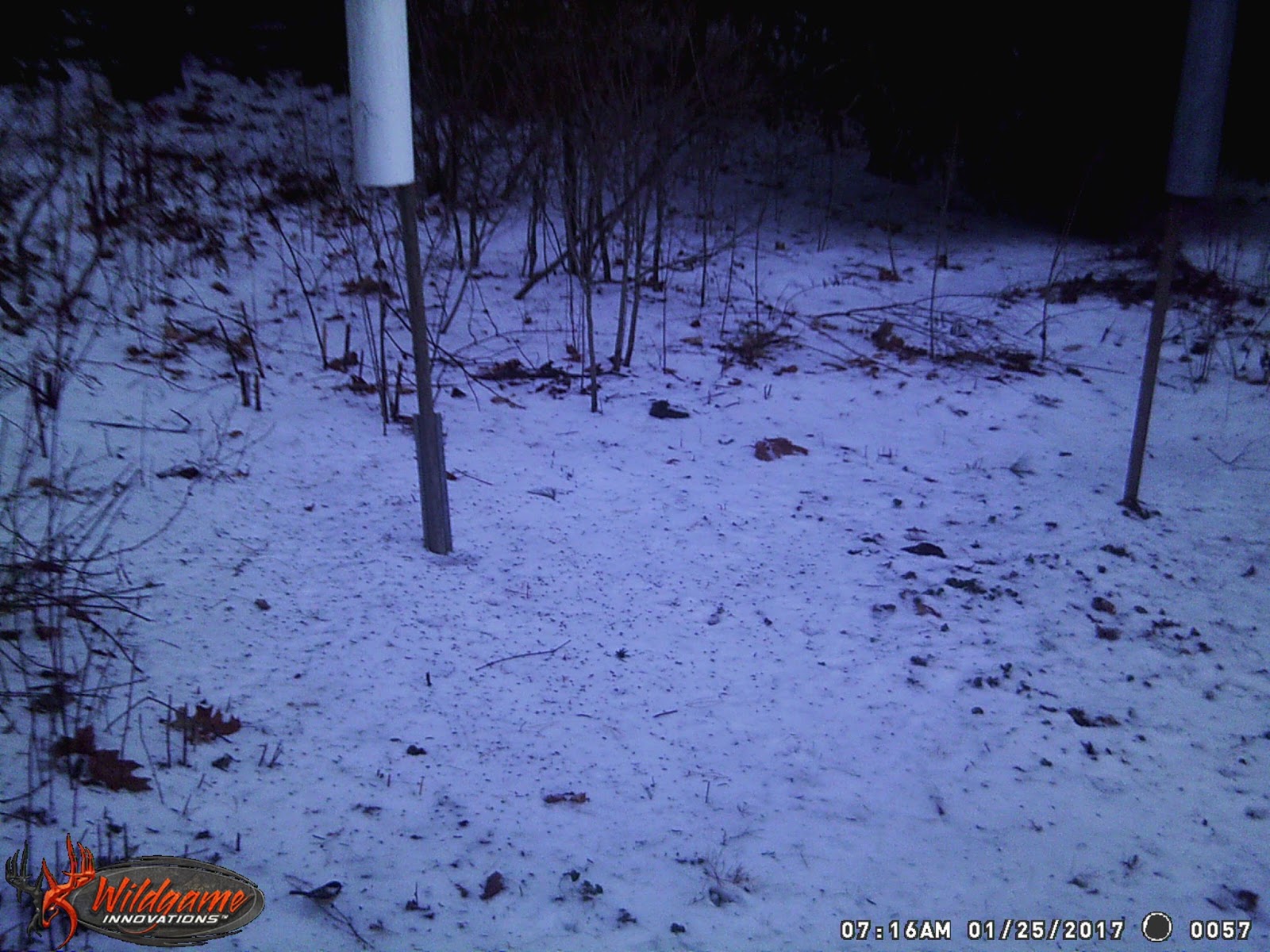
Game cameras have been used for years by hunters and trappers to know what "game" animals are on their property. Today, we see these cameras being used for security, wildlife research, and many other tasks, though they are still most commonly used to monitor game species by hunters.
The great thing about these cameras is that they provide a minimally invasive and cost-effective way to answer simple questions about a habitat, ie, which animals are found where, and when?

As game cameras increase in popularity, they've also decreased in cost. Advances in technology have made it easy to get a relatively cheap camera that will last you a few years. We'd like to encourage local landowners to invest in one or more of these cameras just to see what species you can capture on your property. You may be surprised at what you find!
 =
=
At White Memorial, game cameras are used to explore which species are using different habitats. In previous blog posts you can see all the different species we recorded remotely using these cameras. Whether it was pointed toward a carcass to view scavengers, or aimed at a headwater stream to view animals using water, they always provide some insight to wildlife habits.
However, our scope is limited to our four cameras and small research staff. We hope that citizen science can help fill in the gaps of our knowledge of the local wildlife.
However, our scope is limited to our four cameras and small research staff. We hope that citizen science can help fill in the gaps of our knowledge of the local wildlife.

As game cameras increase in popularity, they've also decreased in cost. Advances in technology have made it easy to get a relatively cheap camera that will last you a few years. We'd like to encourage local landowners to invest in one or more of these cameras just to see what species you can capture on your property. You may be surprised at what you find!
The Rhode Island Natural History Survey has outlined some advice for landowners who may want to use game cameras on their property. Topics such as using them for security reasons, and the legality of using them at a land trust or other popularly recreated area. That link is here.
The Nature Conservancy has gathered some insight about using game cameras for citizen science, along with advice for purchasing cameras. That content is available here.
We hope you are inspired to explore the unknown side of your land; the side that you don't get to witness in person. The elusive animals that escape the limited field of your vision may be captured by a game camera!
To further inspire you, please enjoy some of my personal favorite photos gathered from camera traps this season.
Happy Trapping!
 |
| This Catbird was captured after a river otter changed the angle of my camera. |
 |
| This White-tailed Deer was captured at Apple Hill upper field along a stone wall that separates the open field from the dense vegetation. |
 |
| A River Otter spotted at Cat Swamp off the Laurel Hill trail. This camera was placed about 12 feet high in a tree facing down toward the swamp |
 |
| This is the River Otter that chewed on and tossed around the game camera I placed on a log in at Mallard Marsh. |
 =
=
This fawn was found at Mallard Marsh (between 202 and Whites Wood Road) after my game camera was messed with by the River Otter.
 |
| This Black Bear was captured off the Mattatuck near Beaver Pond |