Showing posts with label American Crow. Show all posts

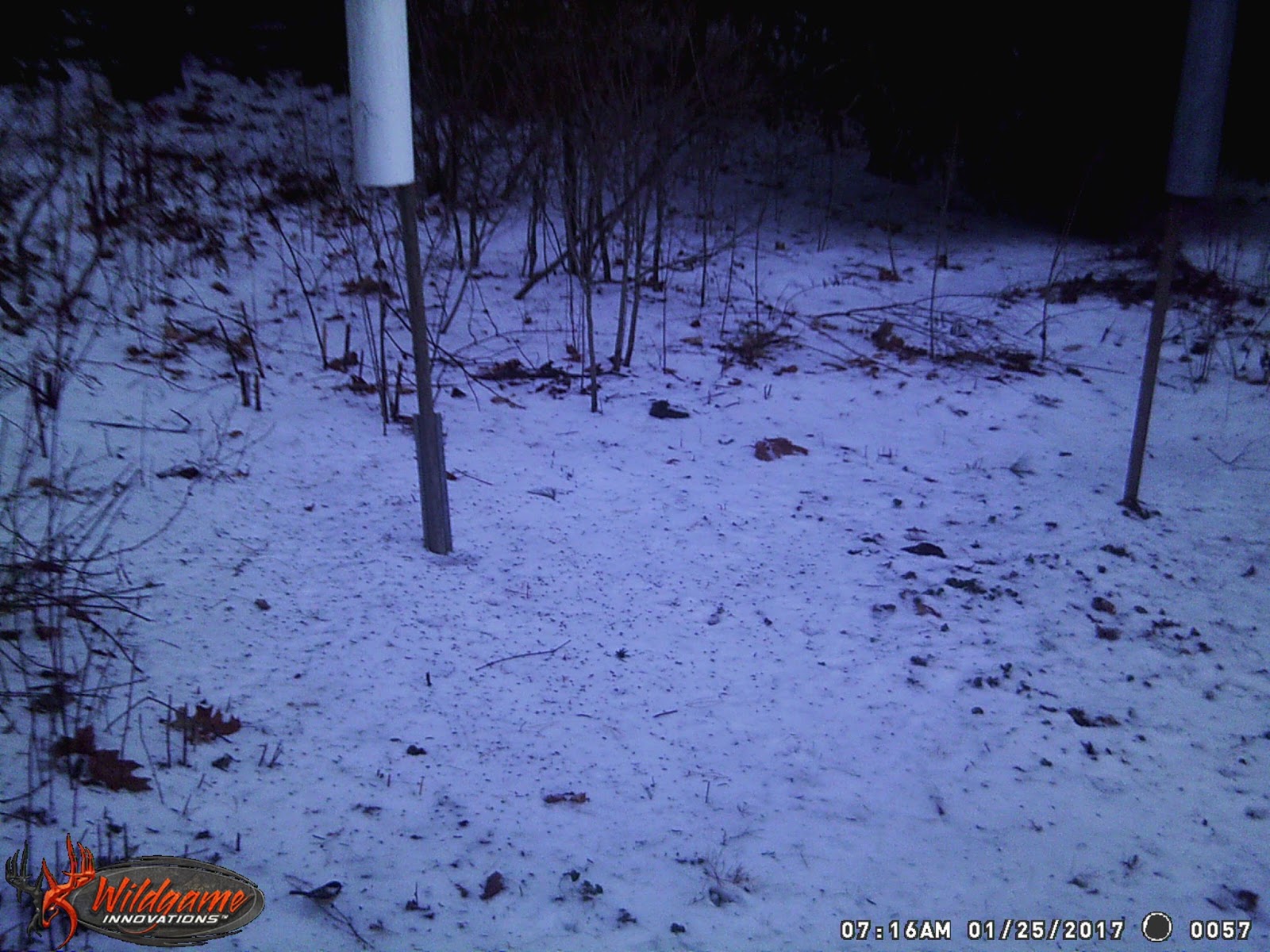
Wildlife Camera Images -- March 2017


Images recorded at White Memorial Conservation Center Bird Blind, unless stated otherwise on the White Memorial Foundation Property.  Time stamped is Eastern Standard Time, daylight savings time is not used.

 Mammals

Virginia Opossum
Eastern Coyote at Harris Rd. Field
Eastern Coyote at Heron Pond Outlet

Red Fox

Red Fox

Red Fox

Red Fox in StormWise Project along S.R. 63
Raccoon

Piebald White-tailed Deer in StormWise Project along S.R. 63

White-tailed Deer in Harris Rd. Field
Red Squirrel
White-footed Mouse at Heron Pond Outlet

Eastern Gray Squirrel

Birds

American Crow

American Robin

Blue Jay

Mourning Dove

Purple Grackle

Purple Grackle

Red-winged Blackbird

Red-winged Blackbirds

Male Wild Turkey at Harris Rd. Field

Wildlife Camera Images -- January 2017

I have set several remotely triggered wildlife cameras along trails and near feeders to record wildlife.  Wildlife cameras have become an important tool for assessing population abundance, habitat associations, and other ecological questions for a variety of wildlife organisms.  White Memorial can use this information as an additional source of species inventory data and I'll periodically post images of wildlife captured using this technology.  

Birds

American Crow and Morning Dove

Black-capped Chickadee

Blue Jay


Dark-eyed Junco

Northern Cardinal

Mourning Dove

Mammals

Eastern Gray Squirrel

White-tailed Deer

Red Fox
Red Fox

Virginia Opossum

Striped Skunk


Red Squirrel

American Crow with avian pox observed

American Crow specimen with likely case of avian pox.

American Crow with likely case of avian pox.
A concerned local resident encountered a dead American Crow (Corvus brachyrhynchos) with suspicious growths.  The images above show the warty and scaly growths that originate on the beak and skin, a likely case of avian pox.  Avian pox is a highly contagious disease that affects only birds and is caused by several known viruses.  Many birds species, ranging from wild to domestic species, can become infected by avian pox.  Disease occurrence is highest in songbirds and game birds, while occasionally observed in raptors and infrequently observed in waterfowl.  Seasonal occurrence is year-round but its prevalence corresponds with environmental factors and transmission amongst some species groups is associated with aspects of bird behavior and population abundance.  There are limited control options for this disease.  Vaccinating domestic birds is the primary method for controlling it on farms, including backyard poultry.  There are few control options for avian pox in wild bird populations.  One way it is transmitted amongst wild birds is by contaminated bird-feeders, therefore the best control method is to regularly clean bird feeders with a 10% chlorine bleach solution.  This animal was found dead on the road and collected on State Route 132 in Bethlehem and Woodbury, CT approximately 2 miles from portions of the White Memorial Foundation property. Although is likely an isolated observation, we'll be keeping a close eye on additional reports nearby in the future.  The specimen was in good condition which permitted a closer external inspection.  The animal exhibited an emaciated condition and the warty lesions likely obscured the vision of this animal.  These factors likely led to it's weakened condition which directly caused or contributed to the death of this individual.  No further tests or examinations were performed.

Further information can be found at USGS National Wildlife Health Center website, USGS NWHC Field Manual, and Michigan DNR

West Nile Virus Continues Killing Bird Species Commonly Observed At White Memorial

West Nile Virus was first documented in Connecticut and North America in 1999.  The mosquito-borne disease has spread throughout the continent, meanwhile killing millions of birds as it spread.  American Crow, Common Raven, and Blue Jay were the first birds observed dying in Connecticut.  Fortunately, these populations were able to recover since then, but many other bird species have not faired as well, including Purple Finch and Tufted Titmouse.  A brief article that outlines the major findings of this paper can be found here.  

The original publication is an important examination of how emerging infectious diseases are impacting and will continue to impact many bird species.  This lesson is not a new one for us in Connecticut.  We've observed how White Nose Syndrome has severely decimated several bat species that were regarded to as common a decade ago.  We are learning about new pathogens that are spreading around the world and could have devistating impacts to very important species we conserve.    Our best course of action for the long-term conservation of our natural resources is to prevent the introduction of these pathogens and pests from entering the continent.  

Mystery Pellet at Bird Feeder

Tom Gaynor, a White Memorial friend,
found this mysterious item at his bird feeder the other day.
Can you guess what it is and who left it?

Several bird species have a unique way of digesting their food.  When a bird swallows large objects or lots of food at one sitting the food needs to be processed in the crop, which is an organ that grinds the food into smaller parts.  Then the food enters the stomach, where digestive juices containing acids and enzymes break the food into smaller more useful pieces.  The portion of the food that is not as digestible and remains large gets pushed back up into an organ before the stomach that is also considered part of digestive system called the proventriculus.  The proventriculus compacts the indigestible pieces into a compact ball referred to as a pellet.  The pellet is regurgitated out the mouth and onto the ground.  Pellets are cool things because when we dissect the pellet we can learn what the animal has eaten.  For instance, owls and other birds of prey eat small mammals and birds.  By dissecting the pellet and identifying the skull, fur, and feathers in the pellet we can learn what species the bird ate but it also indicates what species can be found in the area where the bird hunts. Pretty cool!

Take a closer look at the pellet photographed above.  This pellet has small stones and vegetative material in it.  So, what bird would eat small stones and vegetation.  A pretty hungry one, you might think!  Some birds have adapted tough beaks to break open the seeds but other birds have not.  The stones aid in the crushing of food in the crop and some vegetation like tough seeds need a little bit more grinding to extract the food inside that tough seed coat.  Or sometimes these stones could also help break down even tougher food items like bones.  So, what are your clues so far - the bird is eating mostly vegetation and seeds, but does not have a tough enough bill to break open seeds like sunflower seeds so it needs to also eat small stones.

Let's look at the size of the pellet next.  This pellet measures about 3 centimeters long and about 1.5 cm wide.  So that would have be to a relatively larger bird to make a pellet that size.  So, not a house finch, sparrow, or goldfinch.  Probably not a Northern Cardinal either.  Any guesses yet, we've learned a lot so far...


This pellet is the calling card of an American Crow!  Crows have highly variable diet and can eat both vegetable and meat, which makes them an omnivore.  The stones help them break down the seeds and bones that they eat.  Take a closer look around your bird feeder next time to see what evidence you find to tell you what is visiting it.  Learning what you can there will help you figure things out when you observe something on your next venture into the woods.

Baby Birds Are Hatching Out All Over!

Red-bellied Woodpecker

by Patty Levin from http://www.birds.cornell.edu/


Downy Woodpecker from


Common Grackle by John Borom

from http://www.weeksbay.org/


Baltimore Oriole by Jeff Lewis from


American Crow by Darlene Knox


Despite the absolutely awful weather that has plagued us for the past few days it seems as if baby birds are hatching out all over White Memorial. Some of those birds that hatched in the past 2 or 3 weeks are already fledging. The photos above depict just a few of the many birds that we saw yesterday and Sunday. Pt. Folly was especially productive. Amazingly, 2 of the Baltimore Oriole nests with young were only 25' apart. They were near campsite 3 for anyone interested in seeing them. Also around that site and the observation platform were 4 Common Grackle nests. Two of them had young fledging out when a pair of Cooper's Hawks came winging in. Each hawk grabbed a young grackle before flying off with many angry adult grackles and other birds in hot pursuit. I wish we could have gotten photos of all that action! Grackles around the Museum Area and N. Shore Marsh also have a ton of babies. While not nearly as abundant as some other bird species, Red-bellied and Downy Woodpeckers seem to be having a very good year for producing young. I found active Red-bellied Woodpecker nests around the Museum, behind Ongley Pond, and along N. Shore Rd., and Downy Woodpecker nests along the Lake, Windmill Hill, Butternut Brook, and Cranberry Pond Trails and at the Bantam Lake Outlet. American Crows have been nesting around here since March, and now fledglings are everywhere. I found 3 Fish Crows with their American cousins at Wheeler Hill yesterday. Other less common species that we found feeding fledglings included Blue-winged Warblers at Icehouse Field, Eastern Towhees at Wheeler Hill, Wood Thrushes along the Lake and Butternut Brook Trails, Black-and-White Warblers along N. Shore Rd., and Barred Owls at Wheeler Hill and Pine Island. My next few blog postings will probably cover more breeding bird activity, including results from the Litchfield Hills Summer Bird Count, as this is the season for them. Despite the hoards of mosquitoes this would be an ideal time of year for you to go out and look for those birds while they are busy attending their young.

A Walk Along Webster Rd., Through Catlin Woods

Group of Wildlife Watchers along Webster Rd.
photographed by Dave Rosgen
On Wednesday, 2/16/11, Dave Rosgen led a group of wildlife watchers along the entire length of Webster Rd., which runs between Rt. 63 and White's Woods Rd. This allowed us to view the mixed coniferous/deciduous forest that is Catlin Woods, the wetland complexes along Miry and Catlin Brooks, and the fields that belong to Arethusa Farm without slipping and sliding on ice and snow. When we started out, the only thing that we encountered were American Crows, but that soon changed as we approached the farm fields. We saw a large flock of European Starlings in flight. They were being pursued by an American Kestrel, which has become a rare species to find in Connectcut during the winter.


Male American Kestrel photo from Animal Planet Photos